Thomas C C, Rathod S D, De Silva M J, Weiss H A, Patel V
Department of Psychology, Princeton University, Princeton, NJ, USA.
Department of Population Health, London School of Hygiene and Tropical Medicine, London, UK.
Glob Ment Health (Camb). 2016 Apr 18;3:e14. doi: 10.1017/gmh.2016.7. eCollection 2016.
Common mental disorders (CMD) are among the most significant contributors to disability worldwide. Patient-reported disability outcomes should be included as a key metric in the comparative assessment of value across global mental health interventions. This study aims to evaluate the validity of a widely used, cross-cultural tool - the 12-item World Health Organization Disability Assessment Schedule II (WHODAS) - as a functional outcome measure for CMD treatment.
The study population includes 1024 participants with CMD enrolled in the MANAS trial in India. CMD was assessed using the Revised Clinical Interview Schedule (CIS-R). Disability was assessed using the 12-item WHODAS II plus a measure of disability days. This analysis presents the correlations between these disability items and CMD symptom severity at 2 months after enrollment (convergent validity) and the items' associations with CMD recovery 4 months later (external responsiveness).
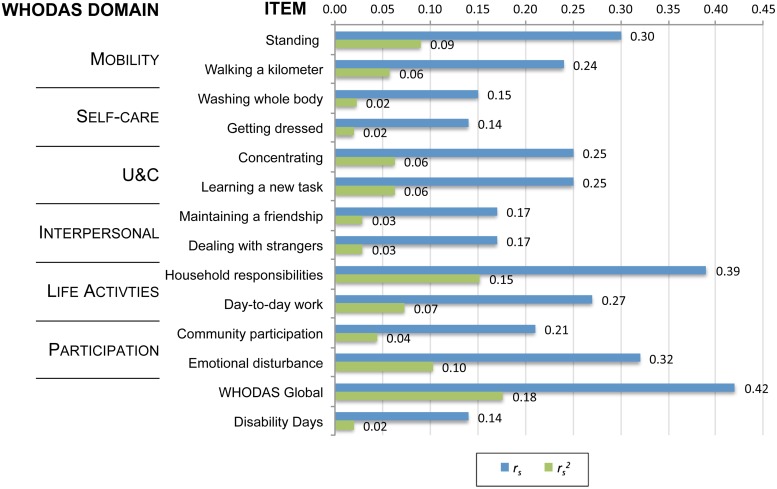
All items showed a positive correlation of disability with CMD symptom severity ( < 0.001). The WHODAS items of 'standing,' 'household responsibilities,' and 'emotional disturbance' explained the most variance in CMD symptom severity. Improvements in 'disability days,' 'emotional disturbance,' 'standing,' 'household responsibilities,' 'day-to-day work,' and 'concentrating' were significantly associated with CMD recovery over follow-up.
Further research is recommended on a CMD-specific WHODAS subscale comprised of the six WHODAS items found to be most strongly associated with CMD severity and recovery. This shorter, CMD-specific disability subscale would critically serve as a common metric to compare intervention impact on patient-centered outcomes and, in turn, to allocate global mental health resources efficiently.
常见精神障碍(CMD)是全球残疾的最重要促成因素之一。患者报告的残疾结果应作为全球精神卫生干预措施价值比较评估的关键指标。本研究旨在评估一种广泛使用的跨文化工具——12项世界卫生组织残疾评定量表第二版(WHODAS)——作为CMD治疗功能结局指标的有效性。
研究人群包括1024名参与印度MANAS试验的CMD患者。使用修订后的临床访谈时间表(CIS-R)评估CMD。使用12项WHODAS II加上残疾天数来评估残疾情况。本分析呈现了这些残疾项目与入组后2个月时CMD症状严重程度之间的相关性(聚合效度)以及这些项目与4个月后CMD康复的关联(外部反应度)。
所有项目均显示残疾与CMD症状严重程度呈正相关(<0.001)。“站立”“家务责任”和“情绪困扰”这几个WHODAS项目在CMD症状严重程度方面解释的变异最多。“残疾天数”“情绪困扰”“站立”“家务责任”“日常工作”和“注意力集中”方面的改善与随访期间的CMD康复显著相关。
建议对由六个与CMD严重程度和康复关联最强的WHODAS项目组成的CMD特异性WHODAS子量表进行进一步研究。这个更简短的、CMD特异性残疾子量表将至关重要地作为一个通用指标,用于比较干预对以患者为中心的结局的影响,进而有效地分配全球精神卫生资源。