Bronger Holger, Karge Anne, Dreyer Tobias, Zech Daniela, Kraeft Sara, Avril Stefanie, Kiechle Marion, Schmitt Manfred
Department of Gynecology and Obstetrics, Technical University of Munich, D-81675 Munich, Germany.
Department of Pathology, Technical University of Munich, D-81675 Munich, Germany.
Oncol Lett. 2017 Jun;13(6):4224-4230. doi: 10.3892/ol.2017.5994. Epub 2017 Apr 5.
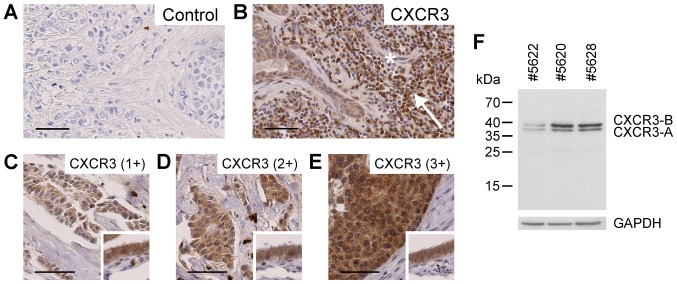
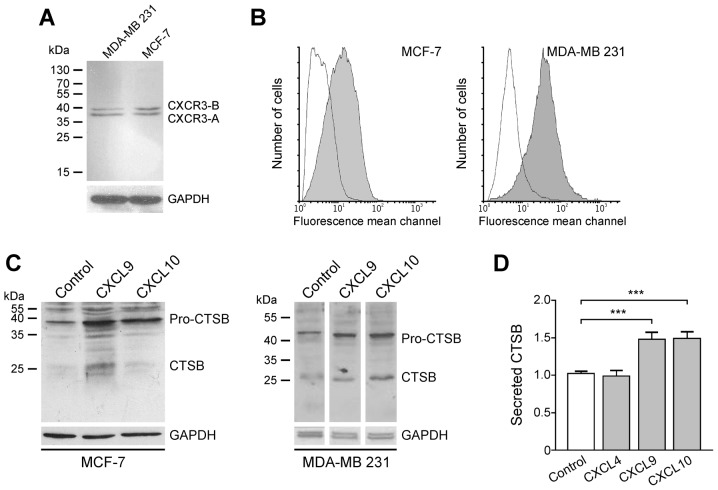
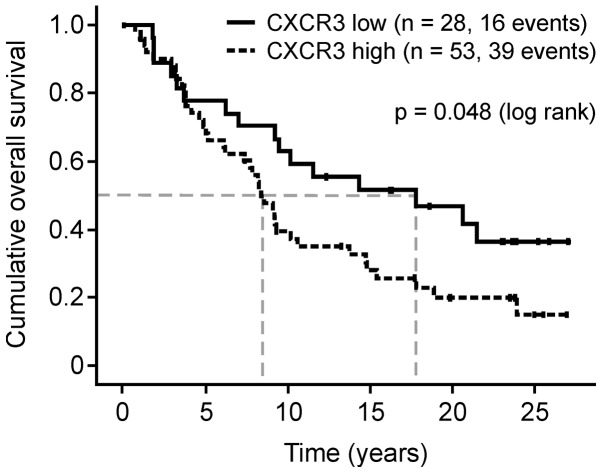
Cathepsin B (CTSB) is a lysosomal cysteine protease that has been linked to the progression of breast cancer, for example by activation of other proteases and tumor-promoting cytokines, thereby supporting tumor invasion and metastasis. Previously, it was shown that CTSB cleaves and inactivates C-X-C motif chemokine receptor 3 (CXCR3) chemokines. As CXCR3 ligands have been demonstrated to induce proteases in cancer cells, the present study hypothesized that they may also affect CTSB in breast cancer cells. The results demonstrated that the human breast cancer tumor cell lines MCF-7 and MDA-MB-231 express the CXCR3 splice variants A and B and CTSB. Upon binding to CXCR3, the two chemokine ligands C-X-C motif chemokine ligand (CXCL) 9 and CXCL10 trigger upregulation of CTSB in these breast cancer cells, whereas the CXCR3-B-specific ligand CXCL4 has no such effect, suggesting the involvement of CXCR3-A in the regulation of CTSB. In early-stage human breast cancer specimens (n=81), overexpression of CXCR3 is associated with statistically significant poorer overall survival, independent of lymph node status, tumor size and nuclear grading (hazard ratio=1.99; 95% confidence interval=1.00-3.97; P=0.050). In conclusion, the data from the current study propose a so far unknown mechanism by which breast cancer cells may exploit tumor-suppressive chemokines to enhance their invasiveness and reduce immune cell infiltration by the degradation of these chemokines. This mechanism may support the established unfavorable prognostic feature of CXCR3 expression in breast cancer.
组织蛋白酶B(CTSB)是一种溶酶体半胱氨酸蛋白酶,它与乳腺癌的进展有关,例如通过激活其他蛋白酶和促肿瘤细胞因子,从而促进肿瘤侵袭和转移。此前有研究表明,CTSB可切割并使C-X-C基序趋化因子受体3(CXCR3)趋化因子失活。由于CXCR3配体已被证明可诱导癌细胞中的蛋白酶,因此本研究推测它们也可能影响乳腺癌细胞中的CTSB。结果表明,人乳腺癌肿瘤细胞系MCF-7和MDA-MB-231表达CXCR3剪接变体A、B和CTSB。与CXCR3结合后,两种趋化因子配体C-X-C基序趋化因子配体(CXCL)9和CXCL10可触发这些乳腺癌细胞中CTSB的上调,而CXCR3-B特异性配体CXCL4则无此作用,这表明CXCR3-A参与了CTSB 的调节。在早期人乳腺癌标本(n=81)中,CXCR3的过表达与总体生存率在统计学上显著降低相关,与淋巴结状态、肿瘤大小和核分级无关(风险比=1.99;95%置信区间=1.00-3.97;P=0.050)。总之,本研究的数据提出了一种迄今未知的机制,即乳腺癌细胞可能利用肿瘤抑制性趋化因子来增强其侵袭性,并通过降解这些趋化因子来减少免疫细胞浸润。这一机制可能支持了乳腺癌中CXCR3表达既定的不良预后特征。