Babii A, Kovalchuk S, Glazko T, Kosovsky G, Glazko V
Federal State Budget Scientific Institution Center of Experimental Embryology and Reproductive Biotechnologies, Moscow, Russia.
Federal State Educational Institution of Higher Education Russian State Agrarian University - MAA named after K. A. Timiryazev, Moscow, Russia.
Curr Genomics. 2017 Jun;18(3):278-286. doi: 10.2174/1389202918666161108143909.
DNA transposons helitrons are mobile genetic elements responsible for major movements of the genetic material within and across different genomes. This ability makes helitrons suitable candidate elements for the development of new approaches of multilocus genotyping of live-stock animals, along with the well-known microsatellite loci.
We aimed to estimate the informativeness of helitron and microsatellite markers in assessing the consolidation and the "gene pool" standards of two commercial dairy cattle breeds (Ayrshire breed and holsteinized Black-and-White cattle) and one local breed of Kalmyk cattle, and to reveal any inter-breed difference in the organization of genomic regions flanked by helitrons in the studied cattle breeds.
We used the combination of two highly-polymorphic genomic elements - helitrons and trinu-cleotide microsatellites (AGC)6G and (GAG)6C, respectively - for genome scanning of the sampled groups of cattle. Also, we pyrosequenced the genomic regions flanked by the inverted repeats of 3'-end of Heligloria family of helitron fragments.
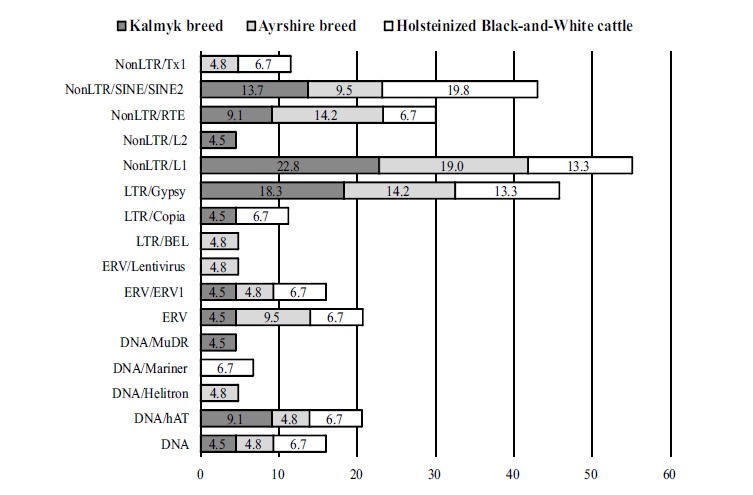
Generally, the both combinations of markers generated polymorphic spectra, based on which certain interbreed differentiation could be observed. The analysis of the identified interspersed repeats suggests that in factory and local cattle the genomic regions flanked by helitron fragments are shaped differently and contain different superfamilies of transposable elements, especially retrotransposons.
Despite the well-known fact of retrotransposon-dependent microsatellite expansion, our data suggest that, in the cattle genome, the DNA transposons and microsatellites can also be found in close neighbourhood, and that helitrons and retrotransposons may form domains of increased variability - targets for factors of artificial selection.
DNA转座子Helitron是可移动遗传元件,负责遗传物质在不同基因组内及跨基因组的主要移动。这种能力使Helitron成为开发家畜多位点基因分型新方法的合适候选元件,与著名的微卫星位点一样。
我们旨在评估Helitron和微卫星标记在评估两个商业奶牛品种(艾尔夏牛品种和荷斯坦化黑白花牛)以及一个卡尔梅克牛地方品种的群体结构和“基因库”标准方面的信息含量,并揭示所研究牛品种中Helitron侧翼基因组区域组织的品种间差异。
我们分别使用两种高度多态的基因组元件——Helitron和三核苷酸微卫星(AGC)6G和(GAG)6C——对采样的牛群进行基因组扫描。此外,我们对Helitron片段的Heligloria家族3'端反向重复侧翼的基因组区域进行焦磷酸测序。
总体而言,两种标记组合均产生了多态性图谱,基于此可观察到一定的品种间分化。对鉴定出的散布重复序列的分析表明,在工厂化养殖牛和本地牛中,Helitron片段侧翼的基因组区域形状不同,包含不同的转座元件超家族,尤其是逆转录转座子。
尽管存在逆转录转座子依赖的微卫星扩增这一已知事实,但我们的数据表明,在牛基因组中,DNA转座子和微卫星也可能紧密相邻,并且Helitron和逆转录转座子可能形成变异性增加的区域——人工选择因素的作用靶点。