Hawkins Paulina, Mercado Erik, Chochua Sopio, Castillo Maria E, Reyes Isabel, Chaparro Eduardo, Gladstone Rebecca, Bentley Stephen D, Breiman Robert F, Metcalf Benjamin J, Beall Bernard, Ochoa Theresa J, McGee Lesley
Emory University, Atlanta, USA; Centers for Disease Control and Prevention, Atlanta, USA.
Universidad Peruana Cayetano Heredia, Lima, Peru.
Int J Med Microbiol. 2017 Oct;307(7):415-421. doi: 10.1016/j.ijmm.2017.07.008. Epub 2017 Jul 22.
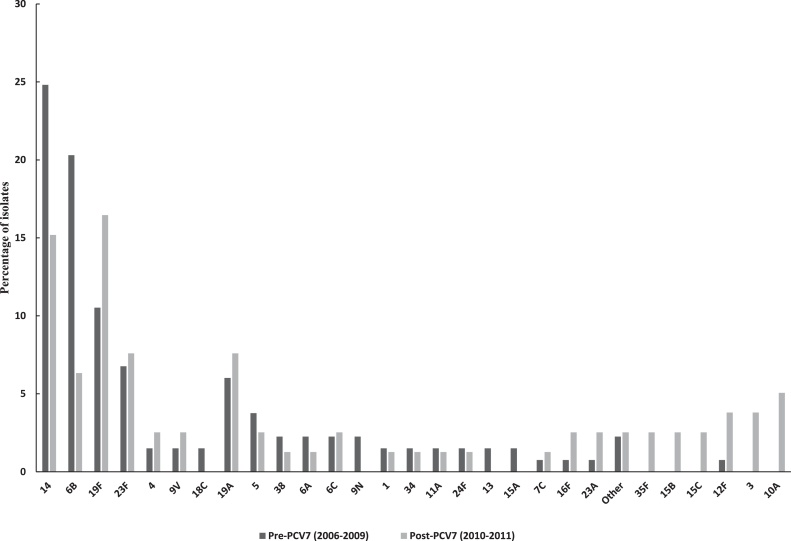
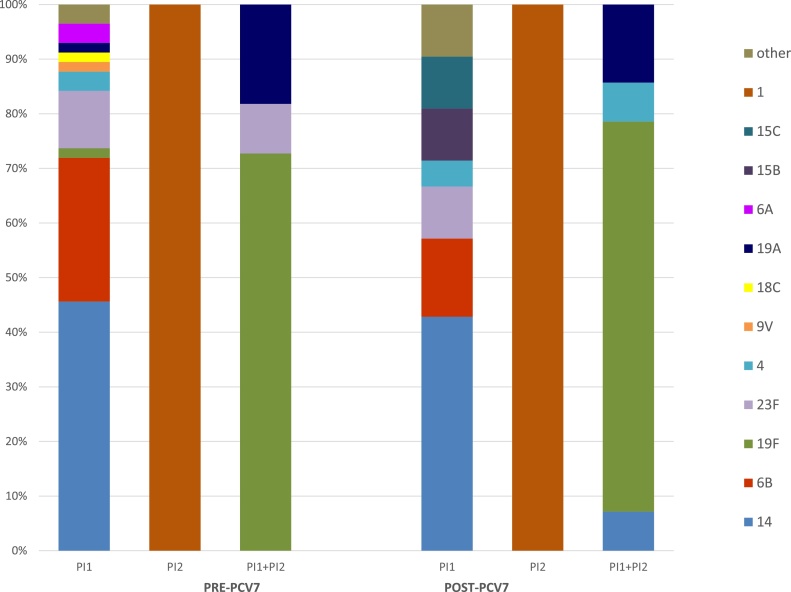
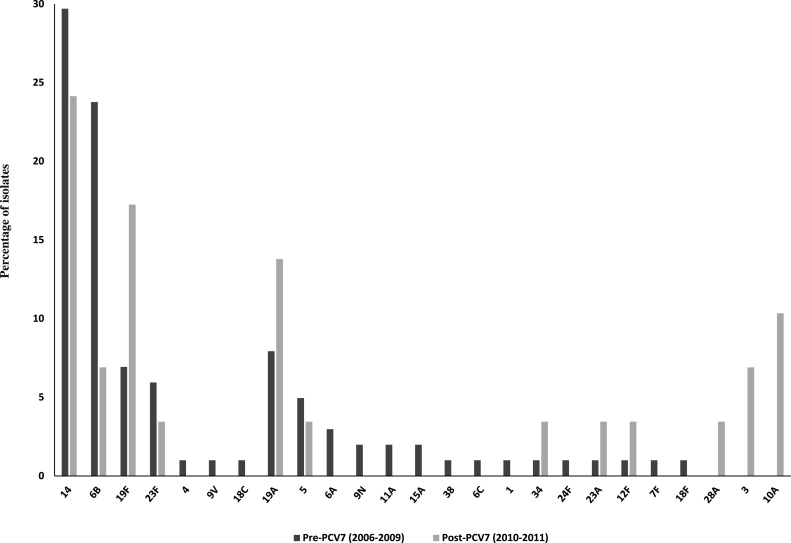
Before PCV7 introduction, invasive pneumococcal disease (IPD) was responsible for approximately 12,000-18,000 deaths annually among children <5years in Latin America. In Peru, PCV7 was introduced in 2009. We used whole genome sequencing to deduce key features of invasive strains collected in Lima, Peru from 2006 to 2011. We sequenced 212 IPD isolates from 16 hospitals in Lima pre (2006-2009; n=133) and post (2010-2011; n=79) PCV7 introduction; 130 (61.3%) isolates were from children≤5years old. CDC's Streptococcus lab bioinformatics pipeline revealed serotypes, sequence types (STs), pilus genes, PBP types and other resistance determinants. During the pre-PCV7 period, serotype 14 was the most common serotype (24.8%), followed by 6B (20.3%), 19F (10.5%), and 23F (6.8%). Post-PCV7, the proportion of PCV7 serotype 6B decreased significantly (to 6.3%), while 19F (16.3%), 14 (15.0%), 23F (7.5%), and 19A (7.5%) were the most common serotypes; only serotypes 3 and 10A increased significantly. Overall, 82% (n=173) of all isolates carried at least one resistance determinant, including 72 (34%) isolates that carried resistance determinants against 3 or more antimicrobial classes; of these 72 isolates, 56 (78%) belonged to a PCV7 serotype. Eighty-two STs were identified, with 53 of them organized in 14 clonal complexes. ST frequencies were distributed differently pre and post-PCV7 introduction, with only 18 of the 57 STs identified in years 2006-2009 isolates also observed in years 2010-2011 isolates. The apparent expansion of a 19F/ST1421 lineage with predicted β-lactam resistance (PBP type 13:16:20) and carrying resistance determinants against four additional antimicrobial classes was observed.
在引入7价肺炎球菌结合疫苗(PCV7)之前,侵袭性肺炎球菌疾病(IPD)每年导致拉丁美洲5岁以下儿童约12,000 - 18,000人死亡。在秘鲁,PCV7于2009年引入。我们使用全基因组测序来推断2006年至2011年在秘鲁利马收集的侵袭性菌株的关键特征。我们对利马16家医院在引入PCV7之前(2006 - 2009年;n = 133)和之后(2010 - 2011年;n = 79)收集的212株IPD分离株进行了测序;130株(61.3%)分离株来自5岁及以下儿童。美国疾病控制与预防中心(CDC)的链球菌实验室生物信息学流程揭示了血清型、序列类型(STs)、菌毛基因、青霉素结合蛋白(PBP)类型和其他耐药决定因素。在PCV7引入之前,血清型14是最常见的血清型(24.8%),其次是6B(20.3%)、19F(10.5%)和23F(6.8%)。引入PCV7后,PCV7血清型6B的比例显著下降(至6.3%),而19F(16.3%)、14(15.0%)、23F(7.5%)和19A(7.5%)是最常见的血清型;只有血清型3和10A显著增加。总体而言,所有分离株中有82%(n = 173)携带至少一种耐药决定因素,其中72株(34%)携带针对3种或更多抗菌药物类别的耐药决定因素;在这72株分离株中,56株(78%)属于PCV7血清型。共鉴定出82种序列类型(STs),其中53种组织成14个克隆复合体。STs的频率在引入PCV7之前和之后分布不同,在2006 - 2009年分离株中鉴定出的57种STs中,只有18种在2010 - 2011年分离株中也被观察到。观察到一个具有预测β - 内酰胺耐药性(PBP类型13:16:20)且携带针对另外四种抗菌药物类别的耐药决定因素的19F/ST1421谱系明显扩张。