
魁北克省农场动物和人类病例分离株中截短现象的特征分析。
Characterisation of truncation in isolates from farm animals and human cases in the province of Quebec.
作者信息
Fravalo Philippe, Cherifi Tamazight, Neira Feliciano Kersti Dina, Letellier Ann, Fairbrother Julie-Hélène, Bekal Sadjia
机构信息
University of Montreal, Faculty veterinary medicine, Dpt Pathology Microbiology 3190 Sicotte J2S2M2, Saint Hyacinthe, QC, Canada.
Laboratoire d'épidémiosurveillance animale du Québec Ministry of Agriculture, Fisheries and Food, Saint Hyacinthe, QC, Canada.
出版信息
Vet Rec Open. 2017 Apr 23;4(1):e000199. doi: 10.1136/vetreco-2016-000199. eCollection 2017.
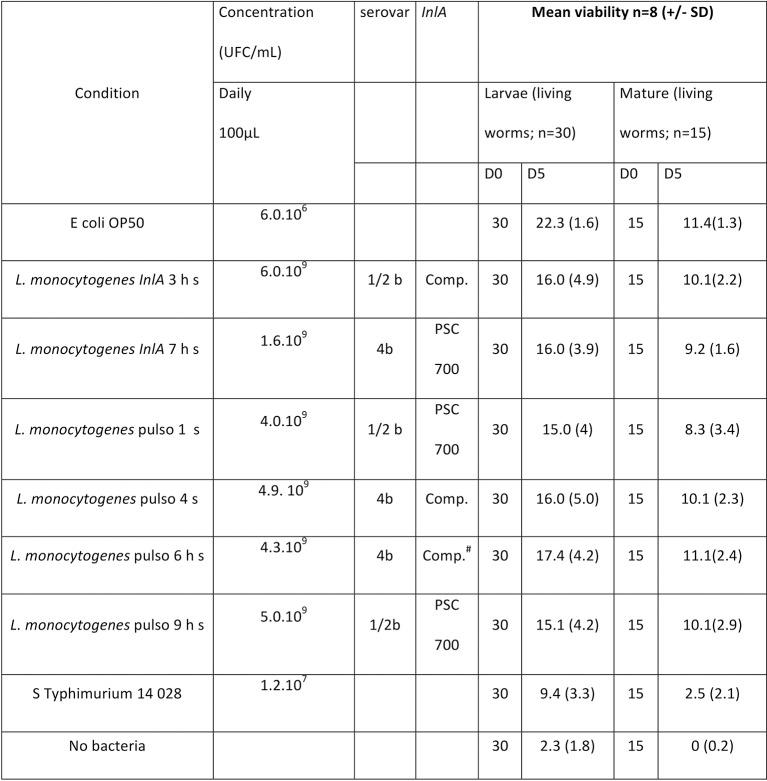
The introduction of into the food production chain is a concern, with numerous grouped cases of listeriosis associated with milk-derived or pork-derived products have been documented. Management of this zoonotic pathogen considers all strains as an equal risk. Recently, a new perspective for characterisation of strain virulence was introduced with the discovery of the unaltered sequence of as a determinant of strain virulence; this has also been reported as an infrequent finding among so-called environmental strains, that is, strains isolated from food or from surfaces in food industries. The aim of this study was to differentiate strains isolated from animal cases versus those from human cases and to differentiate clinical strains from environmental ones using a virulence testing model. In Quebec in 2013/2014, the surveillance of clinical isolates registered a total of 20 strains of animal origin and 16 pulsed-field gel electrophoresis types isolated from human cases. The mixed PCR multiplex agglutination protocol used for geno-serotyping clearly discriminated genogroup IVB strains from bovine and human origins. The presence of a premature stop codon single nucleotide polymorphism in the gene sequence in clinical strains and the identical behaviour of particular strains in the model are discussed in this paper from the perspective of industrial management of risk.
将[具体内容缺失]引入食品生产链令人担忧,已有大量与牛奶制品或猪肉制品相关的李斯特菌病聚集病例被记录在案。对这种人畜共患病原体的管理将所有菌株视为同等风险。最近,随着发现[具体内容缺失]的未改变序列作为菌株毒力的决定因素,引入了一种表征菌株毒力的新视角;据报道,这在所谓的环境菌株(即从食品或食品工业表面分离的菌株)中也是罕见的发现。本研究的目的是使用[具体内容缺失]毒力测试模型区分从动物病例分离的[具体内容缺失]菌株与从人类病例分离的菌株,并区分临床菌株与环境菌株。在2013/2014年的魁北克,对[具体内容缺失]临床分离株的监测共记录了20株动物源菌株和16种从人类病例分离的脉冲场凝胶电泳类型。用于基因血清分型的混合PCR多重凝集方案清楚地区分了来自牛和人类的IVB基因群菌株。本文从[具体内容缺失]风险的工业管理角度讨论了临床菌株中[具体内容缺失]基因序列中提前终止密码子单核苷酸多态性的存在以及特定菌株在[具体内容缺失]模型中的相同行为。



 Zotero 插件