Sabra Ahmed, Lawrence Matthew James, Aubrey Robert, Obaid Daniel, Chase Alexander, Smith Dave, Thomas Phillip, Storton Sharon, Davies Gareth R, Hawkins Karl, Williams Phylip Rhodri, Morris Keith, Evans Phillip Adrian
NISCHR Haemostasis Biomedical Research Unit, Morriston Hospital, ABMU Health Board, Swansea, UK.
NISCHR Haemostasis Biomedical Research Unit, College of Medicine, Swansea University, Swansea, UK.
Open Heart. 2017 Jun 23;4(2):e000562. doi: 10.1136/openhrt-2016-000562. eCollection 2017.
Coronary artery disease (CAD) is associated with an increased prothrombotic tendency and is also linked to unfavourably altered clot microstructure. We have previously described a biomarker of clot microstructure (d) that is unfavourably altered in acute myocardial infarction. The d biomarker assesses whether the blood will form denser or looser microstructures when it clots. In this study we assessed in patients with stable chest pain whether d can differentiate between obstructed and unobstructed CAD.
A blood sample prior to angiography was obtained from 251 consecutive patients undergoing diagnostic coronary angiography. Patients were categorised based on angiographic findings as presence or absence of obstructive CAD (stenosis ≥50%). The blood sample was assessed using the d biomarker, standard laboratory markers and platelet aggregometry (Multiplate).
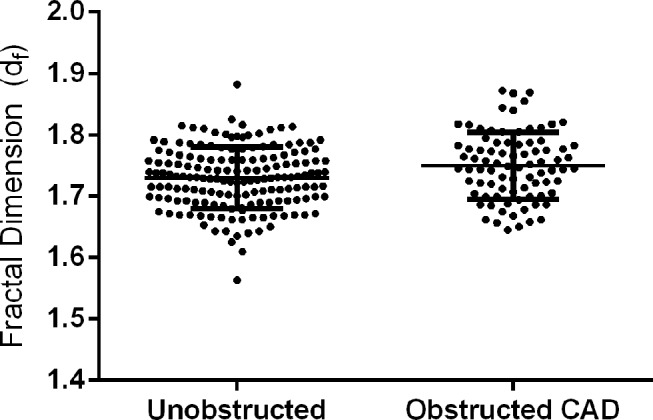
A significant difference (p=0.028) in d was observed between obstructive CAD (1.748±0.057, n=83) and unobstructive CAD (1.732±0.052, n=168), where patients with significant CAD produce denser, more tightly packed clots. d was also raised in men with obstructive CAD compared with women (1.745±0.055 vs 1.723±0.052, p=0.007). Additionally d significantly correlated with the platelets response to arachidonic acid as measured by the ASPItest area under the curve readings from platelet aggregometry (correlation coefficient=0.166, p=0.008), a low value of the ASPItest indicating effective aspirin use was associated with looser, less dense clots.
For the first time, we characterise clot microstructure, as measured by d, in patients with stable CAD. d can potentially be used to risk-stratify patients with stable CAD and assess the efficacy of therapeutic interventions by measuring changes in clot microstructure.
冠状动脉疾病(CAD)与血栓形成倾向增加相关,并且还与不良的血凝块微观结构改变有关。我们之前描述过一种血凝块微观结构的生物标志物(d),其在急性心肌梗死中发生了不良改变。d生物标志物评估血液在凝固时会形成更致密还是更疏松的微观结构。在本研究中,我们评估了在稳定型胸痛患者中,d能否区分阻塞性和非阻塞性CAD。
从251例连续接受诊断性冠状动脉造影的患者中获取血管造影术前的血样。根据血管造影结果将患者分类为有无阻塞性CAD(狭窄≥50%)。使用d生物标志物、标准实验室指标和血小板聚集测定法(Multiplate)对血样进行评估。
在阻塞性CAD(1.748±0.057,n = 83)和非阻塞性CAD(1.732±0.052,n = 168)之间观察到d有显著差异(p = 0.028),其中有显著CAD的患者会产生更致密、堆积更紧密的血凝块。与女性相比,阻塞性CAD男性的d也升高(1.745±0.055对1.723±0.052,p = 0.007)。此外,d与血小板聚集测定法曲线下面积读数(ASPItest)测量的血小板对花生四烯酸的反应显著相关(相关系数 = 0.166,p = 0.008),ASPItest值低表明阿司匹林使用有效,这与更疏松、密度更低的血凝块有关。
我们首次对稳定型CAD患者中通过d测量的血凝块微观结构进行了特征描述。d有可能用于对稳定型CAD患者进行风险分层,并通过测量血凝块微观结构的变化来评估治疗干预的疗效。