Patterson Angela M, Watson Alastair J M
Quadram Institute, Norwich Research Park, Norwich, United Kingdom.
Norwich Medical School, University of East Anglia, Norwich, United Kingdom.
Front Immunol. 2017 Jul 18;8:841. doi: 10.3389/fimmu.2017.00841. eCollection 2017.
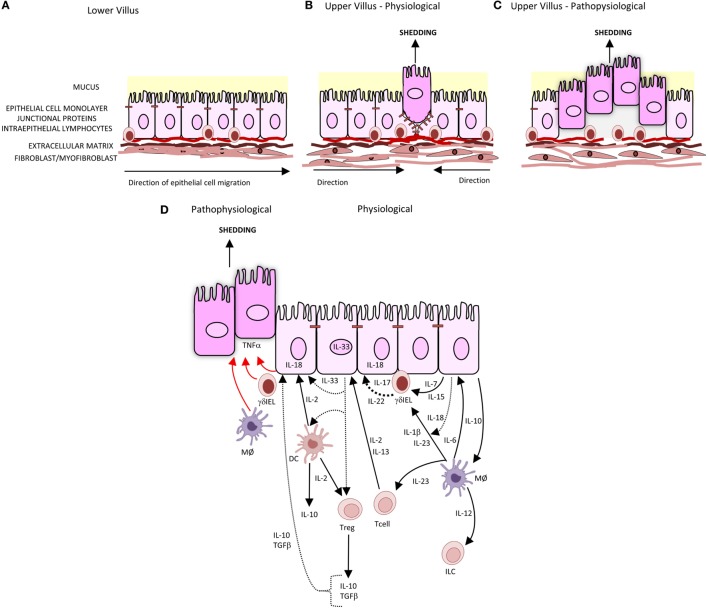
Intestinal epithelial cells play a fundamental role in maintaining homeostasis. Shedding of intestinal cells in a controlled manner is critical to maintenance of barrier function. Barrier function is maintained during this shedding process by a redistribution of tight junctional proteins to facilitate closure of the gap left by the shedding cell. However, despite the obvious importance of epithelial cell shedding to gut health, a central question is how the extrusion of epithelial cells is achieved, enabling barrier integrity to be maintained in the healthy gut and restored during inflammation remains largely unanswered. Recent studies have provided evidence that excessive epithelial cell shedding and loss of epithelial barrier integrity is triggered by exposure to lipopolysaccharide or tumor necrosis factor alpha. Subsequent studies have provided evidence of the involvement of specific cellular components and signaling mechanisms as well as the functionality of microbiota that can be either detrimental or beneficial for intestinal barrier integrity. This review will focus on the evidence and decipher how the signaling systems through which the mucosal immune system and microbiota can regulate epithelial cell shedding and how these mechanisms interact to preserve the viability of the epithelium.
肠上皮细胞在维持体内平衡中发挥着重要作用。以可控方式脱落肠细胞对于维持屏障功能至关重要。在这个脱落过程中,紧密连接蛋白的重新分布有助于封闭脱落细胞留下的间隙,从而维持屏障功能。然而,尽管上皮细胞脱落对肠道健康至关重要,但一个核心问题是上皮细胞是如何被挤出的,如何在健康肠道中维持屏障完整性以及在炎症期间如何恢复屏障完整性,这些问题在很大程度上仍未得到解答。最近的研究表明,接触脂多糖或肿瘤坏死因子α会引发上皮细胞过度脱落和上皮屏障完整性丧失。随后的研究提供了证据,证明特定细胞成分和信号机制以及微生物群的功能对肠道屏障完整性可能有害或有益。本综述将聚焦于这些证据,并解读黏膜免疫系统和微生物群通过哪些信号系统调节上皮细胞脱落,以及这些机制如何相互作用以维持上皮细胞的活力。