Wu Xiaomei, Wu Fei-Hua, Wu Qianrong, Zhang Shu, Chen Suping, Sima Matthew
College of Life and Environmental Sciences, Hangzhou Normal UniversityHangzhou, China.
Department of Biology, Duke UniversityDurham, NC, United States.
Front Physiol. 2017 Jul 26;8:539. doi: 10.3389/fphys.2017.00539. eCollection 2017.
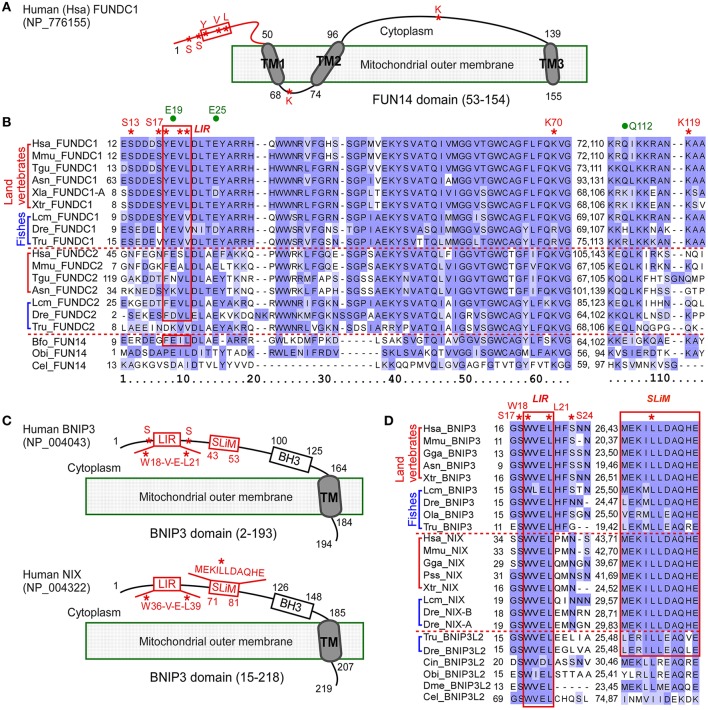
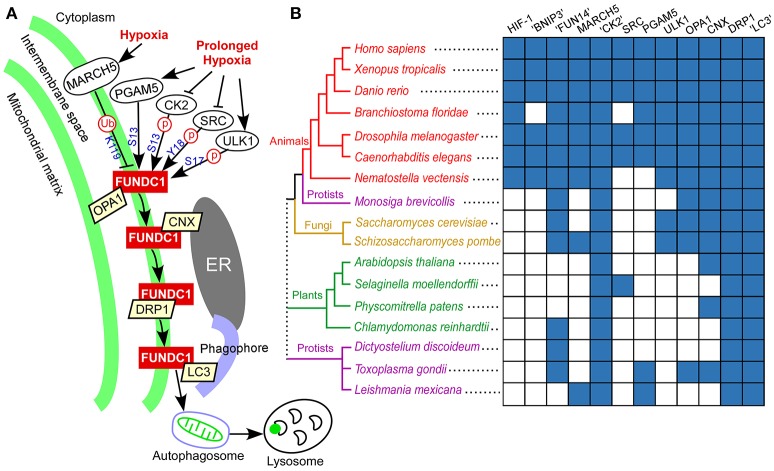
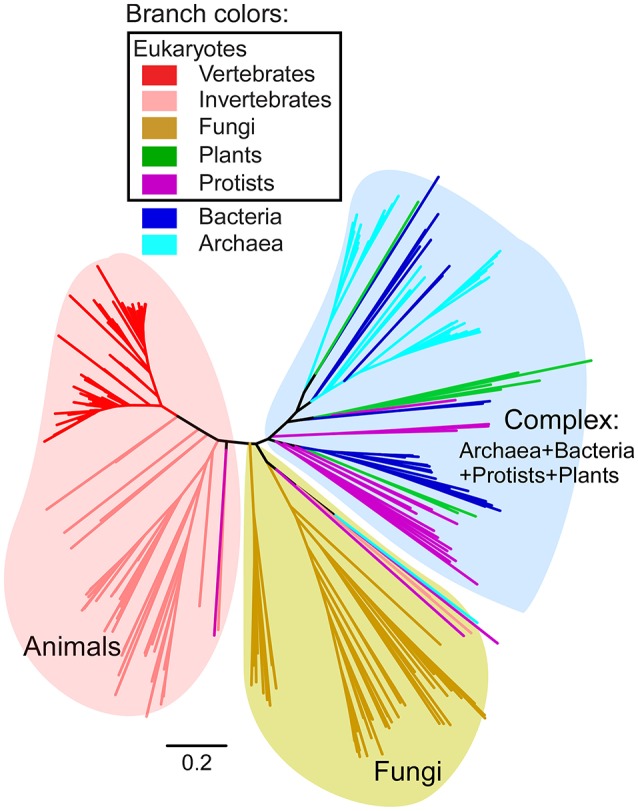
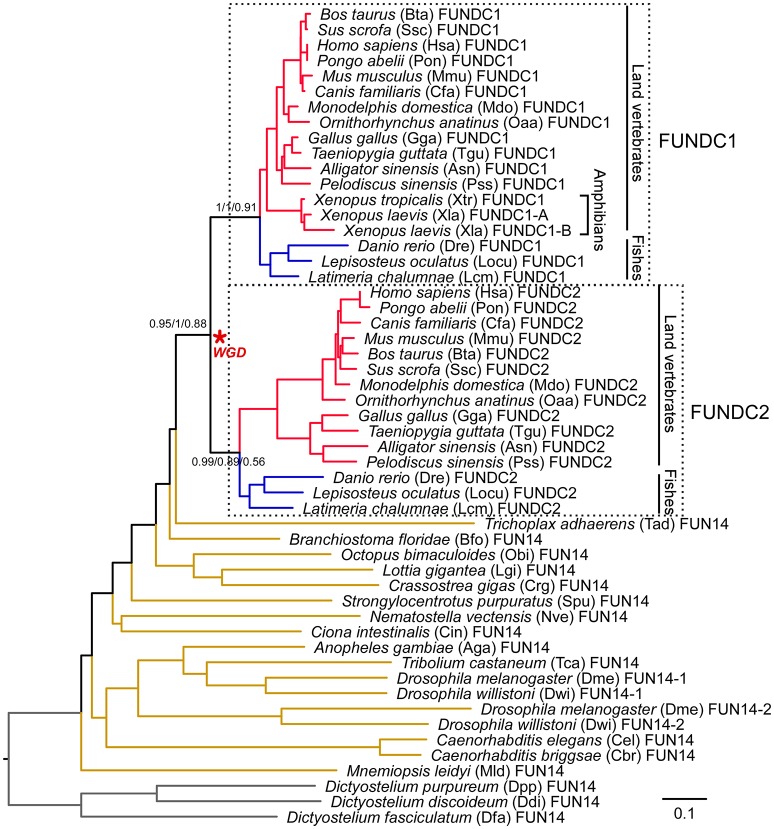
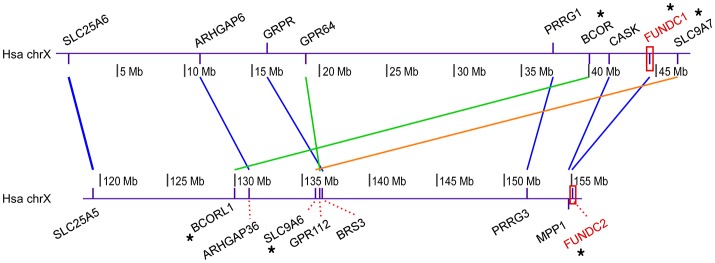
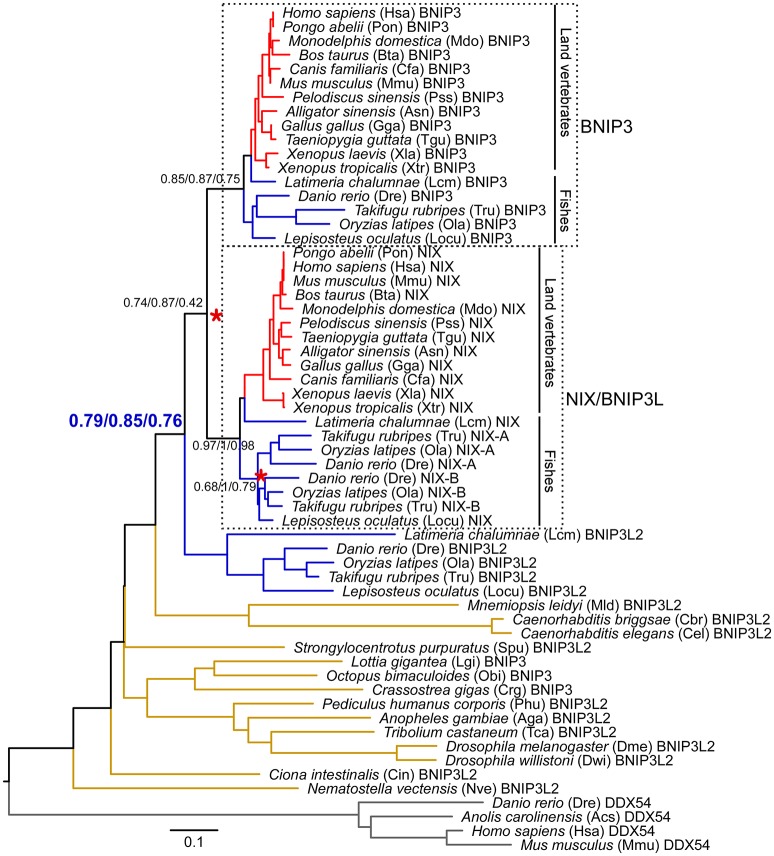
As animals evolved to use oxygen as the main strategy to produce ATP through the process of mitochondrial oxidative phosphorylation, the ability to adapt to fluctuating oxygen concentrations is a crucial component of evolutionary pressure. Three mitophagy receptors, FUNDC1, BNIP3 and NIX, induce the removal of dysfunctional mitochondria (mitophagy) under prolonged hypoxic conditions in mammalian cells, to maintain oxygen homeostasis and prevent cell death. However, the evolutionary origins and structure-function relationships of these receptors remain poorly understood. Here, we found that FUN14 domain-containing proteins are present in archaeal, bacterial and eukaryotic genomes, while the family of BNIP3 domain-containing proteins evolved from early animals. We investigated conservation patterns of the critical amino acid residues of the human mitophagy receptors. These residues are involved in receptor regulation, mainly through phosphorylation, and in interaction with LC3 on the phagophore. Whereas FUNDC1 may be able to bind to LC3 under the control of post-translational regulations during the early evolution of vertebrates, BINP3 and NIX had already gained the ability for LC3 binding in early invertebrates. Moreover, FUNDC1 and BNIP3 each lack a layer of phosphorylation regulation in fishes that is conserved in land vertebrates. Molecular evolutionary analysis revealed that BNIP3 and NIX, as the targets of oxygen sensing HIF-1α, showed higher rates of substitution in fishes than in mammals. Conversely, FUNDC1 and its regulator MARCH5 showed higher rates of substitution in mammals. Thus, we postulate that the structural traces of mitophagy receptors in land vertebrates and fishes may reflect the process of vertebrate transition from water onto land, during which the changes in atmospheric oxygen concentrations acted as a selection force in vertebrate evolution. In conclusion, our study, combined with previous experimental results, shows that hypoxia-induced mitophagy regulated by FUDNC1/MARCH5 might use a different mechanism from the HIF-1α-dependent mitophagy regulated by BNIP3/NIX.
随着动物进化到通过线粒体氧化磷酸化过程将氧气作为产生三磷酸腺苷(ATP)的主要策略,适应波动氧浓度的能力是进化压力的关键组成部分。三种线粒体自噬受体,即FUNDC1、BNIP3和NIX,在哺乳动物细胞长期缺氧条件下诱导去除功能失调的线粒体(线粒体自噬),以维持氧稳态并防止细胞死亡。然而,这些受体的进化起源和结构 - 功能关系仍知之甚少。在这里,我们发现含FUN14结构域的蛋白质存在于古菌、细菌和真核生物基因组中,而含BNIP3结构域的蛋白质家族则从早期动物进化而来。我们研究了人类线粒体自噬受体关键氨基酸残基的保守模式。这些残基主要通过磷酸化参与受体调节,并参与与吞噬泡上的LC3相互作用。虽然FUNDC1在脊椎动物早期进化过程中可能能够在翻译后调控的控制下与LC3结合,但BINP3和NIX在早期无脊椎动物中就已经获得了与LC3结合的能力。此外,FUNDC1和BNIP3在鱼类中各自缺乏在陆地脊椎动物中保守的一层磷酸化调节。分子进化分析表明,作为氧感应HIF - 1α靶点的BNIP3和NIX在鱼类中的替代率高于哺乳动物。相反,FUNDC1及其调节因子MARCH5在哺乳动物中的替代率更高。因此,我们推测陆地脊椎动物和鱼类中线粒体自噬受体的结构痕迹可能反映了脊椎动物从水生到陆生的转变过程,在此期间大气氧浓度的变化在脊椎动物进化中起到了选择作用。总之,我们的研究与先前的实验结果相结合表明,由FUDNC1/MARCH5调控的缺氧诱导的线粒体自噬可能使用与由BNIP3/NIX调控的HIF - 1α依赖性线粒体自噬不同的机制。