Berghuijs Herman N C, Yin Xinyou, Ho Q Tri, Retta Moges A, Verboven Pieter, Nicolaï Bart M, Struik Paul C
Centre for Crop Systems Analysis, Wageningen University & Research, Droevendaalsesteeg 1, Wageningen, The Netherlands.
BioSolar Cells, Wageningen, The Netherlands.
PLoS One. 2017 Sep 7;12(9):e0183746. doi: 10.1371/journal.pone.0183746. eCollection 2017.
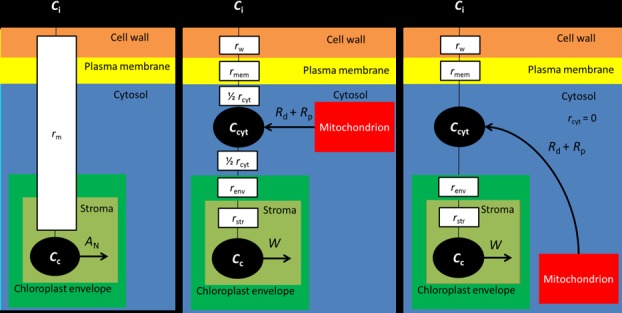
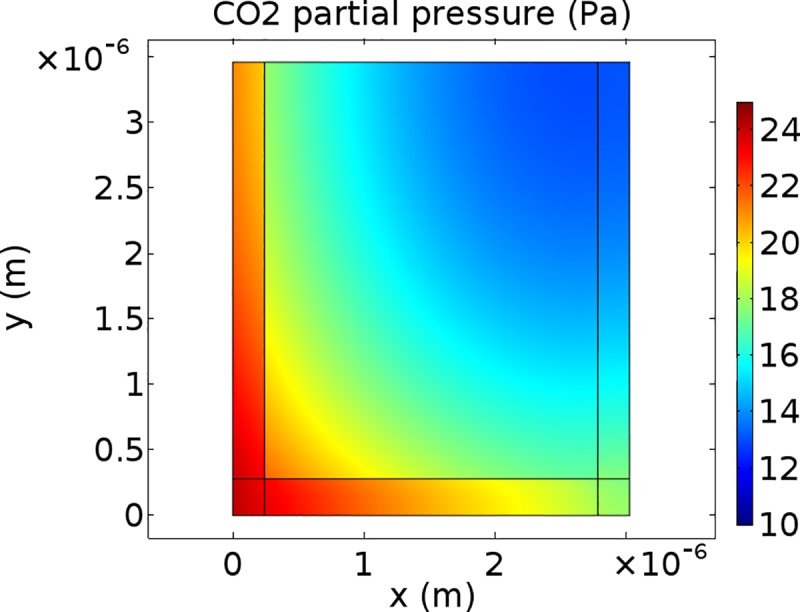
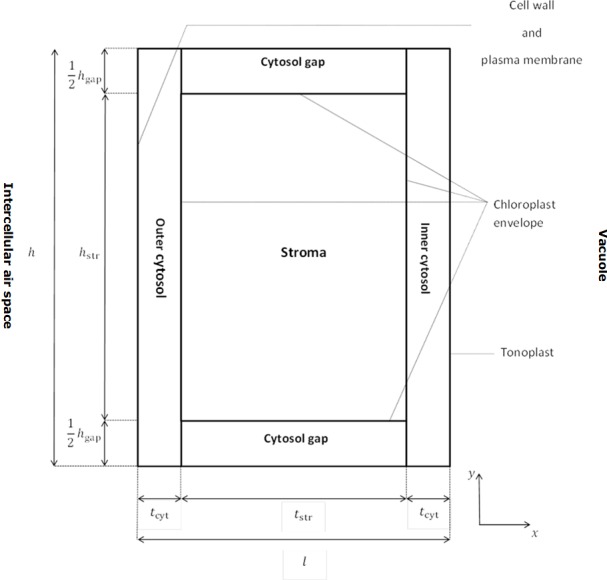
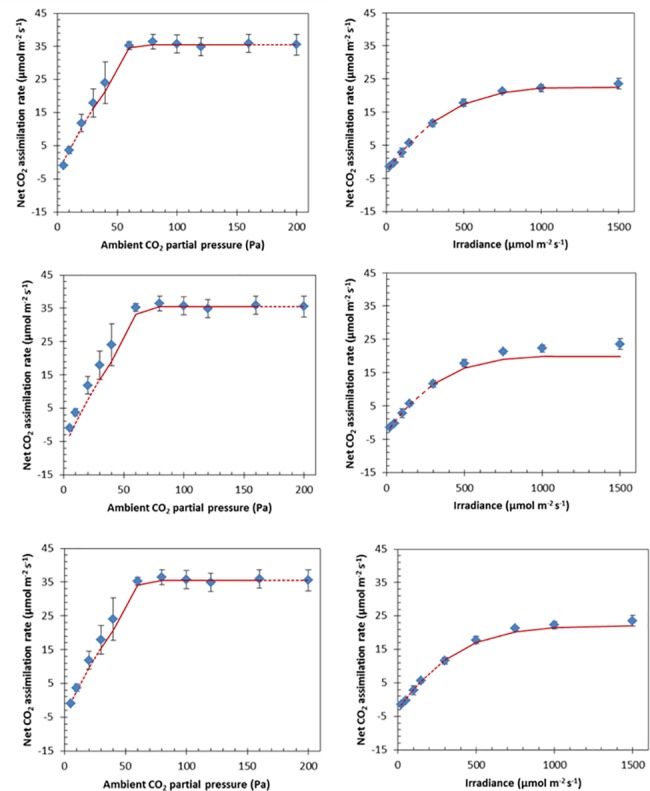
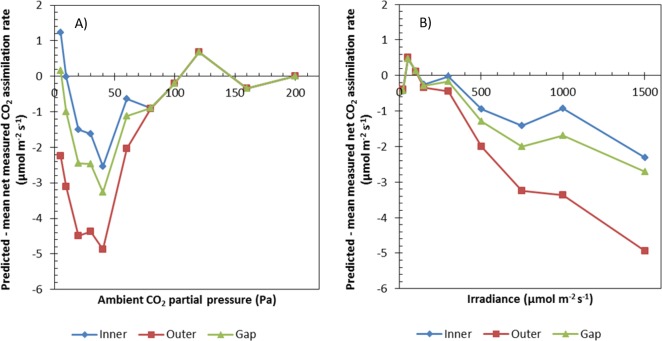
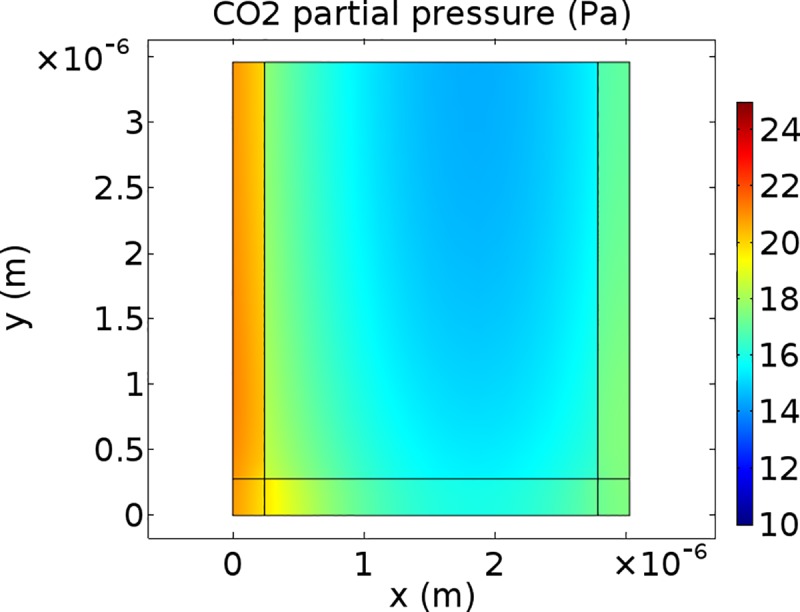
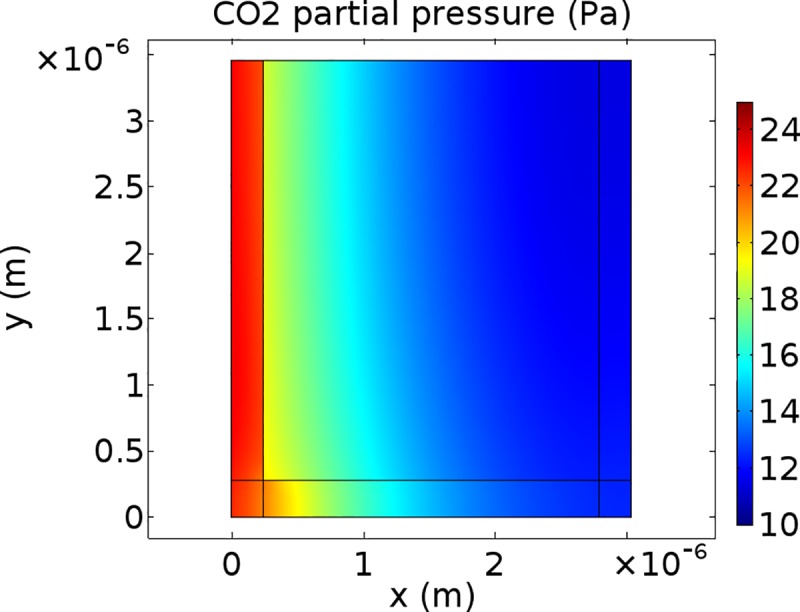
The rate of photosynthesis depends on the CO2 partial pressure near Rubisco, Cc, which is commonly calculated by models using the overall mesophyll resistance. Such models do not explain the difference between the CO2 level in the intercellular air space and Cc mechanistically. This problem can be overcome by reaction-diffusion models for CO2 transport, production and fixation in leaves. However, most reaction-diffusion models are complex and unattractive for procedures that require a large number of runs, like parameter optimisation. This study provides a simpler reaction-diffusion model. It is parameterized by both leaf physiological and leaf anatomical data. The anatomical data consisted of the thickness of the cell wall, cytosol and stroma, and the area ratios of mesophyll exposed to the intercellular air space to leaf surfaces and exposed chloroplast to exposed mesophyll surfaces. The model was used directly to estimate photosynthetic parameters from a subset of the measured light and CO2 response curves; the remaining data were used for validation. The model predicted light and CO2 response curves reasonably well for 15 days old tomato (cv. Admiro) leaves, if (photo)respiratory CO2 release was assumed to take place in the inner cytosol or in the gaps between the chloroplasts. The model was also used to calculate the fraction of CO2 produced by (photo)respiration that is re-assimilated in the stroma, and this fraction ranged from 56 to 76%. In future research, the model should be further validated to better understand how the re-assimilation of (photo)respired CO2 is affected by environmental conditions and physiological parameters.
光合作用速率取决于核酮糖-1,5-二磷酸羧化酶(Rubisco)附近的二氧化碳分压Cc,通常由使用叶肉总阻力的模型来计算。此类模型并未从机制上解释细胞间空气空间中的二氧化碳水平与Cc之间的差异。通过叶片中二氧化碳传输、产生和固定的反应扩散模型可以克服这一问题。然而,大多数反应扩散模型都很复杂,对于像参数优化这样需要大量运行次数的程序来说缺乏吸引力。本研究提供了一个更简单的反应扩散模型。它由叶片生理数据和叶片解剖数据进行参数化。解剖数据包括细胞壁、细胞质基质和叶绿体基质的厚度,以及暴露于细胞间空气空间的叶肉与叶片表面的面积比,和暴露的叶绿体与暴露的叶肉表面的面积比。该模型直接用于从测量的光响应曲线和二氧化碳响应曲线的子集中估算光合参数;其余数据用于验证。如果假设(光)呼吸产生的二氧化碳释放发生在内部细胞质基质或叶绿体之间的间隙中,该模型能较好地预测15日龄番茄(品种Admiro)叶片的光响应曲线和二氧化碳响应曲线。该模型还用于计算(光)呼吸产生的二氧化碳在叶绿体基质中重新同化的比例,这一比例在56%至76%之间。在未来的研究中,该模型应进一步验证,以更好地了解(光)呼吸产生的二氧化碳的重新同化如何受到环境条件和生理参数的影响。