
长江三角洲地区 2000 年稻田和非稻田管理下的土壤有机磷转化。
Soil organic phosphorus transformations during 2000 years of paddy-rice and non-paddy management in the Yangtze River Delta, China.
机构信息
Institute of Bio- and Geosciences, Agrosphere Institute (IBG-3), Forschungszentrum Jülich GmbH, Jülich, 52428, Germany.
Department of Natural Resources and Environmental Sciences, University of Illinois at Urbana-Champaign, Urbana, IL, 61801, USA.
出版信息
Sci Rep. 2017 Sep 7;7(1):10818. doi: 10.1038/s41598-017-10071-0.
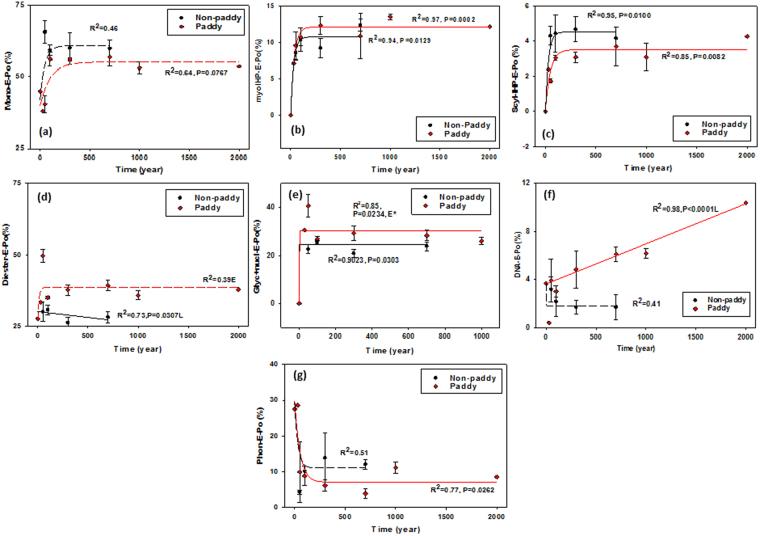
The contents and properties of soil organic phosphorus (P) largely drive ecosystem productivity with increasing development of natural soil. We hypothesized that soil P would initially increase with paddy management and then would persist under steady-state conditions. We analyzed soils from a 2000-year chronosequence of a rice-wheat rotation and an adjacent non-paddy 700-year chronosequence in Bay of Hangzhou (China) for their P composition using solution P-NMR after NaOH-EDTA extraction. Land reclamation promoted P accumulation in both paddy and non-paddy topsoils (depths ≤ 18 cm) until steady-state equilibria were reached within 200 years of land use. Greater P concentrations were found, however, in the non-paddy subsoils than in those under paddy management. Apparently, the formation of a dense paddy plough pan hindered long-term P accumulation in the paddy subsoil. The surface soils showed higher proportions of orthophosphate diesters under paddy than under non-paddy management, likely reflecting suppressed decomposition of crop residues despite elevated microbial P compounds stocks under anaerobic paddy-rice management. Intriguingly, the composition of P was remarkably stable after 194-years of paddy management and 144-years of non-paddy management, suggesting novel steady-state equilibria of P dynamics had been reached in these man-made ecosystems after less than two centuries.
土壤有机磷(P)的含量和性质在自然土壤不断发展的过程中极大地影响着生态系统的生产力。我们假设土壤 P 最初会随着稻田管理而增加,然后在稳定状态下持续存在。我们分析了来自中国杭州湾一个 2000 年水稻-小麦轮作和相邻 700 年非稻田时间序列的土壤,使用 NaOH-EDTA 提取后,用溶液 P-NMR 分析土壤 P 组成。开垦土地促进了稻田和非稻田表土(深度≤18cm)中 P 的积累,直到土地利用 200 年内达到稳定平衡。然而,在非稻田底土中发现了更高的 P 浓度,而在稻田管理下的底土中则没有。显然,密实地犁稻田阻碍了稻田底土中 P 的长期积累。表层土壤中,稻田管理下的正磷酸盐二酯比例高于非稻田管理下的比例,这可能反映了尽管在厌氧水稻管理下微生物 P 化合物储量升高,但作物残体的分解受到抑制。有趣的是,经过 194 年的稻田管理和 144 年的非稻田管理后,P 的组成惊人地稳定,这表明在不到两个世纪的时间里,这些人为生态系统中 P 动态已经达到了新的稳定平衡。


 Zotero 插件