Ozkunt Okan, Karademir Gökhan, Sariyilmaz Kerim, Gemalmaz Halil Can, Dikici Fatih, Domanic Unsal
Department of Orthopedics and Traumatology, Acibadem University, Atakent Hospital, Istanbul, Turkey.
Department of Orthopedics and Traumatology, Istanbul University, Istanbul School of Medicine, Istanbul, Turkey.
Acta Orthop Traumatol Turc. 2017 Oct;51(5):377-380. doi: 10.1016/j.aott.2017.08.002. Epub 2017 Sep 8.
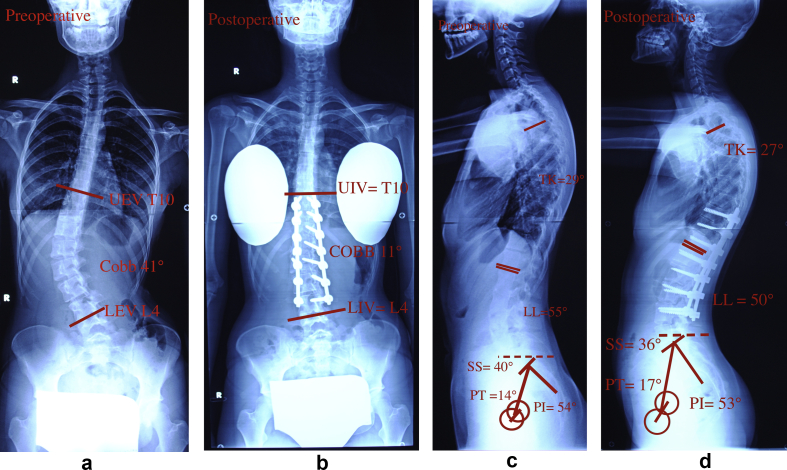
The aim of this study was to evaluate preoperative and postoperative spinopelvic parameters and the influence of lowest instrumented vertebrae on sagittal parameters in Lenke 5 Adolescent Idiopathic Scoliosis (AIS) patients.
A total of 42 patients (37 females, 5 males; mean age: 16.71 ± 3.46 years) were included in the study. Preoperative and postoperative last follow up lumbar lordosis (LL), thoracic kyphosis (TK), pelvic tilt (PT), pelvic incidence (PI) and sacral slope (SS) angles measured. By stopped fusion in L3, L4 or L5 we divided the group into three parts.
Mean follow-up was 43 months. Preoperatively, the mean TK and LL were 36.8° and 55.3°. At the last follow up, the mean TK and LL were 27.1° and 49.0° degrees, respectively. Preoperatively, the mean PI, PT and SS were 53.3°, 16.1° and 37.4° degrees. At the last follow up, the mean PI, PT and SS were 52.7°, 19.9° and 33.0° respectively. Significant differences were observed for SS (p = 0.003), TK (p = 0.004), LL (p = 0.012) and PT (p = 0.013) postoperatively for all patients. According the L3 and L4 groups there is significant difference in SS, LL (p = 0.013) and PT (p = 0.018) which means a significant decrease occurs in SS and LL when the distal fusion level changes from L3 to L4 but significant increase in PT in L3 group to compensate spinopelvic change after surgery.
The selection of more distal level for fusion adversely affects the compensation mechanisms of sagittal balance in Lenke 5 AIS patients.
Level IV, Therapeutic study.
本研究旨在评估Lenke 5型青少年特发性脊柱侧凸(AIS)患者术前和术后的脊柱骨盆参数,以及最低融合椎体对矢状面参数的影响。
本研究共纳入42例患者(37例女性,5例男性;平均年龄:16.71±3.46岁)。测量术前和术后末次随访时的腰椎前凸(LL)、胸椎后凸(TK)、骨盆倾斜(PT)、骨盆入射角(PI)和骶骨倾斜角(SS)。通过在L3、L4或L5处停止融合,将该组患者分为三部分。
平均随访43个月。术前,平均TK和LL分别为36.8°和55.3°。在末次随访时,平均TK和LL分别为27.1°和49.0°。术前,平均PI、PT和SS分别为53.3°、16.1°和37.4°。在末次随访时,平均PI、PT和SS分别为52.7°、19.9°和33.0°。所有患者术后SS(p = 0.003)、TK(p = 0.004)、LL(p = 0.012)和PT(p = 0.013)均有显著差异。根据L3和L4组,SS、LL(p = 0.013)和PT(p = 0.018)存在显著差异,这意味着当远端融合水平从L3变为L4时,SS和LL显著降低,但L3组的PT显著增加,以补偿术后脊柱骨盆的变化。
选择更低位的融合水平会对Lenke 5型AIS患者矢状面平衡的代偿机制产生不利影响。
IV级,治疗性研究。