*Clinical Research Division, Fred Hutchinson Cancer Research Center Department of †Medicine ¶Radiology, University of Washington, Seattle, WA ‡Immune Design, Seattle, WA, and South San Francisco, CA §Mount Sinai School of Medicine, Tisch Cancer Institute, New York, NY ∥MD Anderson Cancer Center, Houston, TX #Royal Marsden Hospital/Institute of Cancer Research, London, England.
J Immunother. 2017 Oct;40(8):302-306. doi: 10.1097/CJI.0000000000000183.
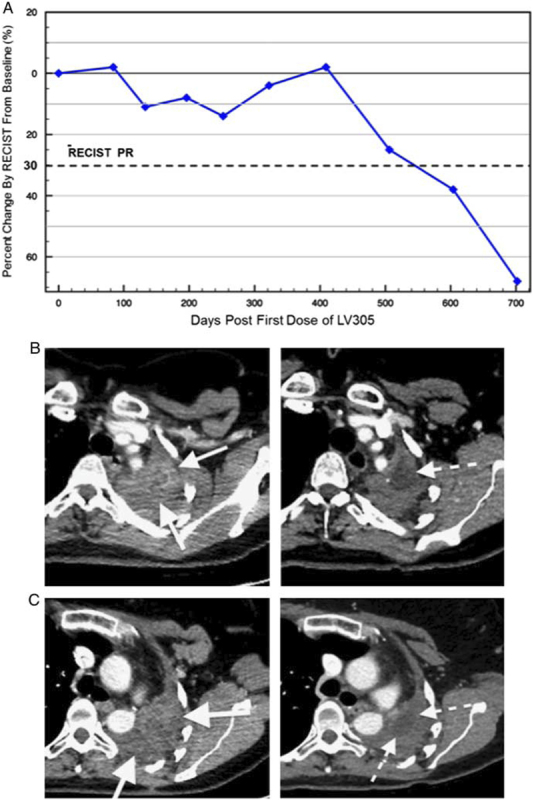
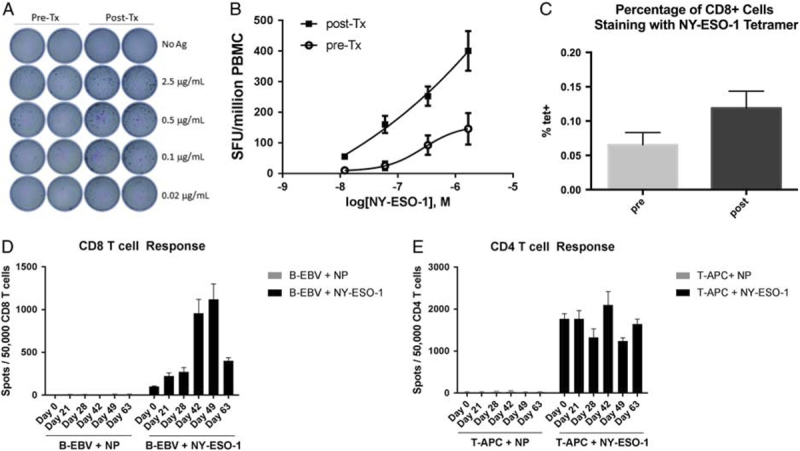
Effective induction of antitumor T cells is a pivotal goal of cancer immunotherapy. To this end, lentiviral vectors (LV) are uniquely poised to directly prime CD8 T-cell responses via transduction of dendritic cells in vivo and have shown promise as active cancer therapeutics in preclinical tumor models. However, until now, significant barriers related to production and regulation have prevented their widespread use in the clinic. We developed LV305, a dendritic cell-targeting, integration-deficient, replication incompetent LV from the ZVex platform, encoding the full-length cancer-testis antigen NY-ESO-1. LV305 is currently being evaluated in phase 1 and 2 trials in metastatic recurrent cancer patients with NY-ESO-1 positive solid tumors as a single agent and in combination with anti-PD-L1. Here we report on the first patient treated with LV305, a young woman with metastatic, recurrent, therapy-refractive NY-ESO-1 synovial sarcoma. The patient developed a robust NY-ESO-1-specific CD4 and CD8 T-cell response after 3 intradermal injections with LV305, and subsequently over 85% disease regression that is continuing for >2.5 years posttherapy. No adverse events >grade 2 occurred. This case demonstrates that LV305 can be safely administered and has the potential to induce a significant clinical benefit and immunologic response in a patient with advanced stage cancer.
有效诱导抗肿瘤 T 细胞是癌症免疫治疗的关键目标。为此,慢病毒载体 (LV) 通过体内转导树突状细胞,具有直接引发 CD8 T 细胞反应的独特优势,并在临床前肿瘤模型中作为活性癌症治疗药物显示出前景。然而,到目前为止,与生产和监管相关的重大障碍阻止了它们在临床上的广泛应用。我们开发了 LV305,这是一种来自 ZVex 平台的树突状细胞靶向、整合缺陷、复制失活的 LV,编码全长癌症睾丸抗原 NY-ESO-1。LV305 目前正在转移性复发性癌症患者中进行 1 期和 2 期临床试验,这些患者的 NY-ESO-1 阳性实体肿瘤为单一药物,与抗 PD-L1 联合使用。在这里,我们报告了首例接受 LV305 治疗的患者,该患者患有转移性、复发性、难治性 NY-ESO-1 滑膜肉瘤。该患者在接受 3 次 LV305 皮内注射后,产生了强烈的 NY-ESO-1 特异性 CD4 和 CD8 T 细胞反应,随后超过 85%的疾病消退,并且在治疗后持续超过 2.5 年。没有发生 >2 级的不良反应。该病例表明,LV305 可以安全给药,并且有可能在晚期癌症患者中诱导显著的临床获益和免疫反应。