
青蒿素分剂量给药并不提高抗疟治疗效果。
Split dosing of artemisinins does not improve antimalarial therapeutic efficacy.
机构信息
Mahidol Oxford Tropical Medicine Research Unit, Faculty of Tropical Medicine, Mahidol University, 420/6 Rajvithi Rd, Bangkok, 10400, Thailand.
Centre for Tropical Medicine & Global Health, Nuffield Department of Clinical Medicine, University of Oxford, Oxford, UK.
出版信息
Sci Rep. 2017 Sep 21;7(1):12132. doi: 10.1038/s41598-017-12483-4.
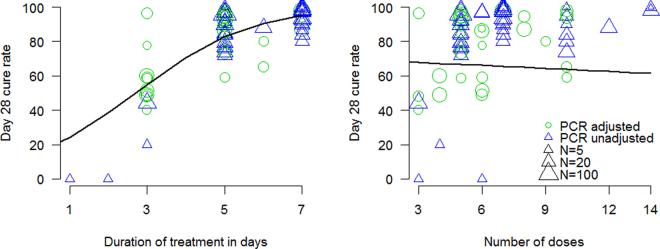
It has been suggested recently, based on pharmacokinetic-pharmacodynamic modelling exercises, that twice daily dosing of artemisinins increases malaria parasite killing and so could "dramatically enhance and restore drug effectiveness" in artemisinin resistant P. falciparum malaria infections. It was recommended that split dosing should be incorporated into all artemisinin combination regimen designs. To explain why parasite clearance rates were not faster with split dose regimens it was concluded that splenic malaria parasite clearance capacity was readily exceeded, resulting in the accumulation of dead parasites in the circulation, that parasite clearance was therefore an unreliable measure of drug efficacy, and instead that human immunity is the primary determinant of clearance rates. To test these various hypotheses we performed a logistic meta-regression analysis of cure rates from all falciparum malaria treatment trials (n = 40) with monotherapy arms containing artemisinin or a derivative (76 arms). There was no evidence that split dosing enhanced cure rates.
最近有人提出,基于药代动力学-药效学建模研究,青蒿素类药物每日两次给药可增强疟原虫杀伤作用,因此可能“显著增强和恢复青蒿素耐药疟原虫感染的药物疗效”。有人建议,在所有青蒿素联合治疗方案设计中应纳入分剂量给药。为了解释为什么分剂量方案未能使寄生虫清除率更快,研究得出的结论是,脾脏清除疟原虫的能力很容易被超过,导致死寄生虫在循环中积累,因此寄生虫清除率不是药物疗效的可靠衡量标准,相反,人类免疫力是清除率的主要决定因素。为了验证这些不同的假设,我们对所有含青蒿素或其衍生物的单纯治疗试验(n=40)的治愈率(76 个治疗组)进行了逻辑回归分析。没有证据表明分剂量给药能提高治愈率。
 Zotero 插件