• 文献检索
  • 文档翻译
  • 深度研究
  • 学术资讯
  • Suppr Zotero 插件Zotero 插件
  • 邀请有礼
  • 套餐&价格
  • 历史记录
应用&插件
Suppr Zotero 插件Zotero 插件浏览器插件Mac 客户端Windows 客户端微信小程序
定价
高级版会员购买积分包购买API积分包
服务
文献检索文档翻译深度研究API 文档MCP 服务
关于我们
关于 Suppr公司介绍联系我们用户协议隐私条款
关注我们

Suppr 超能文献

核心技术专利:CN118964589B侵权必究
粤ICP备2023148730 号-1Suppr @ 2026

文献检索

告别复杂PubMed语法,用中文像聊天一样搜索,搜遍4000万医学文献。AI智能推荐,让科研检索更轻松。

立即免费搜索

文件翻译

保留排版,准确专业,支持PDF/Word/PPT等文件格式,支持 12+语言互译。

免费翻译文档

深度研究

AI帮你快速写综述,25分钟生成高质量综述,智能提取关键信息,辅助科研写作。

立即免费体验

一种基于模型的3D描述符的自动表面检测方法。

A Method for Automatic Surface Inspection Using a Model-Based 3D Descriptor.

作者信息

Madrigal Carlos A, Branch John W, Restrepo Alejandro, Mery Domingo

机构信息

Departamento de Ingeniería Electrónica, Instituto Tecnológico Metropolitano, Medellín 050013, Colombia.

Facultad de Minas, Universidad Nacional de Colombia, Medellín 050041, Colombia.

出版信息

Sensors (Basel). 2017 Oct 2;17(10):2262. doi: 10.3390/s17102262.

DOI:10.3390/s17102262
PMID:28974037
原文链接:https://pmc.ncbi.nlm.nih.gov/articles/PMC5676666/
Abstract

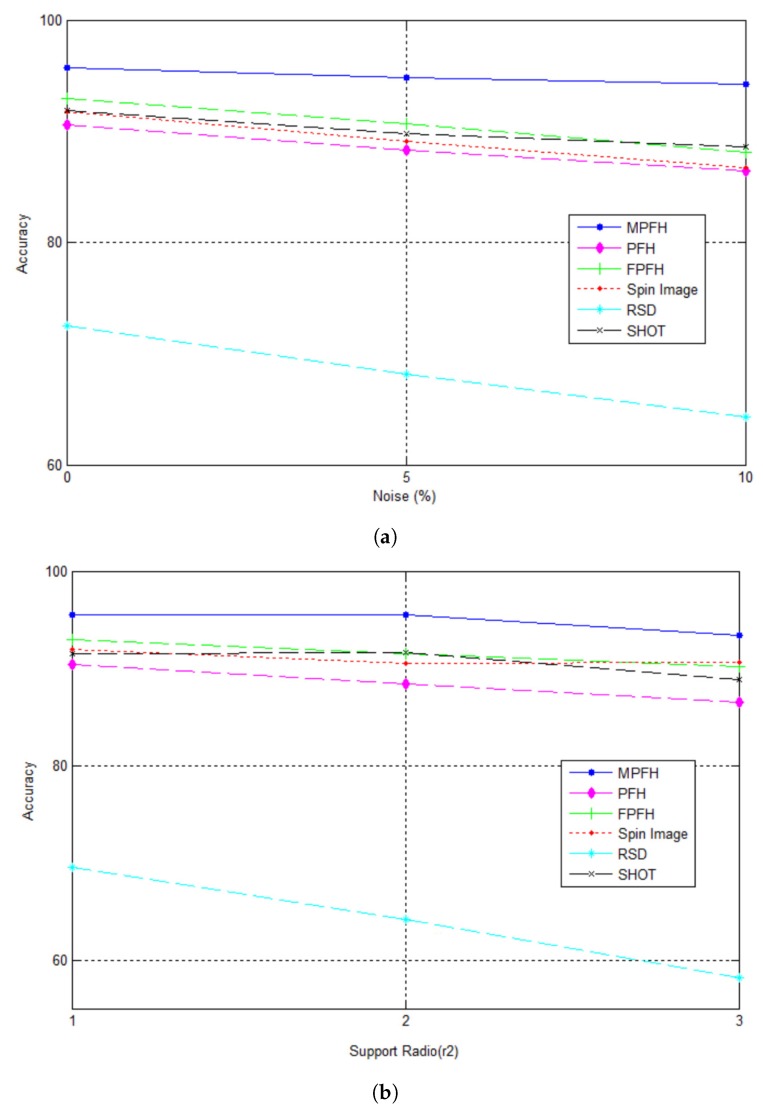
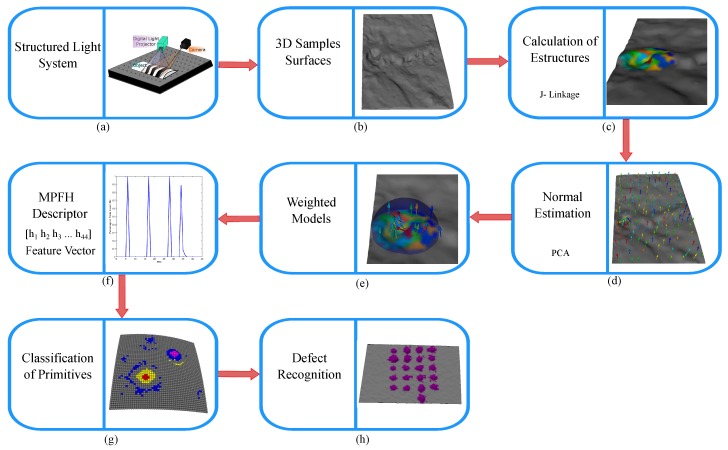
Automatic visual inspection allows for the identification of surface defects in manufactured parts. Nevertheless, when defects are on a sub-millimeter scale, detection and recognition are a challenge. This is particularly true when the defect generates topological deformations that are not shown with strong contrast in the 2D image. In this paper, we present a method for recognizing surface defects in 3D point clouds. Firstly, we propose a novel 3D local descriptor called the Model Point Feature Histogram (MPFH) for defect detection. Our descriptor is inspired from earlier descriptors such as the Point Feature Histogram (PFH). To construct the MPFH descriptor, the models that best fit the local surface and their normal vectors are estimated. For each surface model, its contribution weight to the formation of the surface region is calculated and from the relative difference between models of the same region a histogram is generated representing the underlying surface changes. Secondly, through a classification stage, the points on the surface are labeled according to five types of primitives and the defect is detected. Thirdly, the connected components of primitives are projected to a plane, forming a 2D image. Finally, 2D geometrical features are extracted and by a support vector machine, the defects are recognized. The database used is composed of 3D simulated surfaces and 3D reconstructions of defects in welding, artificial teeth, indentations in materials, ceramics and 3D models of defects. The quantitative and qualitative results showed that the proposed method of description is robust to noise and the scale factor, and it is sufficiently discriminative for detecting some surface defects. The performance evaluation of the proposed method was performed for a classification task of the 3D point cloud in primitives, reporting an accuracy of 95%, which is higher than for other state-of-art descriptors. The rate of recognition of defects was close to 94%.

摘要

自动视觉检测能够识别制造零件中的表面缺陷。然而,当缺陷处于亚毫米尺度时,检测和识别就成为一项挑战。当缺陷产生的拓扑变形在二维图像中没有强烈对比显示时,情况尤其如此。在本文中,我们提出了一种用于识别三维点云中表面缺陷的方法。首先,我们提出了一种名为模型点特征直方图(MPFH)的新型三维局部描述符用于缺陷检测。我们的描述符受到诸如点特征直方图(PFH)等早期描述符的启发。为了构建MPFH描述符,需要估计最适合局部表面的模型及其法向量。对于每个表面模型,计算其对表面区域形成的贡献权重,并根据同一区域模型之间的相对差异生成一个直方图,以表示潜在的表面变化。其次,通过一个分类阶段,根据五种原语类型对表面上的点进行标记并检测缺陷。第三,将原语的连通分量投影到一个平面上,形成一幅二维图像。最后,提取二维几何特征,并通过支持向量机识别缺陷。所使用的数据库由三维模拟表面以及焊接、人造牙齿、材料压痕、陶瓷中的缺陷三维重建和缺陷三维模型组成。定量和定性结果表明,所提出的描述方法对噪声和比例因子具有鲁棒性,并且对于检测某些表面缺陷具有足够的区分能力。针对三维点云在原语中的分类任务对所提出方法进行了性能评估,报告的准确率为95%,高于其他现有描述符。缺陷识别率接近94%。
https://cdn.ncbi.nlm.nih.gov/pmc/blobs/ec36/5676666/c964117684a2/sensors-17-02262-g015.jpg
https://cdn.ncbi.nlm.nih.gov/pmc/blobs/ec36/5676666/ae4add8625ea/sensors-17-02262-g001.jpg
https://cdn.ncbi.nlm.nih.gov/pmc/blobs/ec36/5676666/74169792bdb5/sensors-17-02262-g002.jpg
https://cdn.ncbi.nlm.nih.gov/pmc/blobs/ec36/5676666/c9cb00ffe412/sensors-17-02262-g003.jpg
https://cdn.ncbi.nlm.nih.gov/pmc/blobs/ec36/5676666/a4d03684b196/sensors-17-02262-g004.jpg
https://cdn.ncbi.nlm.nih.gov/pmc/blobs/ec36/5676666/b06e7f0883ed/sensors-17-02262-g005.jpg
https://cdn.ncbi.nlm.nih.gov/pmc/blobs/ec36/5676666/5e03b42137d5/sensors-17-02262-g006.jpg
https://cdn.ncbi.nlm.nih.gov/pmc/blobs/ec36/5676666/5efef5883ed9/sensors-17-02262-g007.jpg
https://cdn.ncbi.nlm.nih.gov/pmc/blobs/ec36/5676666/46fbca132bd1/sensors-17-02262-g008.jpg
https://cdn.ncbi.nlm.nih.gov/pmc/blobs/ec36/5676666/a1f0962f0270/sensors-17-02262-g009.jpg
https://cdn.ncbi.nlm.nih.gov/pmc/blobs/ec36/5676666/be7d0708fa1a/sensors-17-02262-g010.jpg
https://cdn.ncbi.nlm.nih.gov/pmc/blobs/ec36/5676666/40469ff9815b/sensors-17-02262-g011.jpg
https://cdn.ncbi.nlm.nih.gov/pmc/blobs/ec36/5676666/67299a2e098e/sensors-17-02262-g012a.jpg
https://cdn.ncbi.nlm.nih.gov/pmc/blobs/ec36/5676666/ea888ddf7732/sensors-17-02262-g013.jpg
https://cdn.ncbi.nlm.nih.gov/pmc/blobs/ec36/5676666/753b8fb27e7e/sensors-17-02262-g014.jpg
https://cdn.ncbi.nlm.nih.gov/pmc/blobs/ec36/5676666/c964117684a2/sensors-17-02262-g015.jpg
https://cdn.ncbi.nlm.nih.gov/pmc/blobs/ec36/5676666/ae4add8625ea/sensors-17-02262-g001.jpg
https://cdn.ncbi.nlm.nih.gov/pmc/blobs/ec36/5676666/74169792bdb5/sensors-17-02262-g002.jpg
https://cdn.ncbi.nlm.nih.gov/pmc/blobs/ec36/5676666/c9cb00ffe412/sensors-17-02262-g003.jpg
https://cdn.ncbi.nlm.nih.gov/pmc/blobs/ec36/5676666/a4d03684b196/sensors-17-02262-g004.jpg
https://cdn.ncbi.nlm.nih.gov/pmc/blobs/ec36/5676666/b06e7f0883ed/sensors-17-02262-g005.jpg
https://cdn.ncbi.nlm.nih.gov/pmc/blobs/ec36/5676666/5e03b42137d5/sensors-17-02262-g006.jpg
https://cdn.ncbi.nlm.nih.gov/pmc/blobs/ec36/5676666/5efef5883ed9/sensors-17-02262-g007.jpg
https://cdn.ncbi.nlm.nih.gov/pmc/blobs/ec36/5676666/46fbca132bd1/sensors-17-02262-g008.jpg
https://cdn.ncbi.nlm.nih.gov/pmc/blobs/ec36/5676666/a1f0962f0270/sensors-17-02262-g009.jpg
https://cdn.ncbi.nlm.nih.gov/pmc/blobs/ec36/5676666/be7d0708fa1a/sensors-17-02262-g010.jpg
https://cdn.ncbi.nlm.nih.gov/pmc/blobs/ec36/5676666/40469ff9815b/sensors-17-02262-g011.jpg
https://cdn.ncbi.nlm.nih.gov/pmc/blobs/ec36/5676666/67299a2e098e/sensors-17-02262-g012a.jpg
https://cdn.ncbi.nlm.nih.gov/pmc/blobs/ec36/5676666/ea888ddf7732/sensors-17-02262-g013.jpg
https://cdn.ncbi.nlm.nih.gov/pmc/blobs/ec36/5676666/753b8fb27e7e/sensors-17-02262-g014.jpg
https://cdn.ncbi.nlm.nih.gov/pmc/blobs/ec36/5676666/c964117684a2/sensors-17-02262-g015.jpg

相似文献

1
A Method for Automatic Surface Inspection Using a Model-Based 3D Descriptor.一种基于模型的3D描述符的自动表面检测方法。
Sensors (Basel). 2017 Oct 2;17(10):2262. doi: 10.3390/s17102262.
2
A Deep-Learning-based 3D Defect Quantitative Inspection System in CC Products Surface.基于深度学习的 CC 产品表面 3D 缺陷定量检测系统。
Sensors (Basel). 2020 Feb 12;20(4):980. doi: 10.3390/s20040980.
3
Three-Dimensional Object Recognition and Registration for Robotic Grasping Systems Using a Modified Viewpoint Feature Histogram.使用改进的视点特征直方图的机器人抓取系统的三维物体识别与配准
Sensors (Basel). 2016 Nov 23;16(11):1969. doi: 10.3390/s16111969.
4
PPTFH: Robust Local Descriptor Based on Point-Pair Transformation Features for 3D Surface Matching.PPTFH:基于点对变换特征的鲁棒局部描述符用于3D表面匹配。
Sensors (Basel). 2021 May 7;21(9):3229. doi: 10.3390/s21093229.
5
An Automatic Surface Defect Inspection System for Automobiles Using Machine Vision Methods.基于机器视觉的汽车表面自动缺陷检测系统。
Sensors (Basel). 2019 Feb 4;19(3):644. doi: 10.3390/s19030644.
6
Automatic point cloud registration algorithm based on the feature histogram of local surface.基于局部曲面特征直方图的自动点云配准算法。
PLoS One. 2020 Sep 11;15(9):e0238802. doi: 10.1371/journal.pone.0238802. eCollection 2020.
7
Surface Defect Detection of Cabbage Based on Curvature Features of 3D Point Cloud.基于三维点云曲率特征的甘蓝表面缺陷检测
Front Plant Sci. 2022 Jul 14;13:942040. doi: 10.3389/fpls.2022.942040. eCollection 2022.
8
Recognizing objects in 3D point clouds with multi-scale local features.利用多尺度局部特征在三维点云中识别物体。
Sensors (Basel). 2014 Dec 15;14(12):24156-73. doi: 10.3390/s141224156.
9
Mining compact bag-of-patterns for low bit rate mobile visual search.挖掘紧凑的模式袋以用于低比特率移动视觉搜索。
IEEE Trans Image Process. 2014 Jul;23(7):3099-113. doi: 10.1109/TIP.2014.2324291.
10
Registration of 3D point clouds using a local descriptor based on grid point normal.基于网格点法线的局部描述符对三维点云进行配准。
Appl Opt. 2021 Oct 1;60(28):8818-8828. doi: 10.1364/AO.437477.

引用本文的文献

1
A High-Precision Multi-Beam Optical Measurement Method for Cylindrical Surface Profile.一种用于圆柱面轮廓的高精度多光束光学测量方法。
Micromachines (Basel). 2023 Aug 3;14(8):1555. doi: 10.3390/mi14081555.
2
LiDAR-Based Structural Health Monitoring: Applications in Civil Infrastructure Systems.基于激光雷达的结构健康监测:在民用基础设施系统中的应用。
Sensors (Basel). 2022 Jun 18;22(12):4610. doi: 10.3390/s22124610.
3
Non-Contact Body Measurement for Qinchuan Cattle with LiDAR Sensor.基于 LiDAR 传感器的秦川牛非接触体尺测量

本文引用的文献

1
Online fabric defect inspection using smart visual sensors.基于智能视觉传感器的在线织物缺陷检测。
Sensors (Basel). 2013 Apr 9;13(4):4659-73. doi: 10.3390/s130404659.
Sensors (Basel). 2018 Sep 9;18(9):3014. doi: 10.3390/s18093014.
4
Automatic Fabric Defect Detection with a Multi-Scale Convolutional Denoising Autoencoder Network Model.基于多尺度卷积去噪自动编码器网络模型的织物缺陷自动检测
Sensors (Basel). 2018 Apr 2;18(4):1064. doi: 10.3390/s18041064.