Smith James M, Moss John A, Srinivasan Priya, Butkyavichene Irina, Gunawardana Manjula, Fanter Rob, Miller Christine S, Sanchez Debbie, Yang Flora, Ellis Shanon, Zhang Jining, Marzinke Mark A, Hendrix Craig W, Kapoor Amita, Baum Marc M
Laboratory Branch, Division of HIV/AIDS Prevention, National Center for HIV/AIDS, Viral Hepatitis, STD, and TB Prevention, Centers for Disease Control and Prevention, Atlanta, Georgia, United States of America.
Department of Chemistry, Oak Crest Institute of Science, Monrovia, California, United States of America.
PLoS One. 2017 Oct 5;12(10):e0185946. doi: 10.1371/journal.pone.0185946. eCollection 2017.
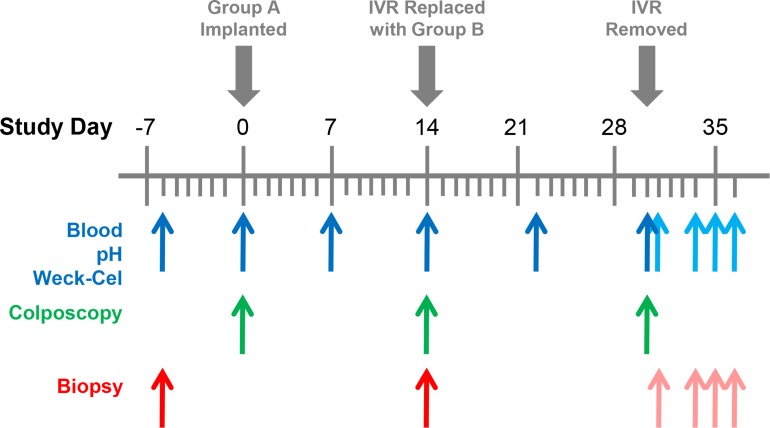
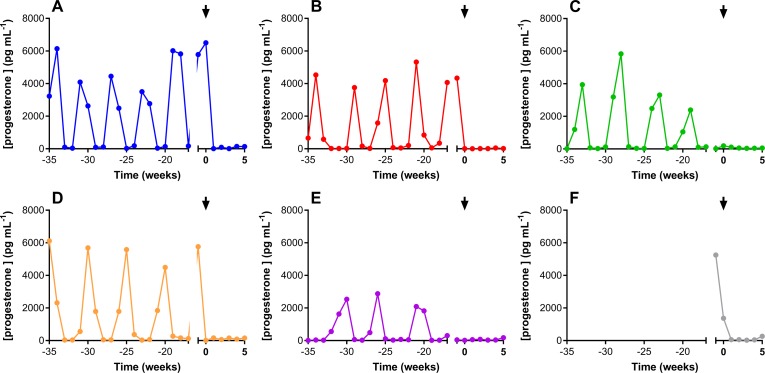
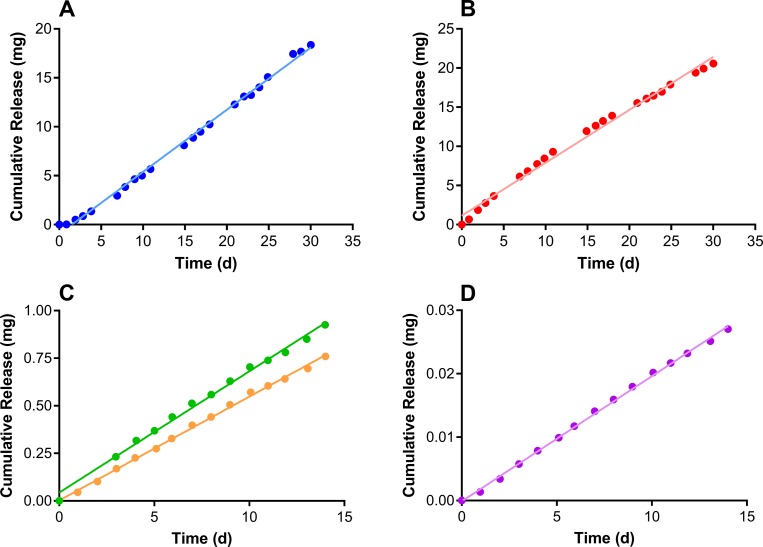
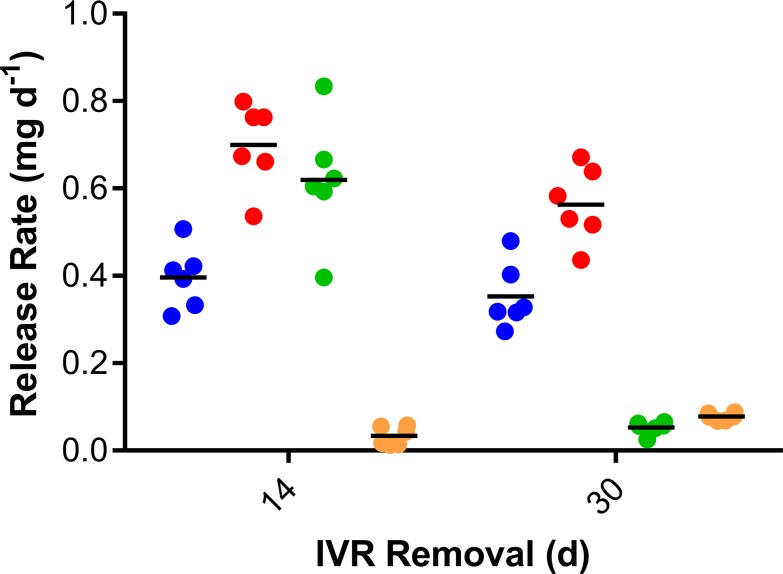
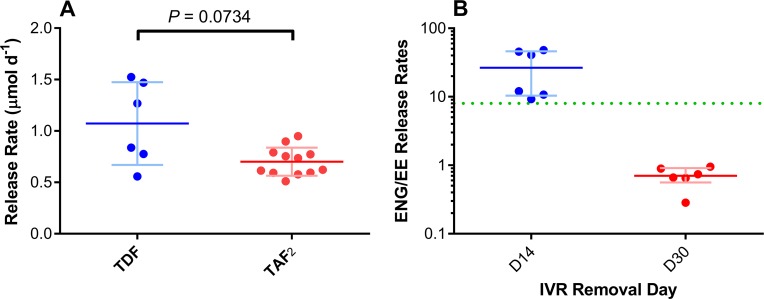
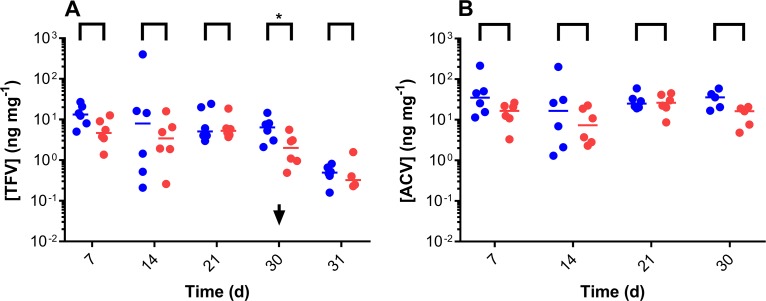
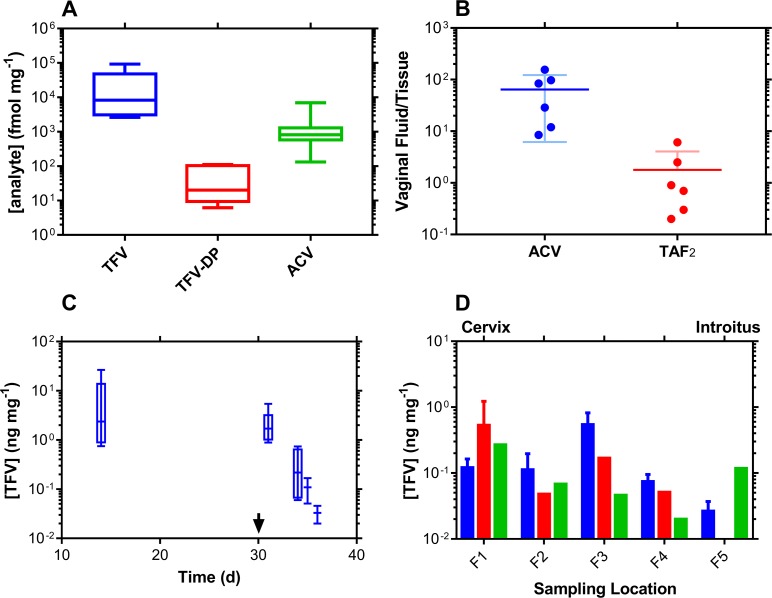
Globally, women bear an uneven burden for sexual HIV acquisition. Results from two clinical trials evaluating intravaginal rings (IVRs) delivering the antiretroviral agent dapivirine have shown that protection from HIV infection can be achieved with this modality, but high adherence is essential. Multipurpose prevention technologies (MPTs) can potentially increase product adherence by offering protection against multiple vaginally transmitted infections and unintended pregnancy. Here we describe a coitally independent, long-acting pod-IVR MPT that could potentially prevent HIV and HSV infection as well as unintended pregnancy. The pharmacokinetics of MPT pod-IVRs delivering tenofovir alafenamide hemifumarate (TAF2) to prevent HIV, acyclovir (ACV) to prevent HSV, and etonogestrel (ENG) in combination with ethinyl estradiol (EE), FDA-approved hormonal contraceptives, were evaluated in pigtailed macaques (N = 6) over 35 days. Pod IVRs were exchanged at 14 days with the only modification being lower ENG release rates in the second IVR. Plasma progesterone was monitored weekly to determine the effect of ENG/EE on menstrual cycle. The mean in vivo release rates (mg d-1) for the two formulations over 30 days ranged as follows: TAF2 0.35-0.40; ACV 0.56-0.70; EE 0.03-0.08; ENG (high releasing) 0.63; and ENG (low releasing) 0.05. Mean peak progesterone levels were 4.4 ± 1.8 ng mL-1 prior to IVR insertion and 0.075 ± 0.064 ng mL-1 for 5 weeks after insertion, suggesting that systemic EE/ENG levels were sufficient to suppress menstruation. The TAF2 and ACV release rates and resulting vaginal tissue drug concentrations (medians: TFV, 2.4 ng mg-1; ACV, 0.2 ng mg-1) may be sufficient to protect against HIV and HSV infection, respectively. This proof of principle study demonstrates that MPT-pod IVRs could serve as a potent biomedical prevention tool to protect women's sexual and reproductive health and may increase adherence to HIV PrEP even among younger high-risk populations.
在全球范围内,女性在通过性行为感染艾滋病毒方面承受着不均衡的负担。两项评估递送抗逆转录病毒药物达匹韦林的阴道环(IVR)的临床试验结果表明,采用这种方式可以实现预防艾滋病毒感染,但高依从性至关重要。多功能预防技术(MPT)通过提供针对多种经阴道传播感染和意外怀孕的防护,有可能提高产品依从性。在此,我们描述了一种独立于性交的长效豆荚式IVR MPT,它有可能预防艾滋病毒和单纯疱疹病毒(HSV)感染以及意外怀孕。在35天内,对6只猪尾猕猴评估了递送替诺福韦艾拉酚胺半富马酸盐(TAF2)以预防艾滋病毒、阿昔洛韦(ACV)以预防HSV以及依托孕烯(ENG)与炔雌醇(EE,美国食品药品监督管理局批准的激素避孕药)联合使用的MPT豆荚式IVR的药代动力学。在第14天更换豆荚式IVR,唯一的改变是第二个IVR中ENG的释放速率较低。每周监测血浆孕酮以确定ENG/EE对月经周期的影响。两种制剂在30天内的平均体内释放速率(mg d-1)如下:TAF2 0.35 - 0.40;ACV 0.56 - 0.70;EE 0.03 - 0.08;ENG(高释放)0.63;ENG(低释放)0.05。IVR插入前孕酮平均峰值水平为4.4±1.8 ng mL-1,插入后5周为0.075±0.064 ng mL-1,这表明全身EE/ENG水平足以抑制月经。TAF2和ACV的释放速率以及由此产生(中位数:替诺福韦,2.4 ng mg-1;ACV,0.2 ng mg-1)的阴道组织药物浓度可能分别足以预防艾滋病毒和HSV感染。这项原理验证研究表明,MPT豆荚式IVR可作为一种有效的生物医学预防工具,保护女性的性健康和生殖健康,甚至可能提高年轻高危人群对艾滋病毒暴露前预防(PrEP)的依从性。