Meertens Linda Jacqueline Elisabeth, Scheepers Hubertina Cj, De Vries Raymond G, Dirksen Carmen D, Korstjens Irene, Mulder Antonius Lm, Nieuwenhuijze Marianne J, Nijhuis Jan G, Spaanderman Marc Ea, Smits Luc Jm
Care and Public Health Research Institute (CAPHRI), Department of Epidemiology, Maastricht University, Maastricht, Netherlands.
School for Oncology and Developmental Biology (GROW), Department of Obstetrics and Gynecology, Maastricht University Medical Centre, Maastricht, Netherlands.
JMIR Res Protoc. 2017 Oct 26;6(10):e203. doi: 10.2196/resprot.7837.
A number of first-trimester prediction models addressing important obstetric outcomes have been published. However, most models have not been externally validated. External validation is essential before implementing a prediction model in clinical practice.
The objective of this paper is to describe the design of a study to externally validate existing first trimester obstetric prediction models, based upon maternal characteristics and standard measurements (eg, blood pressure), for the risk of pre-eclampsia (PE), gestational diabetes mellitus (GDM), spontaneous preterm birth (PTB), small-for-gestational-age (SGA) infants, and large-for-gestational-age (LGA) infants among Dutch pregnant women (Expect Study I). The results of a pilot study on the feasibility and acceptability of the recruitment process and the comprehensibility of the Pregnancy Questionnaire 1 are also reported.
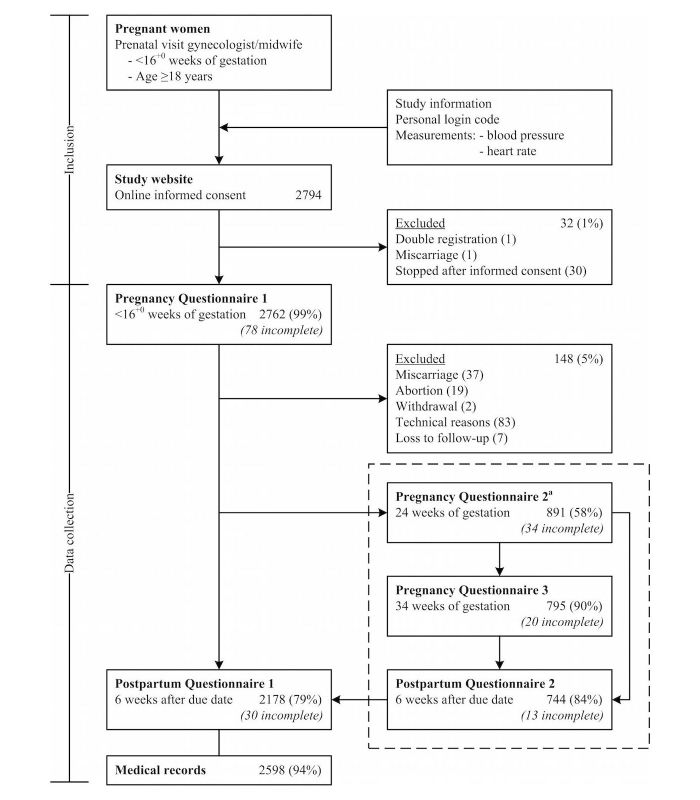
A multicenter prospective cohort study was performed in The Netherlands between July 1, 2013 and December 31, 2015. First trimester obstetric prediction models were systematically selected from the literature. Predictor variables were measured by the Web-based Pregnancy Questionnaire 1 and pregnancy outcomes were established using the Postpartum Questionnaire 1 and medical records. Information about maternal health-related quality of life, costs, and satisfaction with Dutch obstetric care was collected from a subsample of women. A pilot study was carried out before the official start of inclusion. External validity of the models will be evaluated by assessing discrimination and calibration.
Based on the pilot study, minor improvements were made to the recruitment process and online Pregnancy Questionnaire 1. The validation cohort consists of 2614 women. Data analysis of the external validation study is in progress.
This study will offer insight into the generalizability of existing, non-invasive first trimester prediction models for various obstetric outcomes in a Dutch obstetric population. An impact study for the evaluation of the best obstetric prediction models in the Dutch setting with respect to their effect on clinical outcomes, costs, and quality of life-Expect Study II-is being planned.
Netherlands Trial Registry (NTR): NTR4143; http://www.trialregister.nl/trialreg/admin/rctview.asp?TC=4143 (Archived by WebCite at http://www.webcitation.org/6t8ijtpd9).
已经发表了许多针对重要产科结局的孕早期预测模型。然而,大多数模型尚未经过外部验证。在临床实践中应用预测模型之前,外部验证至关重要。
本文的目的是描述一项研究的设计,该研究旨在基于孕妇特征和标准测量值(如血压),对荷兰孕妇子痫前期(PE)、妊娠期糖尿病(GDM)、自发性早产(PTB)、小于胎龄儿(SGA)和大于胎龄儿(LGA)的风险,对现有的孕早期产科预测模型进行外部验证(期望研究I)。还报告了一项关于招募过程的可行性和可接受性以及妊娠问卷1的可理解性的试点研究结果。
2013年7月1日至2015年12月31日在荷兰进行了一项多中心前瞻性队列研究。从文献中系统地选择孕早期产科预测模型。预测变量通过基于网络的妊娠问卷1进行测量,妊娠结局通过产后问卷1和医疗记录确定。从一部分女性子样本中收集有关孕产妇健康相关生活质量、成本以及对荷兰产科护理满意度的信息。在正式纳入研究开始前进行了一项试点研究。将通过评估区分度和校准来评估模型的外部有效性。
基于试点研究,对招募过程和在线妊娠问卷1进行了一些小的改进。验证队列由2614名女性组成。外部验证研究的数据分析正在进行中。
本研究将深入了解现有非侵入性孕早期预测模型在荷兰产科人群中对各种产科结局的可推广性。正在计划一项影响研究,以评估荷兰环境中最佳产科预测模型对临床结局、成本和生活质量的影响——期望研究II。
荷兰试验注册中心(NTR):NTR4143;http://www.trialregister.nl/trialreg/admin/rctview.asp?TC=4143(由WebCite存档于http://www.webcitation.org/6t8ijtpd9)