
维生素 E(α-生育酚)通过减轻氧化应激和半胱天冬酶-3 的激活来改善马兜铃酸诱导的肾小管上皮细胞死亡。
Vitamin E (α‑tocopherol) ameliorates aristolochic acid‑induced renal tubular epithelial cell death by attenuating oxidative stress and caspase‑3 activation.
机构信息
China Medical University and Academia Sinica, Taichung 404, Taiwan, R.O.C.
Division of Renal Medicine, Tungs' Taichung Metroharbor Hospital, Taichung 435, Taiwan, R.O.C.
出版信息
Mol Med Rep. 2018 Jan;17(1):31-36. doi: 10.3892/mmr.2017.7921. Epub 2017 Oct 27.
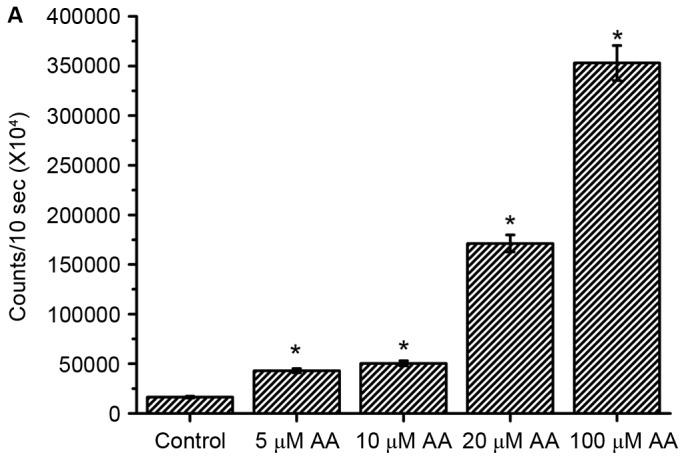
Aristolochic acid (AA) is a component identified in traditional Chinese remedies for the treatment of arthritic pain, coughs and gastrointestinal symptoms. However, previous studies have indicated that AA can induce oxidative stress in renal cells leading to nephropathy. α‑tocopherol exists in numerous types of food, such as nuts, and belongs to the vitamin E isoform family. It possesses antioxidant activities and has been used previously for clinical applications. Therefore, the aim of the present study was to determine whether α‑tocopherol could reduce AA‑induced oxidative stress and renal cell cytotoxicity, determined by cell survival rate, reactive oxygen species detection and apoptotic features. The results indicated that AA markedly induced H2O2 levels and caspase‑3 activity in renal tubular epithelial cells. Notably, the presence of α‑tocopherol inhibited AA‑induced H2O2 and caspase‑3 activity. The present study demonstrated that antioxidant mechanisms of α‑tocopherol may be involved in the increased survival rates from AA‑induced cell injury.
马兜铃酸(AA)是一种被鉴定为用于治疗关节炎疼痛、咳嗽和胃肠道症状的传统中药成分。然而,先前的研究表明,AA 可诱导肾细胞中的氧化应激,从而导致肾病。α-生育酚存在于多种食物中,如坚果,并属于维生素 E 同型家族。它具有抗氧化活性,先前已用于临床应用。因此,本研究旨在确定 α-生育酚是否可以降低 AA 诱导的氧化应激和肾细胞细胞毒性,通过细胞存活率、活性氧检测和凋亡特征来确定。结果表明,AA 可显著诱导肾小管上皮细胞中的 H2O2 水平和 caspase-3 活性。值得注意的是,α-生育酚的存在抑制了 AA 诱导的 H2O2 和 caspase-3 活性。本研究表明,α-生育酚的抗氧化机制可能参与了 AA 诱导的细胞损伤导致的存活率增加。



 Zotero 插件