University of Arkansas for Medical Sciences, Brain Imaging Research Center, Psychiatric Research Institute, Little Rock, AR 72205, USA.
University of Arkansas, Department of Psychological Science, Fayetteville, AR 72701, USA.
Psychiatry Res. 2018 Jan;259:392-397. doi: 10.1016/j.psychres.2017.10.030. Epub 2017 Oct 22.
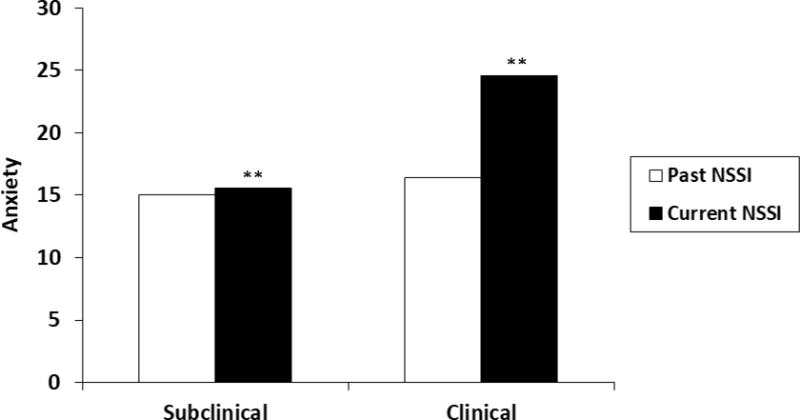
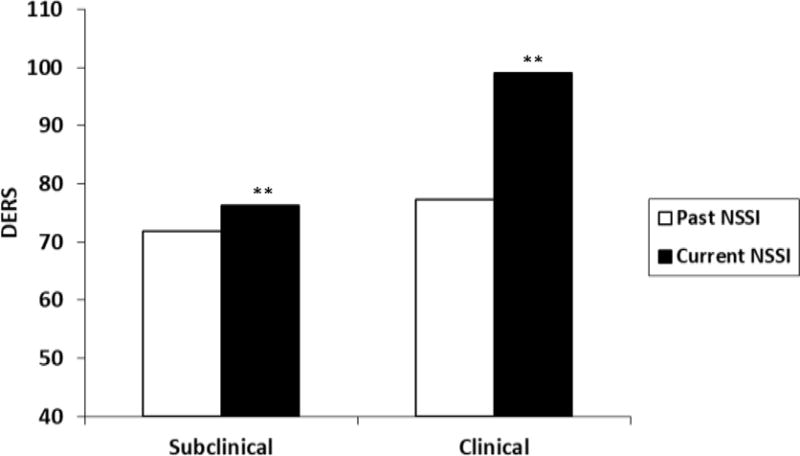
Research on nonsuicidal self-injury (NSSI) has moved beyond examination of factors that associate with the mere presence or absence of the behavior, and into more nuanced examination of which discrete features of NSSI behavior relate to pathology. This study examined two features of NSSI, frequency of occurrence and recency, as cross-sectional predictors of psychopathology in a large community sample of adults with a history of NSSI (N = 315). Results of 2 × 2 factorial ANOVAs testing the interactive effects of NSSI frequency (clinical, subclinical) and recency (current, past) revealed that current NSSI was consistently associated with poorer emotional and behavioral health (e.g., greater symptoms of depression, panic, and anxiety, worse emotion regulation, greater alcohol misuse). Results for NSSI frequency were more variable, though preliminary evidence suggested significant interactions of current NSSI and clinical frequency on emotion dysregulation, general anxiety, and panic. Possible clinical and empirical implications of the NSSI disorder frequency criteria proposed in DSM-5 are discussed.
非自杀性自伤(NSSI)的研究已经超越了对与行为存在或不存在相关的因素的研究,而是更加细致地研究了 NSSI 行为的哪些离散特征与病理学有关。本研究在一个有 NSSI 史的大型社区成人样本(N=315)中,考察了 NSSI 的两个特征,即发生频率和最近发生时间,作为横断面预测心理病理学的指标。2×2 因子方差分析检验 NSSI 频率(临床、亚临床)和最近发生时间(当前、过去)的交互效应的结果表明,当前的 NSSI 始终与较差的情绪和行为健康相关(例如,更多的抑郁、恐慌和焦虑症状,情绪调节更差,更多的酒精滥用)。NSSI 频率的结果更加多变,但初步证据表明,当前 NSSI 和临床频率在情绪失调、一般焦虑和恐慌方面存在显著的交互作用。讨论了 DSM-5 中提出的 NSSI 障碍频率标准的可能临床和实证意义。