Department of Psychology and Neuroscience Baylor University Waco TX USA.
Department of Biology Baylor University Waco TX USA.
Brain Behav. 2017 Oct 18;7(11):e00857. doi: 10.1002/brb3.857. eCollection 2017 Nov.
The goal of this study was to identify changes in quantitative and qualitative aspects of neonatal ultrasonic vocalizations USVs in neuron-subset specific (NS- knockout males and females when compared with wild-type male and female mice.
One signaling cascade that plays a crucial role in the development of an autistic-like phenotype is the PI3K/Akt/mTOR pathway. Mouse models that illustrate this connection include , and NS--deficient mice. While numerous studies have investigated ultrasonic vocalizations in knockout and heterogenous mice, none have investigated USVs in NS- knockout mice using a full spectrum recording system.
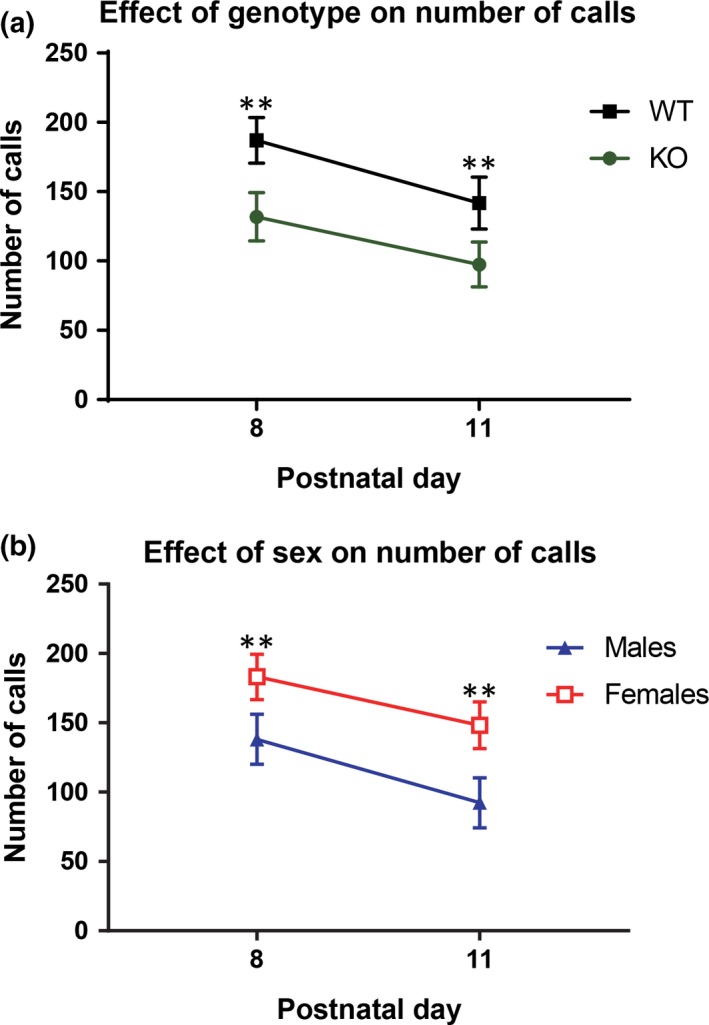
We recorded ultrasonic vocalizations from NS- wild-type and knockout male and female mice on postnatal days 8 and 11. On these days, we measured the number and quality of calls emitted from pups when they were removed from their mothers.
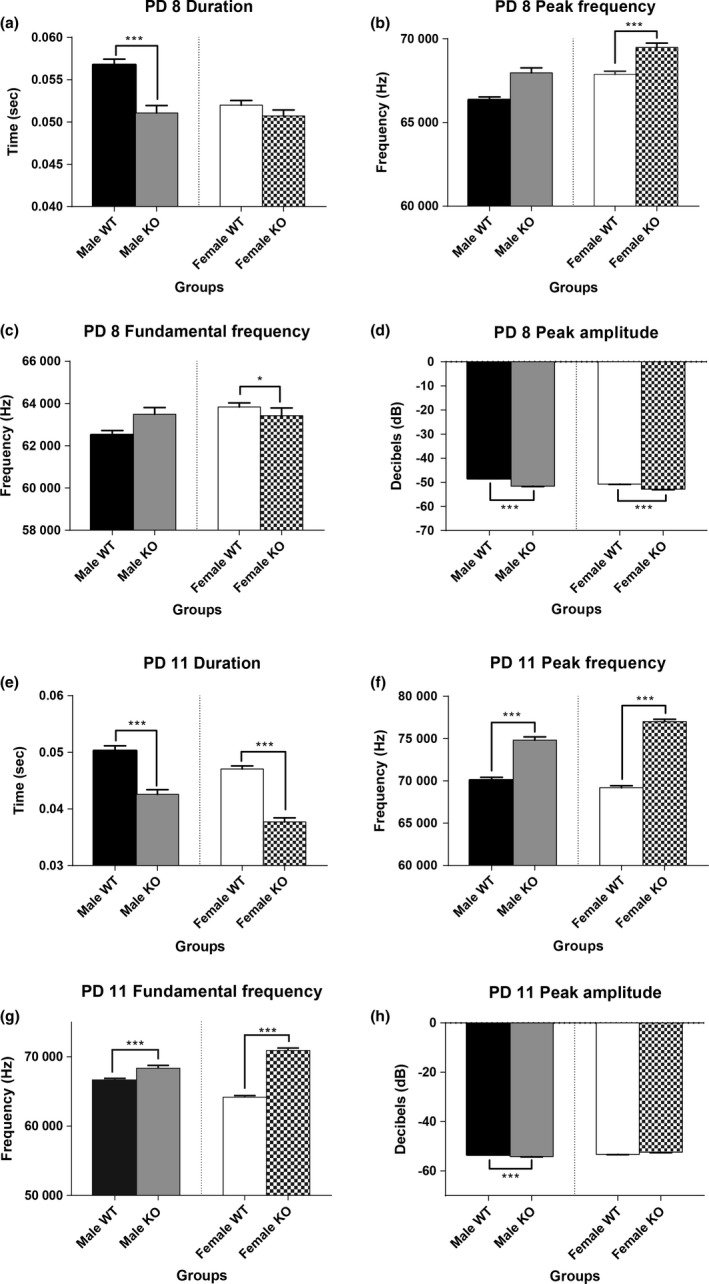
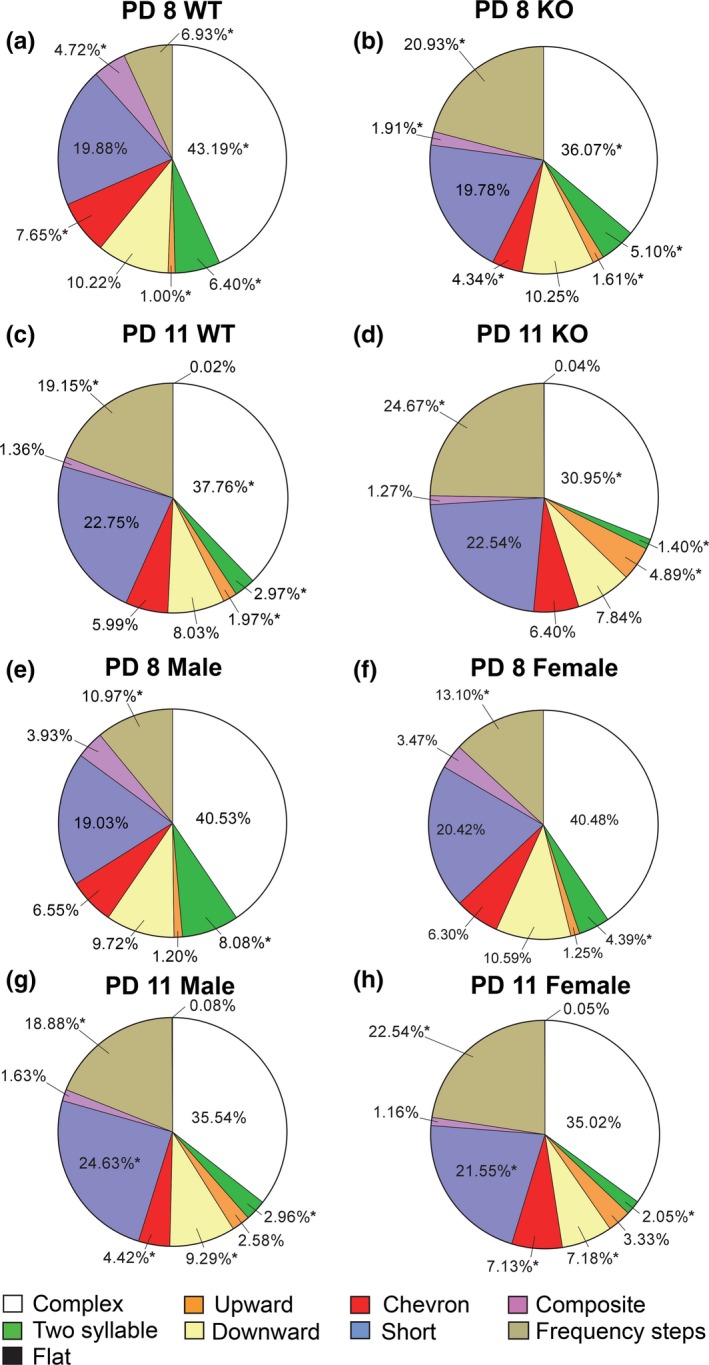
We found that knockout pups emitted fewer vocalizations for both sexes (<.05). Knockout males had calls of a shorter duration and lower peak amplitude on day 8, while showing a shorter duration, lower peak amplitude, and higher peak and fundamental frequency on day 11 (<.001). Knockout females vocalized at a lower peak amplitude and fundamental frequency, and a higher peak frequency on day 8, while showing a shorter duration and a higher peak and fundamental frequency on day 11 (<.001). Spectrographic analyses also revealed significant differences in call type for both genotypes and sexes (<.05).
These findings demonstrate that deletion of NS- results in significant decreases in vocalizations across both sexes. Additionally, our findings indicate that the aberrant vocalizations and increased call duration seen in other mTOR models are also present in NS- knockout mice. Our study provides evidence of a connection between hyperactive mTOR signaling and neonatal ultrasonic vocalizations.
本研究旨在鉴定神经元亚群特异性(NS-)敲除雄性和雌性小鼠与野生型雄性和雌性小鼠相比,其新生鼠超声发声(USV)在数量和质量方面的变化。
在自闭症样表型的发展中起关键作用的信号级联之一是 PI3K/Akt/mTOR 途径。说明了这种联系的小鼠模型包括 Tsc1 敲除和 Tsc2 敲除以及 NS-敲除小鼠。虽然许多研究已经调查了 Tsc1 敲除和 Tsc2 杂合小鼠的超声发声,但没有使用全谱记录系统研究 NS-敲除小鼠的 USV。
我们在出生后第 8 天和第 11 天记录了 NS-野生型和敲除雄性和雌性小鼠的超声发声。在这些日子里,我们测量了幼鼠从母亲身边移开时发出的叫声数量和质量。
我们发现,雄性和雌性 NS-敲除幼鼠的发声次数均减少(<0.05)。第 8 天,雄性 NS-敲除幼鼠的叫声持续时间和峰值幅度较短,而第 11 天,其叫声持续时间、峰值幅度较短,峰值和基频较高(<0.001)。第 8 天,雌性 NS-敲除幼鼠的叫声峰值幅度和基频较低,峰值频率较高,而第 11 天,其叫声持续时间较短,峰值和基频较高(<0.001)。声谱分析还显示,两种基因型和两种性别之间的叫声类型存在显著差异(<0.05)。
这些发现表明,NS-缺失导致两性的发声明显减少。此外,我们的发现表明,其他 mTOR 模型中存在的异常发声和叫声持续时间增加也存在于 NS-敲除小鼠中。我们的研究为过度活跃的 mTOR 信号与新生鼠超声发声之间的联系提供了证据。