Chitwood M Colter, Lashley Marcus A, Moorman Christopher E, DePerno Christopher S
Fisheries and Wildlife Sciences Department, University of Missouri, 302 Anheuser-Busch Natural Resources Building, Columbia, MO 65211 USA.
Present Address: Wildlife Biology Program, Department of Ecosystem and Conservation Sciences, University of Montana, 32 Campus Drive, Missoula, MT 59812 USA.
J Ethol. 2017;35(3):251-257. doi: 10.1007/s10164-017-0514-z. Epub 2017 Apr 18.
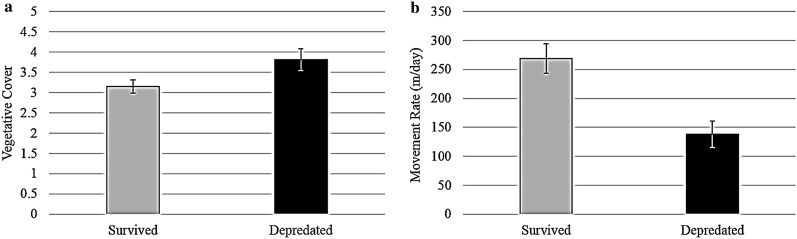
An evolutionary trap occurs when an organism makes a formerly adaptive decision that now results in a maladaptive outcome. Such traps can be induced by anthropogenic environmental changes, with nonnative species introductions being a leading cause. The recent establishment of coyotes () into the southeastern USA has the potential to change white-tailed deer () population dynamics through direct predation and behavioral adaptation. We used movement rate and bedsite characteristics of radiocollared neonates to evaluate their antipredator strategies in the context of novel predation risk in a structurally homogeneous, fire-maintained ecosystem. Neonate bedsites had greater plant cover values compared with random sites ( = 30.136; < 0.001), indicating bedsite selection was consistent with the hider strategy used to avoid predation. We determined selection gradients of coyote predation on neonate movement rate and plant cover and diversity at bedsites during the first 10 days of life. Interestingly, neonates that moved less and bedded in denser cover were more likely to be depredated by coyotes, meaning that greater neonate movement rate and bedsites located in less dense cover were favored by natural selection. These results are counter to expected antipredator strategies in white-tailed deer and exemplify how an adaptive response could be maladaptive in novel contexts.
当生物体做出一个曾经适应性的决策但现在却导致适应不良的结果时,就会出现进化陷阱。这种陷阱可能由人为环境变化引发,引入非本地物种是一个主要原因。最近郊狼进入美国东南部,有可能通过直接捕食和行为适应改变白尾鹿的种群动态。我们利用佩戴无线电项圈的新生鹿的移动速度和卧息地特征,在一个结构单一、由火灾维持的生态系统中,评估它们在面临新的捕食风险时的反捕食策略。与随机地点相比,新生鹿的卧息地有更高的植被覆盖率(F = 30.136;P < 0.001),这表明卧息地选择与用于避免被捕食的隐藏策略一致。我们确定了在新生鹿出生后的前10天里,郊狼对其移动速度以及卧息地的植被覆盖率和多样性的捕食选择梯度。有趣的是,移动较少且在植被更茂密的地方卧息的新生鹿更容易被郊狼捕食,这意味着更高的移动速度以及位于植被较稀疏地方的卧息地更受自然选择青睐。这些结果与白尾鹿预期的反捕食策略相反,例证了在新环境中适应性反应如何可能是适应不良的。