Department of Medical Environmental Biology and Tropical Medicine, School of Medicine, Kangwon National University, Chuncheon, Republic of Korea.
Department of Medical Research, Yangon, Myanmar.
Malar J. 2018 Jan 5;17(1):6. doi: 10.1186/s12936-017-2170-8.
As the prevalence of the malaria has been decreasing in many endemic countries including Myanmar, malaria elimination in Greater Mekong Region was targeted not later than 2030. The relevance of molecular and serological tools to identify residual transmission remains to be established in this setting.
One-year cohort study was conducted and sera samples were collected in every 3 months with active and passive case detection for clinical malaria episodes by RDT, microscopy and molecular method. The sera were used to detect the malaria antibody against PfMSP1-19, PvAMA1, PvDBPII and PvMSP1-19 by protein microarray.
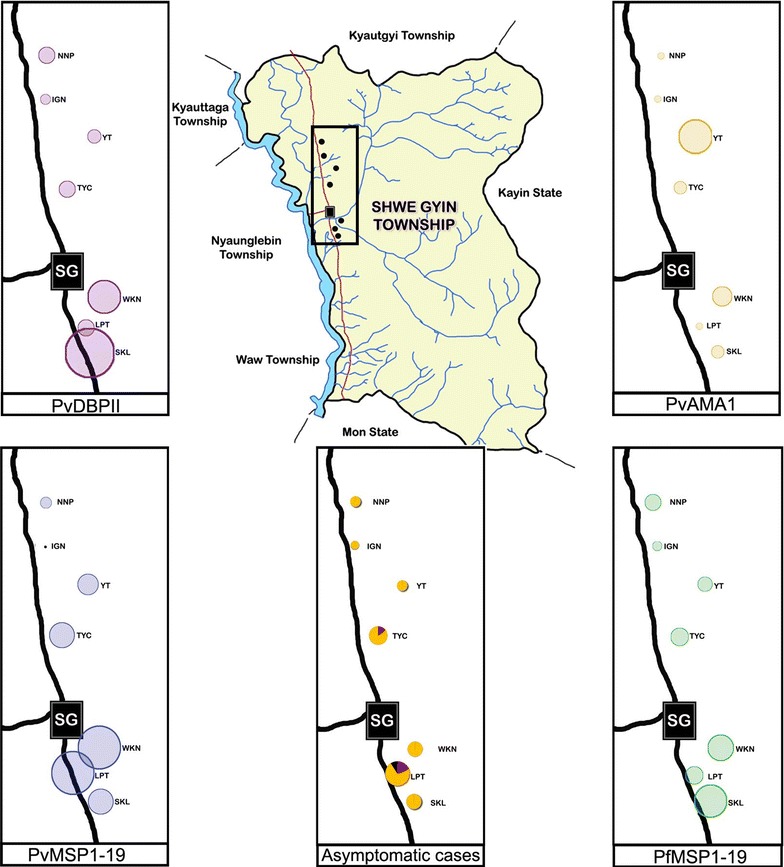
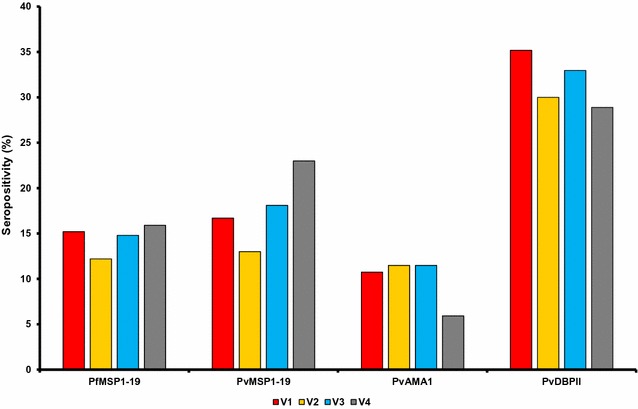
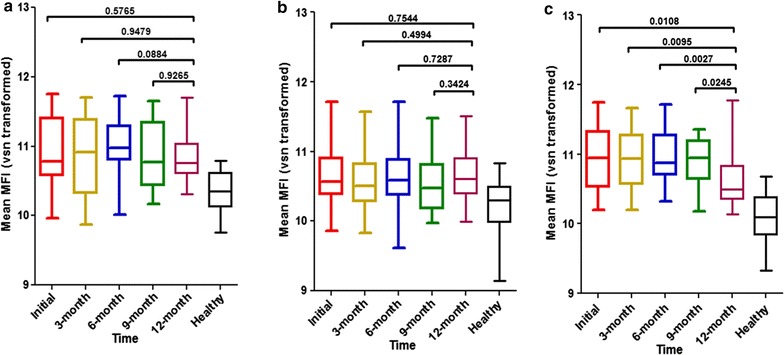
Among the recruited 1182 participants, there was no RDT positive case for malaria infection although two vivax infections were detected by microscopy in initial collection. Molecular methods detected the asymptomatic cases of 28/1182 (2.37%) in first, 5/894 (0.42%) in second, 12/944 (1.02%) in third, 6/889 (0.51%) in fourth collection, respectively. Seropositivity rates against the PfMSP1-19, PvMSP1-19, PvAMA1 and PvDBPII were 73/270 (27.0%), 85/270 (31.5%), 65/270 (24.1%) and 160/270 (59.3%), respectively. PfMSP1-19 and PvMSP1-19 showed high and stable antigenicity in acute and subacute samples but declining in 1-year history samples. No cross reactivity of PfMSP1-19 and PvMSP1-19 between the two species and higher seropositivity among the asymptomatic carriers were observed. Mapping data indicated serological surveillance can detect the geographical pattern of malaria infection under low transmission setting.
These findings support that PfMSP1-19 and PvMSP1-19 are suggested for serosurveillance of the malaria especially in low transmission setting for further necessary actions have to be carried out to eliminate the malaria.
随着包括缅甸在内的许多疟疾流行国家的疟疾发病率持续下降,大湄公河次区域的疟疾消除目标定在 2030 年之前。在这种情况下,分子和血清学工具对于确定残留传播的相关性仍有待确定。
进行了为期一年的队列研究,并通过 RDT、显微镜和分子方法进行主动和被动病例检测,每 3 个月采集一次血清样本,以检测临床疟疾病例。使用蛋白微阵列检测针对 PfMSP1-19、PvAMA1、PvDBPII 和 PvMSP1-19 的疟疾抗体。
在招募的 1182 名参与者中,虽然在初始采集时通过显微镜检测到两例间日疟感染,但没有 RDT 阳性的疟疾病例。分子方法分别在第一次、第二次、第三次和第四次采集时检测到 28/1182(2.37%)、5/894(0.42%)、12/944(1.02%)和 6/889(0.51%)的无症状病例。针对 PfMSP1-19、PvMSP1-19、PvAMA1 和 PvDBPII 的血清阳性率分别为 73/270(27.0%)、85/270(31.5%)、65/270(24.1%)和 160/270(59.3%)。PfMSP1-19 和 PvMSP1-19 在急性和亚急性样本中具有高且稳定的抗原性,但在 1 年历史样本中则下降。在两种物种之间未观察到 PfMSP1-19 和 PvMSP1-19 的交叉反应性,且无症状携带者的血清阳性率更高。绘图数据表明,血清学监测可以在低传播环境下检测疟疾的地理分布模式。
这些发现支持 PfMSP1-19 和 PvMSP1-19 可用于疟疾血清学监测,特别是在低传播环境下,需要进一步采取必要措施消除疟疾。