Klingert Wilfried, Peter Jörg, Thiel Christian, Thiel Karolin, Rosenstiel Wolfgang, Klingert Kathrin, Grasshoff Christian, Königsrainer Alfred, Schenk Martin
Department of General, Visceral and Transplant Surgery, Tübingen University Hospital, Hoppe-Seyler-Str. 3, 72076, Tübingen, Germany.
Department of Computer Engineering, Tübingen University, Sand 13, 72076, Tübingen, Germany.
Intensive Care Med Exp. 2018 Jan 16;6(1):2. doi: 10.1186/s40635-018-0168-3.
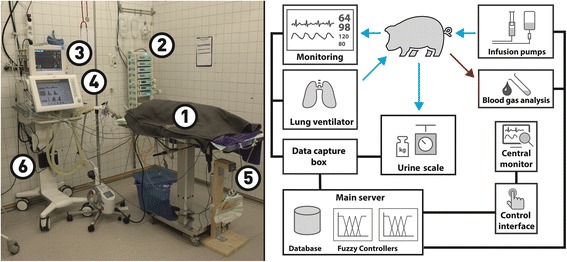
Automated systems are available in various application areas all over the world for the purpose of reducing workload and increasing safety. However, such support systems that would aid caregivers are still lacking in the medical sector. With respect to workload and safety, especially, the intensive care unit appears to be an important and challenging application field. Whereas many closed-loop subsystems for single applications already exist, no comprehensive system covering multiple therapeutic aspects and interactions is available yet. This paper describes a fully closed-loop intensive care therapy and presents a feasibility analysis performed in three healthy pigs over a period of 72 h each to demonstrate the technical and practical implementation of automated intensive care therapy.
The study was performed in three healthy, female German Landrace pigs under general anesthesia with endotracheal intubation. An arterial and a central venous line were implemented, and a suprapubic urinary catheter was inserted. Electrolytes, glucose levels, acid-base balance, and respiratory management were completely controlled by an automated fuzzy logic system based on individual targets. Fluid management by adaption of the respective infusion rates for the individual parameters was included.
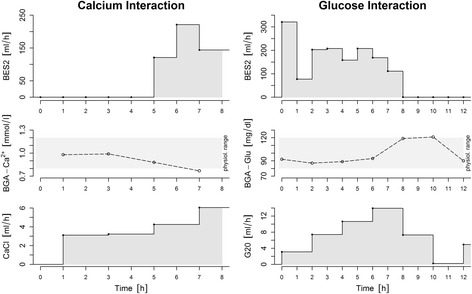
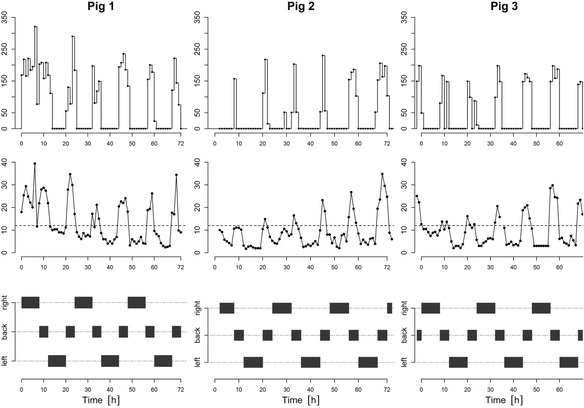
During the study, no manual modification of the device settings was allowed or required. Homoeostasis in all animals was kept stable during the entire observation period. All remote-controlled parameters were maintained within physiological ranges for most of the time (free arterial calcium 73%, glucose 98%, arterial base excess 89%, and etCO 98%). Subsystem interaction was analyzed.
In the presented study, we demonstrate the feasibility of a fully closed-loop system, for which we collected high-resolution data on the interaction and response of the different subsystems. Further studies should use big data approaches to analyze and investigate the interactions between the subsystems in more detail.
为了减轻工作量并提高安全性,世界各地的各种应用领域都有自动化系统。然而,医疗领域仍然缺乏有助于护理人员的此类支持系统。特别是在工作量和安全性方面,重症监护病房似乎是一个重要且具有挑战性的应用领域。虽然已经存在许多用于单一应用的闭环子系统,但尚无涵盖多个治疗方面和相互作用的综合系统。本文描述了一种完全闭环的重症监护治疗,并展示了在三只健康猪身上进行的为期72小时的可行性分析,以证明自动化重症监护治疗的技术和实际实施情况。
该研究在三只健康的雌性德国长白猪身上进行,采用气管插管全身麻醉。实施了动脉和中心静脉导管,并插入了耻骨上导尿管。电解质、葡萄糖水平、酸碱平衡和呼吸管理完全由基于个体目标的自动模糊逻辑系统控制。包括通过调整各个参数的输注速率进行液体管理。
在研究期间,不允许也不需要手动修改设备设置。在整个观察期内,所有动物的体内平衡保持稳定。所有遥控参数在大部分时间内都维持在生理范围内(游离动脉钙73%、葡萄糖98%、动脉碱剩余89%和呼气末二氧化碳98%)。分析了子系统间的相互作用。
在本研究中,我们证明了完全闭环系统的可行性,并收集了不同子系统相互作用和反应的高分辨率数据。进一步的研究应采用大数据方法,更详细地分析和研究子系统之间的相互作用。