Xu Da, Liu Xiao-Feng, Yan Xiao-Luan, Wang Kun, Xing Bao-Cai
Hepatopancreatobiliary Surgery Department I, Key Laboratory of Carcinogenesis and Translational Research, Ministry of Education, Peking University School of Oncology, Beijing Cancer Hospital and Institute, Beijing 100142, P.R. China.
Department of Cell Biology, School of Basic Medical Research, Peking University Health Science Center, Beijing 100191, P.R. China.
Oncol Lett. 2017 Dec;14(6):8051-8059. doi: 10.3892/ol.2017.7191. Epub 2017 Oct 16.
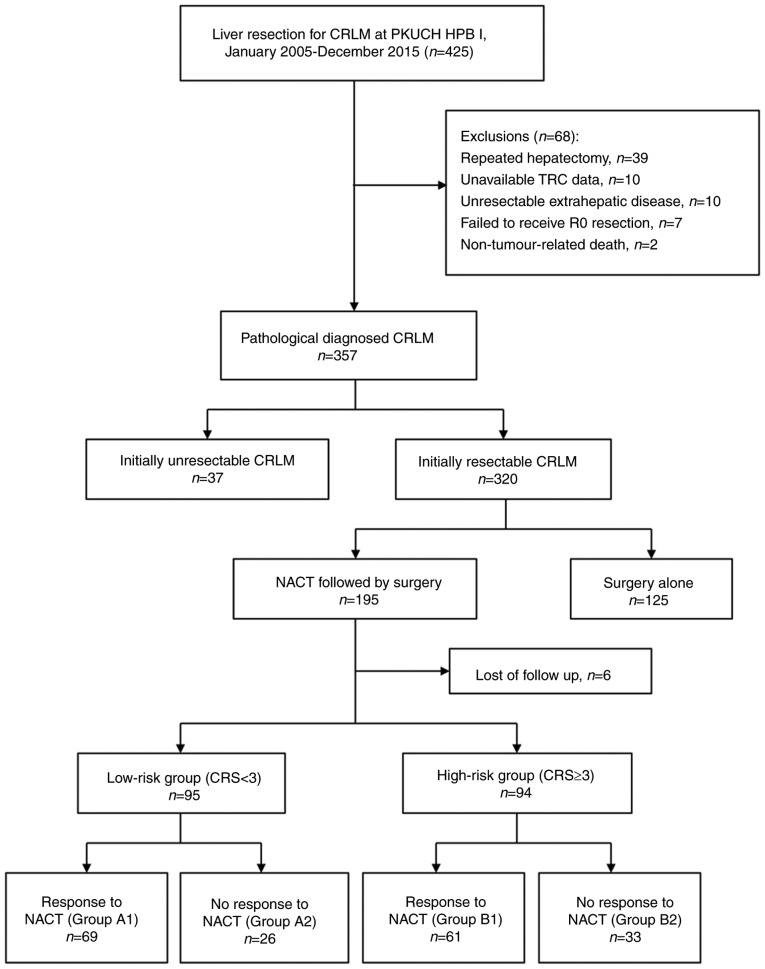
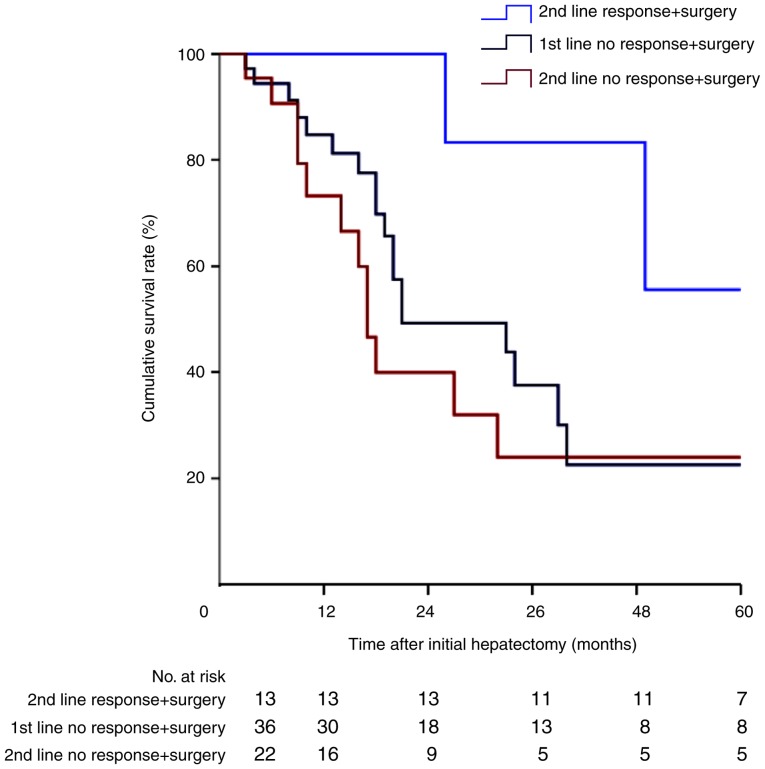
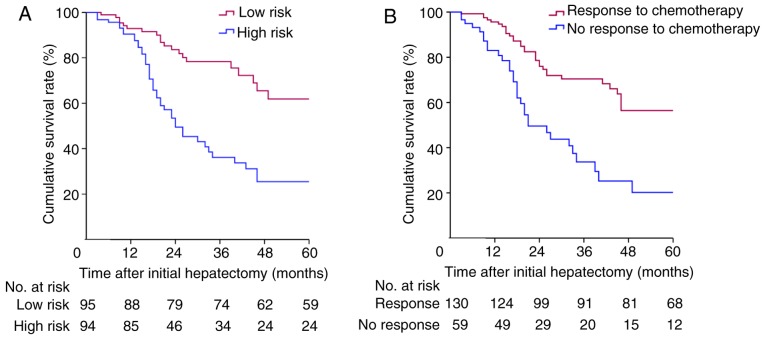
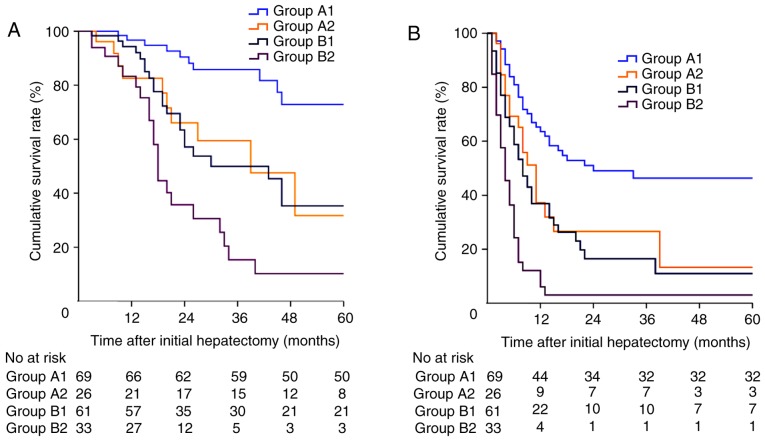
Clinical risk scores and response to pre-operative chemotherapy are prognostic factors of colorectal liver metastases. The aim of the present study was to evaluate the effectiveness of combining these factors to predict patient survival and to select patients for curative therapy. The study included 189 patients who underwent hepatectomy following neo-adjuvant chemotherapy, for initially resectable colorectal liver metastases, between January 2005 and December 2015. Patients were stratified into four sub-groups: A1-2, low clinical risk scores with/without a response to pre-operative chemotherapy; and B1-2, high clinical risk scores with or without a response to pre-operative chemotherapy. Treatment and survival data were analysed. Survival was significantly longer in patients with low clinical risk scores and a response to pre-operative chemotherapy; these factors were confirmed as independent prognostic factors by multivariate analysis. Combining clinical risk score and chemotherapy response classification, patient survival was significantly longer for groups A1-2/B1 compared with for group B2, in which only 10.2% of patients were alive after 5 years. Of those with no response to first-line chemotherapy, survival was significantly longer in patients who responded to second-line chemotherapy. A combined clinical risk score and chemotherapy response classification may aid in identifying suitable candidates for potentially curative therapy.
临床风险评分及对术前化疗的反应是结直肠癌肝转移的预后因素。本研究的目的是评估联合这些因素预测患者生存率及选择可进行根治性治疗患者的有效性。该研究纳入了2005年1月至2015年12月期间因初始可切除的结直肠癌肝转移接受新辅助化疗后行肝切除术的189例患者。患者被分为四个亚组:A1 - 2组,临床风险评分低且对术前化疗有/无反应;B1 - 2组,临床风险评分高且对术前化疗有/无反应。分析了治疗及生存数据。临床风险评分低且对术前化疗有反应的患者生存期明显更长;多因素分析证实这些因素为独立预后因素。联合临床风险评分及化疗反应分类,A1 - 2/B1组患者的生存期明显长于B2组,B2组中仅有10.2%的患者在5年后存活。在对一线化疗无反应的患者中,对二线化疗有反应的患者生存期明显更长。联合临床风险评分及化疗反应分类可能有助于识别适合进行潜在根治性治疗的患者。