D'Hondt Matthias, Gevaert Bert, Stalmans Sofie, Van Dorpe Sylvia, Wynendaele Evelien, Peremans Kathelijne, Burvenich Christian, De Spiegeleer Bart
Drug Quality and Registration (DruQuaR) group, Faculty of Pharmaceutical Sciences, Ghent University, Harelbekestraat 72, B-9000 Ghent, Belgium.
Departments of Medical Imaging and Physiology, Faculty of Veterinary Medicine, Ghent University, Salisburylaan 133, B9820 Merelbeke, Belgium.
J Pharm Anal. 2013 Apr;3(2):93-101. doi: 10.1016/j.jpha.2012.11.002. Epub 2012 Nov 30.
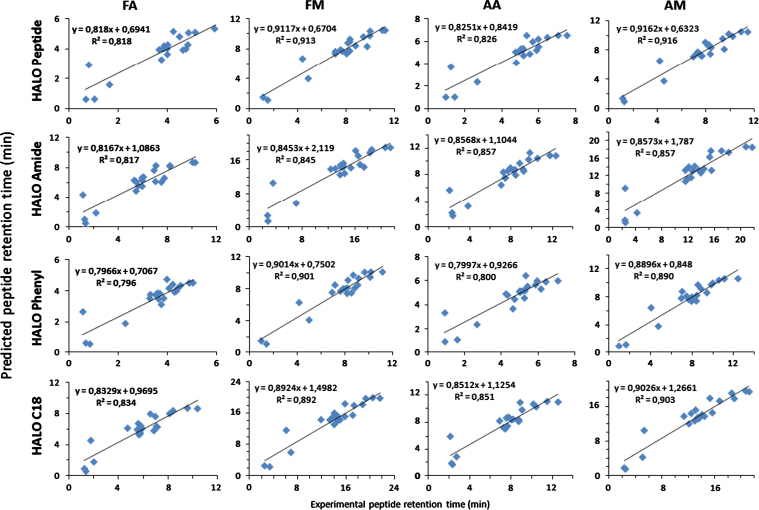
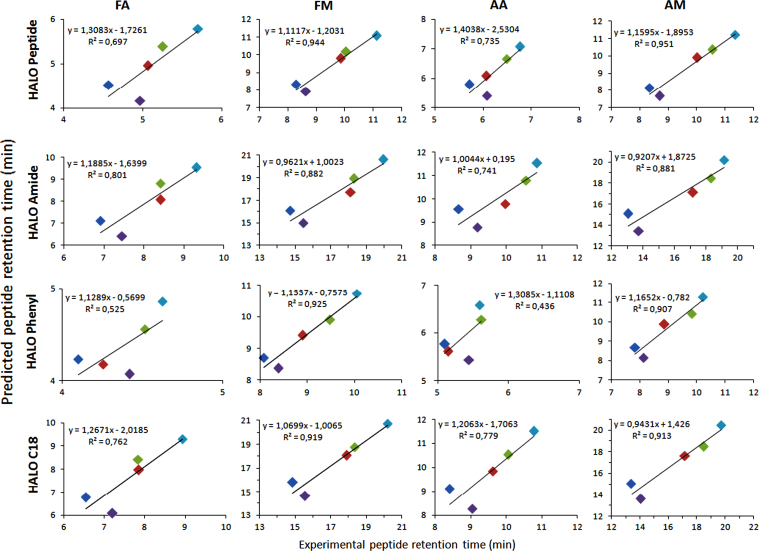
Different fused-core stationary phase chemistries (C18, Amide, Phenyl-hexyl and Peptide ES-C18) were used for the analysis of 21 structurally representative model peptides. In addition, the effects of the mobile phase composition (ACN or MeOH as organic modifier; formic acid or acetic acid, as acidifying component) on the column selectivity, peak shape and overall chromatographic performance were evaluated. The RP-amide column, combined with a formic acid-acetonitrile based gradient system, performed as best. A peptide reversed-phase retention model is proposed, consisting of 5 variables: log SumAA, log Sv, clog P, log nHDon and log nHAcc. Quantitative structure-retention relationship (QSRR) models were constructed for 16 different chromatographic systems. The accuracy of this peptide retention model was demonstrated by the comparison between predicted and experimentally obtained retention times, explaining on average 86% of the variability. Moreover, using an external set of 5 validation peptides, the predictive power of the model was also demonstrated. This peptide retention model includes the novel calculated amino acid descriptor, AA, which was calculated from log P, 3D-MoRSE, RDF and WHIM descriptors.
采用不同的融合核固定相化学组成(C18、酰胺、苯基己基和肽ES-C18)对21种具有结构代表性的模型肽进行分析。此外,还评估了流动相组成(以乙腈或甲醇作为有机改性剂;以甲酸或乙酸作为酸化成分)对柱选择性、峰形和整体色谱性能的影响。RP-酰胺柱与基于甲酸-乙腈的梯度系统相结合时表现最佳。提出了一种肽反相保留模型,该模型由5个变量组成:log SumAA、log Sv、clog P、log nHDon和log nHAcc。针对16种不同的色谱系统构建了定量结构-保留关系(QSRR)模型。通过比较预测保留时间和实验获得的保留时间,证明了该肽保留模型的准确性,平均解释了86%的变异性。此外,使用一组5种验证肽的外部数据集,也证明了该模型的预测能力。该肽保留模型包括新计算的氨基酸描述符AA,它是根据log P、3D-MoRSE、RDF和WHIM描述符计算得出的。