Karolinska Institutet, Stockholm, Sweden.
World Health Organization, Geneva, Switzerland.
Vaccine. 2018 Mar 14;36(12):1577-1582. doi: 10.1016/j.vaccine.2018.02.012. Epub 2018 Feb 14.
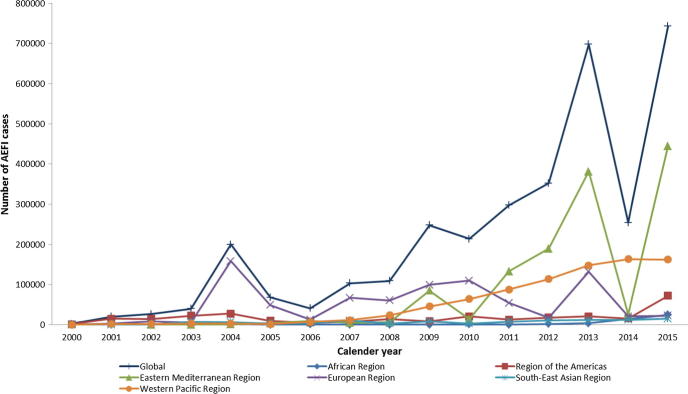
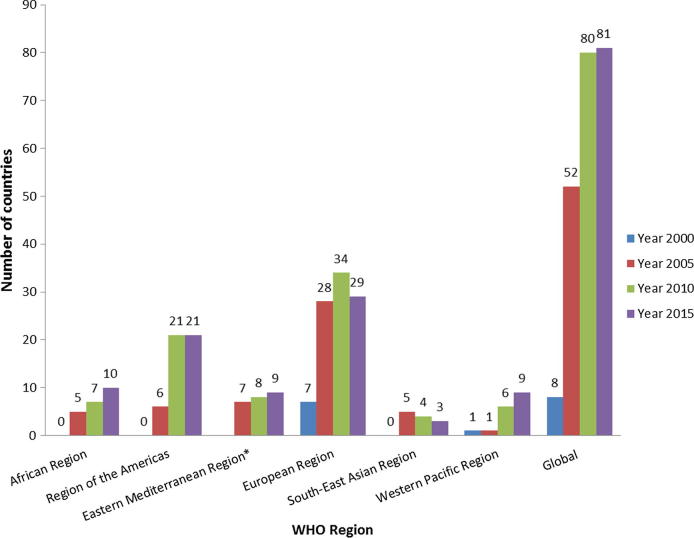
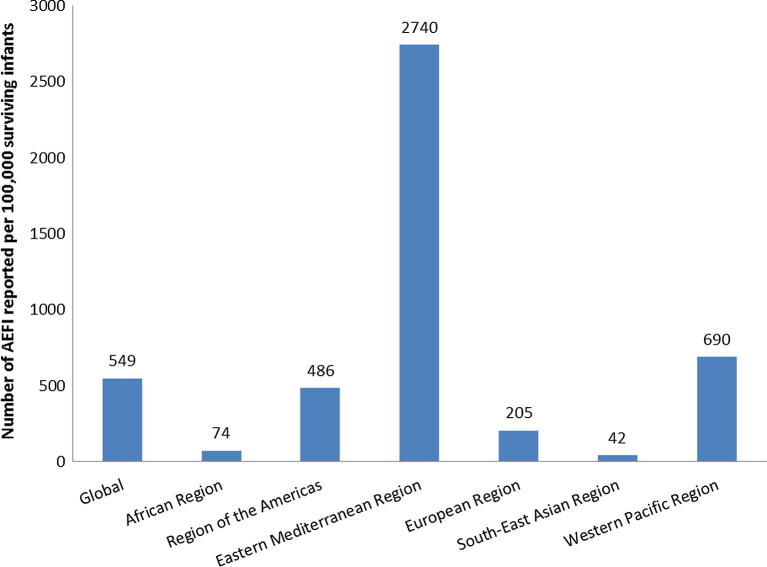
Reporting of adverse events following immunization (AEFI) is a key component for functional vaccine safety monitoring system. The aim of our study is to document trends in the AEFI reporting ratio globally and across the six World Health Organization (WHO) regions. We describe the number of AEFI reports communicated each year through the World Health Organization/United Nations Children's Fund Joint Reporting Form on Immunization from 2000 to 2015. The AEFI reporting ratios (annual AEFI reports per 100,000 surviving infants) were calculated to identify WHO countries (n = 191 in 2000 and n = 194 by 2015) that met a minimal reporting ratio of 10, a target set by the Global Vaccine Action Plan for vaccine safety monitoring as a proxy measure for a functional AEFI reporting system. The number of countries reporting any AEFI fluctuated over time but with progress from 32 (17%) in 2000 to 124 (64%) in 2015. In 2015, the global average AEFI reporting ratio was 549 AEFI reports per 100,000 surviving infants. The number of countries with AEFI reporting ratios greater than 10 increased from 8 (4%) in 2000 to 81 (42%) in 2015. In 2015, 60% of countries in the WHO Region of the Americas reported at least 10 AEFI per 100,000 surviving infants, followed by 55% in European Region, 43% in Eastern Mediterranean Region, 33% in Western Pacific Region, 27% in South-East Asia Region and 21% in African Region. Overall, AEFI reporting has increased over the past sixteen years worldwide, but requires strengthening in a majority of low- and middle- income countries. The AEFI reporting ratio is useful for benchmarking and following trends over time; but does not provide information on the quality of the reporting system and does not guarantee capacity to detect and manage a vaccine safety problem at a national level. Additional efforts are required to ensure and improve data quality, AEFI reporting and surveillance of immunization safety in every country.
疫苗不良事件报告(AEFI)是功能疫苗安全监测系统的一个关键组成部分。我们的研究旨在记录全球和世界卫生组织(WHO)六个区域的 AEFI 报告趋势。我们描述了 2000 年至 2015 年期间通过世界卫生组织/联合国儿童基金会联合免疫报告表每年报告的 AEFI 数量。计算 AEFI 报告率(每 10 万存活婴儿的年度 AEFI 报告数),以确定符合最低报告率 10 的 WHO 国家(2000 年为 191 个,2015 年为 194 个),这是全球疫苗行动计划为疫苗安全监测设定的目标,作为功能 AEFI 报告系统的替代指标。报告任何 AEFI 的国家数量随时间波动,但从 2000 年的 32 个国家(17%)取得进展,到 2015 年的 124 个国家(64%)。2015 年,全球平均 AEFI 报告率为每 10 万存活婴儿 549 份 AEFI 报告。AEFI 报告率大于 10 的国家数量从 2000 年的 8 个(4%)增加到 2015 年的 81 个(42%)。2015 年,世界卫生组织美洲区域 60%的国家报告了每 10 万存活婴儿至少 10 例 AEFI,其次是欧洲区域的 55%、东地中海区域的 43%、西太平洋区域的 33%、东南亚区域的 27%和非洲区域的 21%。总体而言,全球范围内 AEFI 报告在过去 16 年中有所增加,但大多数中低收入国家仍需加强。AEFI 报告率可用于基准比较和随时间跟踪趋势;但它不能提供有关报告系统质量的信息,也不能保证在国家层面发现和管理疫苗安全问题的能力。需要作出更多努力,以确保和提高每个国家的免疫安全数据质量、AEFI 报告和监测。