
口服避孕药会增强等长握力运动期间的运动加压反射。
Oral contraceptives augment the exercise pressor reflex during isometric handgrip exercise.
作者信息
Minahan Clare, O'Neill Hailey, Sikkema Nelie, Joyce Sarah, Larsen Brianna, Sabapathy Surendran
机构信息
Griffith Sports Physiology and Performance, Gold Coast, Queensland, Australia.
Menzies Health Institute Queensland, Griffith University, Gold Coast, Queensland, Australia.
出版信息
Physiol Rep. 2018 Mar;6(5). doi: 10.14814/phy2.13629.
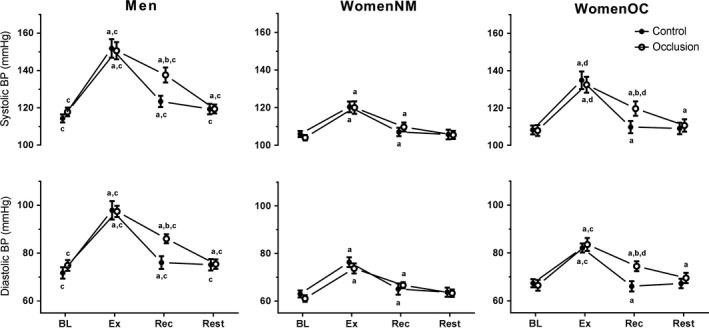
We sought to determine whether oral contraception alters the gender-related differences observed in the exercise pressor reflex during isometric handgrip exercise. Fifteen men, fifteen normally menstruating women (WomenNM), and fifteen women taking monophasic oral contraceptives (WomenOC) completed two trials of a 3-min isometric handgrip exercise protocol performed at 30% of their maximal voluntary contraction: (1) where arterial occlusion was applied to the previously exercising arm during a 3-min recovery period (Occlusion trial); (2) where no arterial occlusion was applied during recovery (Control trial). Handgrip exercise elicited greater increases in mean arterial pressure (MAP) in MEN compared to both female groups (P < 0.05), and in WomenOC compared to WomenNM in both trials (P = 0.01, P = 0.03). After 3 min of recovery, sBP was 12% (P = 0.01) and 9% (P = 0.02) higher in the Occlusion trial when compared to the Control trial for MEN and WomenOC. Conversely, arterial occlusion in recovery from handgrip did not sustain elevated sBP in the Occlusion trial, and sBP returned to recovery levels not different to the Control trial, in WomenNM (P = 0.41). These data indicate that gender-related differences in the metaboreflex during isometric handgrip exercise exist between men and normally menstruating women, but are blunted when men are compared to women taking oral contraceptives. We conclude that the suppression of 17β-estradiol and/or progestogen in women via the administration of oral contraceptives attenuates sex-related differences in the metaboreflex during isometric handgrip exercise.
我们试图确定口服避孕药是否会改变等长握力运动期间运动升压反射中观察到的性别相关差异。15名男性、15名正常月经的女性(WomenNM)和15名服用单相口服避孕药的女性(WomenOC)完成了两项3分钟等长握力运动方案的试验,运动强度为其最大自主收缩的30%:(1)在3分钟恢复期对先前运动的手臂施加动脉闭塞(闭塞试验);(2)在恢复期不施加动脉闭塞(对照试验)。与两个女性组相比,握力运动引起男性的平均动脉压(MAP)升高幅度更大(P < 0.05),并且在两项试验中,与WomenNM相比,WomenOC的MAP升高幅度更大(P = 0.01,P = 0.03)。恢复3分钟后,与男性和WomenOC的对照试验相比,闭塞试验中的收缩压(sBP)分别高出12%(P = 0.01)和9%(P = 0.02)。相反,在握力运动恢复过程中进行动脉闭塞,在闭塞试验中并未使WomenNM的sBP持续升高,sBP恢复到与对照试验无差异的恢复水平(P = 0.41)。这些数据表明,等长握力运动期间代谢反射中的性别相关差异存在于男性和正常月经的女性之间,但与服用口服避孕药的女性相比时这种差异会减弱。我们得出结论,通过口服避孕药抑制女性体内的17β-雌二醇和/或孕激素会减弱等长握力运动期间代谢反射中的性别相关差异。

 Zotero 插件