
使用软骨膜皮岛状皮瓣修复耳甲腔型小耳畸形时的耳屏形成
Tragus formation during concha-type microtia repair using a chondrocutaneous island flap.
作者信息
Ha Jeong Hyun, Jeong Euicheol, Lazaro Hudson
机构信息
Department of Plastic and Reconstructive Surgery, Seoul National University Hospital, Seoul National University College of Medicine, Seoul, Korea.
Department of Plastic Surgery, SMG-SNU Boramae Medical Center, Seoul, Korea.
出版信息
Arch Craniofac Surg. 2018 Mar;19(1):79-82. doi: 10.7181/acfs.2018.19.1.79. Epub 2018 Mar 20.
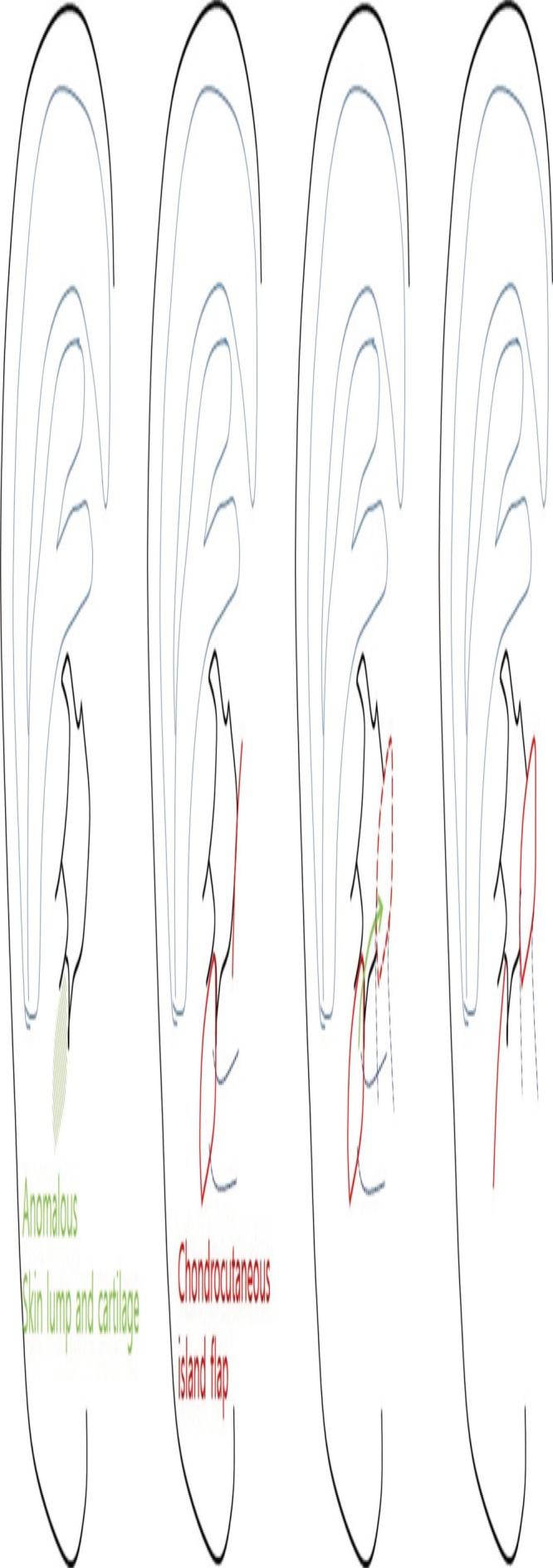
Formation of an ideally-shaped tragus remains one of the most challenging issues during staged tragus reconstruction in microtia patients. The authors describe a new method used to treat a unique case of concha-type microtia in which the 10-year-old male patient had only a portion of pre-existing cartilage at the tragus site. An anomalous skin lump was also present. During the initial stages of the reconstruction, the two-stage Nagata method was used for surgical correction of the microtia. An autologous rib cartilage graft was used to form the ear framework. A temporoparietal fascia flap was also constructed. Remnant skin tags and anomalous cartilage that accompany microtia are usually removed during microtia repair. However, the cartilage and skin lump were preserved during the reconstruction. The skin lump was later used to form a vascularized chondrocutaneous island flap that supplemented the portion of cartilage during tragus formation. The result was a new tragus that was satisfactorily improved in both size and shape. Patients with concha-type microtia may benefit from the use of this new method for tragus formation.
在小耳畸形患者的分期耳屏重建过程中,形成理想形状的耳屏仍然是最具挑战性的问题之一。作者描述了一种用于治疗一例独特的耳甲腔型小耳畸形的新方法,该10岁男性患者在耳屏部位仅有一部分原有的软骨,还存在一个异常的皮肤肿块。在重建的初始阶段,采用两期永田法对小耳畸形进行手术矫正。使用自体肋软骨移植来形成耳支架,还构建了颞顶筋膜瓣。在小耳畸形修复过程中,通常会切除伴随小耳畸形的残留皮肤赘生物和异常软骨。然而,在重建过程中保留了软骨和皮肤肿块。后来,该皮肤肿块被用于形成带血管的软骨皮岛瓣,在耳屏形成过程中补充软骨部分。结果是形成了一个新的耳屏,其大小和形状均得到了令人满意的改善。耳甲腔型小耳畸形患者可能会从这种新的耳屏形成方法中受益。



 Zotero 插件