Saper Michael, Pearce Stephanie, Shung Joseph, Zondervan Robert, Ostrander Roger, Andrews James R
Department of Orthopedics and Sports Medicine, Seattle Children's, Seattle, Washington, USA.
Department of Orthopaedic Surgery, University of South Alabama, Mobile, Alabama, USA.
Orthop J Sports Med. 2018 Apr 5;6(4):2325967118764884. doi: 10.1177/2325967118764884. eCollection 2018 Apr.
The number of adolescent anterior cruciate ligament (ACL) injuries is rising with increased participation in higher level athletics at earlier ages. With an increasing number of primary ACL reconstructions (ACLRs) comes a rise in the incidence of revision ACLRs.
To evaluate the clinical results of revision ACLR across a group of high-level adolescent athletes with at least 2-year follow-up.
Case series; Level of evidence, 4.
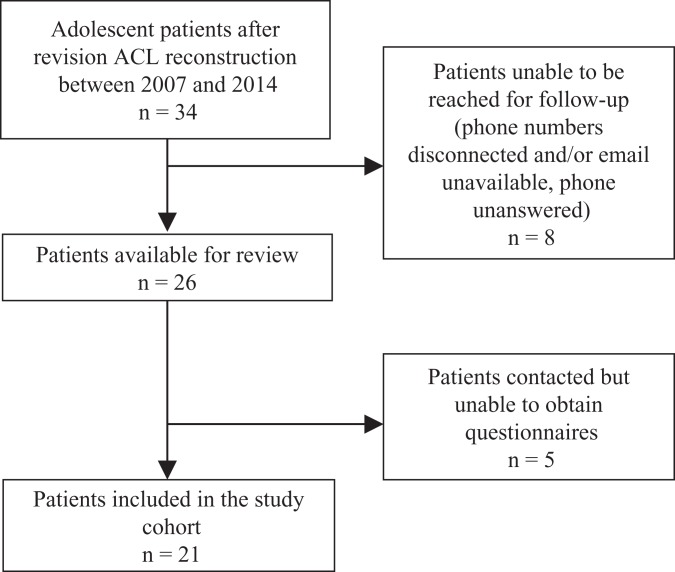
A retrospective review of 21 adolescent athletes (age range, 10-19 years) who underwent revision ACLR with at least 2-year follow-up was conducted. Patient-reported outcome measures (PROMs) included the International Knee Documentation Committee (IKDC) Subjective Knee Evaluation Form, Lysholm knee scoring scale, Tegner activity level scale, and modified Cincinnati Knee Rating System. Return to sport (RTS) and overall patient satisfaction were also assessed.
The mean age at the time of surgery was 16.5 years (range, 14-19 years), and the mean follow-up was 46.4 months (range, 24-97 months); 42.9% of patients were female, and 52.4% of patients participated in collision sports. The mean time to failure after primary ACLR was 13.1 ± 8.0 months, and the most common mechanism of failure was noncontact in at least 66.7% of cases. The revision graft type included bone-patellar tendon-bone (BPTB) in 71.4% of cases; 26.7% of BPTB grafts were from the contralateral extremity. Concomitant procedures were performed for intra-articular lesions in 71.4% of patients. The mean patient satisfaction rate was 95.3%. There were 3 cases of a graft reinjury at a mean of 25 months postoperatively. The mean PROM scores were as follows: IKDC, 87.5 ± 12.7; Tegner, 7.2 ± 2.0; Lysholm, 93.7 ± 9.8; and Cincinnati, 93.4 ± 10.0. Of those attempting to RTS, 68.4% of patients successfully returned at the same level of competition. Patients with a lateral compartment chondral injury were less likely to RTS ( < .05). Independent variables shown to have no significant relationship to PROMs or RTS included age, follow-up, sport classification, associated meniscal tears, revision graft size/type, and concomitant procedures.
Revision ACLR can be an effective surgical option in adolescents participating in collision and contact sports, with good to excellent subjective outcome scores. At a minimum 2-year follow-up, a graft rupture after revision ACLR occurred in 14% of cases. Of the athletes attempting to RTS, 68.4% returned to their preinjury level of competition.
随着青少年更早地参与更高水平的体育运动,青少年前交叉韧带(ACL)损伤的数量正在增加。随着初次ACL重建(ACLR)数量的增加,翻修ACLR的发生率也在上升。
评估一组高水平青少年运动员翻修ACLR至少2年随访后的临床结果。
病例系列;证据等级,4级。
对21例接受翻修ACLR且至少随访2年的青少年运动员(年龄范围10 - 19岁)进行回顾性研究。患者报告的结局指标(PROMs)包括国际膝关节文献委员会(IKDC)主观膝关节评估表、Lysholm膝关节评分量表、Tegner活动水平量表和改良的辛辛那提膝关节评分系统。还评估了恢复运动(RTS)情况和患者总体满意度。
手术时的平均年龄为16.5岁(范围14 - 19岁),平均随访时间为46.4个月(范围24 - 97个月);42.9%的患者为女性,52.4%的患者参加对抗性运动。初次ACLR后失败的平均时间为13.1±8.0个月,至少66.7%的病例中最常见的失败机制为非接触性损伤。翻修移植物类型中,71.4%为骨 - 髌腱 - 骨(BPTB);26.7%的BPTB移植物取自对侧肢体。71.4%的患者因关节内损伤进行了联合手术。患者平均满意度为95.3%。术后平均25个月时有3例移植物再次损伤。PROM平均得分如下:IKDC为87.5±12.7;Tegner为7.2±2.0;Lysholm为93.7±9.8;辛辛那提为93.4±10.0。在尝试恢复运动的患者中,68.4%的患者成功回到了之前的比赛水平。外侧间室软骨损伤的患者恢复运动的可能性较小(P <.05)。与PROMs或RTS无显著关系的独立变量包括年龄、随访时间、运动分类、相关半月板撕裂、翻修移植物大小/类型和联合手术。
翻修ACLR对于参与对抗性和接触性运动的青少年可能是一种有效的手术选择,主观结局评分良好至优秀。至少2年随访时,翻修ACLR后14%的病例发生移植物破裂。在尝试恢复运动的运动员中,68.4%的人回到了受伤前的比赛水平。