
报告称癌症化疗与乙型肝炎感染有关:分析美国 FDA 不良事件报告系统。
Hepatitis B infection reported with cancer chemotherapy: analyzing the US FDA Adverse Event Reporting System.
机构信息
Department of Pharmacy, Nagoya City University Hospital, Nagoya, Japan.
Department of Hospital Pharmacy, Graduate School of Pharmaceutical Sciences, Nagoya City University, Nagoya, Japan.
出版信息
Cancer Med. 2018 Jun;7(6):2269-2279. doi: 10.1002/cam4.1429. Epub 2018 Apr 16.
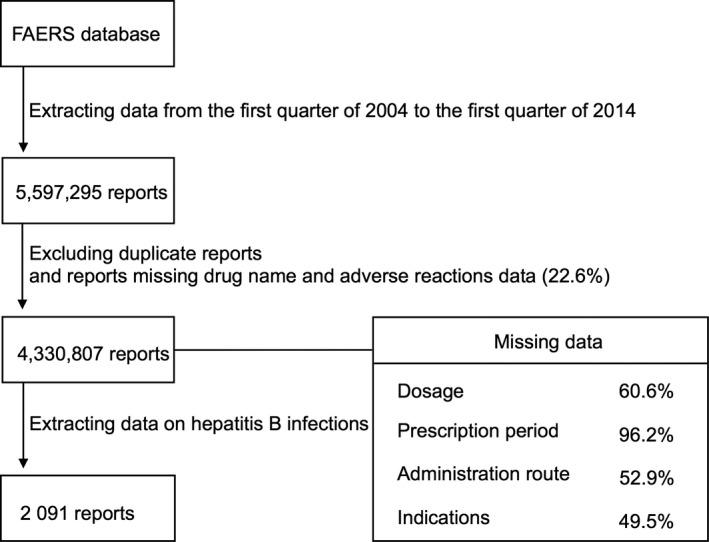
We conducted data mining using the US Food and Drug Administration (FDA) Adverse Event Reporting System (FAERS) database on spontaneously reported adverse events to evaluate the association between anticancer drug therapy and hepatitis B infection. Reports of hepatitis B infection were retrieved from the FAERS database. The reporting odds ratio (ROR) was used to estimate the association between hepatitis B infection and various anticancer agents and drug combinations. We detected statistically significant risk signals of hepatitis B for 33 of 64 anticancer agents by ROR (26 cytotoxicity drugs and seven molecular-targeted drugs). We focused on molecular-targeted drugs and assessed the risk of hepatitis B from specific anticancer drug combinations. The frequency of hepatitis B infection was significantly high for drugs such as rituximab, bortezomib, imatinib, and everolimus. The addition of cyclophosphamide, doxorubicin, and fludarabine to drug combinations additively enhanced the frequency of hepatitis B infection. There were no reports on hepatitis B infection associated with trastuzumab or azacitidine monotherapy. However, trastuzumab-containing regimens (e.g., combinations with docetaxel or paclitaxel) were correlated with the incidence of hepatitis B infection, similar to azacitidine monotherapy. Our findings suggest that the concomitant use of anticancer drugs, such as trastuzumab, taxane, and azacitidine, may contribute to the risk of hepatitis B infection. The unique signals detected from the public database might provide clues to eliminate the threat of HBV in oncology.
我们使用美国食品和药物管理局(FDA)不良事件报告系统(FAERS)数据库进行了数据挖掘,以评估抗癌药物治疗与乙型肝炎感染之间的关联。从 FAERS 数据库中检索到乙型肝炎感染的报告。报告比值比(ROR)用于估计乙型肝炎感染与各种抗癌药物和药物组合之间的关联。我们通过 ROR 检测到 64 种抗癌药物中的 33 种(26 种细胞毒性药物和 7 种分子靶向药物)与乙型肝炎感染相关的统计学显著风险信号。我们关注分子靶向药物,并评估特定抗癌药物组合引起乙型肝炎的风险。利妥昔单抗、硼替佐米、伊马替尼和依维莫司等药物的乙型肝炎感染频率明显较高。环磷酰胺、多柔比星和氟达拉滨的添加使乙型肝炎感染的频率相加性增加。曲妥珠单抗或阿扎胞苷单药治疗与乙型肝炎感染相关的报告均未见。然而,曲妥珠单抗联合方案(例如与多西紫杉醇或紫杉醇联合)与乙型肝炎感染的发生率相关,与阿扎胞苷单药治疗相似。我们的研究结果表明,抗癌药物的联合使用,如曲妥珠单抗、紫杉烷类和阿扎胞苷,可能会增加乙型肝炎感染的风险。从公共数据库中检测到的独特信号可能为消除肿瘤学中 HBV 的威胁提供线索。



 Zotero 插件