Department of Integrated Omics for Biomedical Sciences, Yonsei University, Seoul, 03722, Korea.
Institute for Bio-Medical Convergence, College of Medicine, Catholic Kwandong University, Gangneung, Gangwon-do, 25601, Korea.
Exp Mol Med. 2018 Apr 20;50(4):1-12. doi: 10.1038/s12276-018-0052-y.
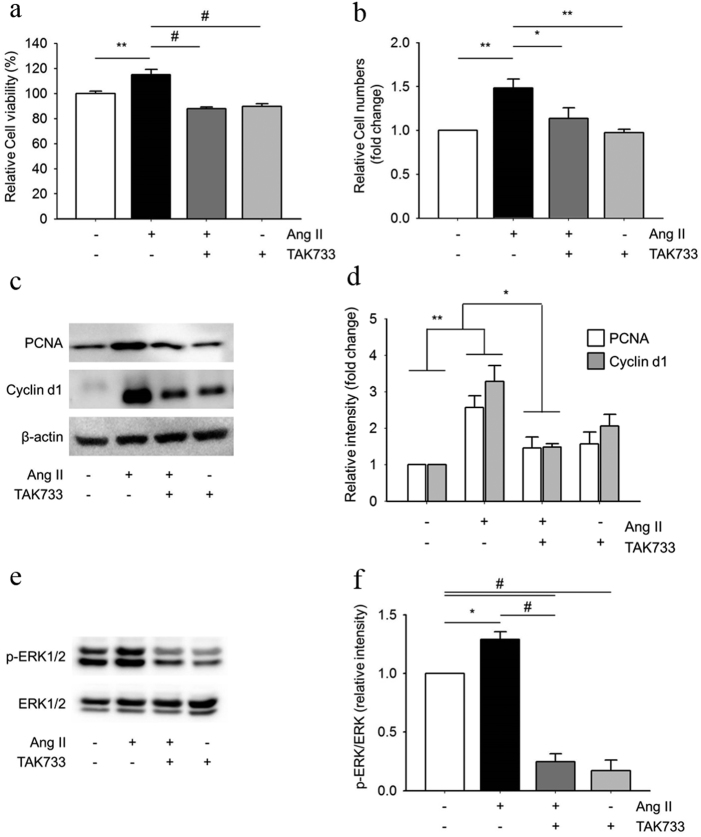
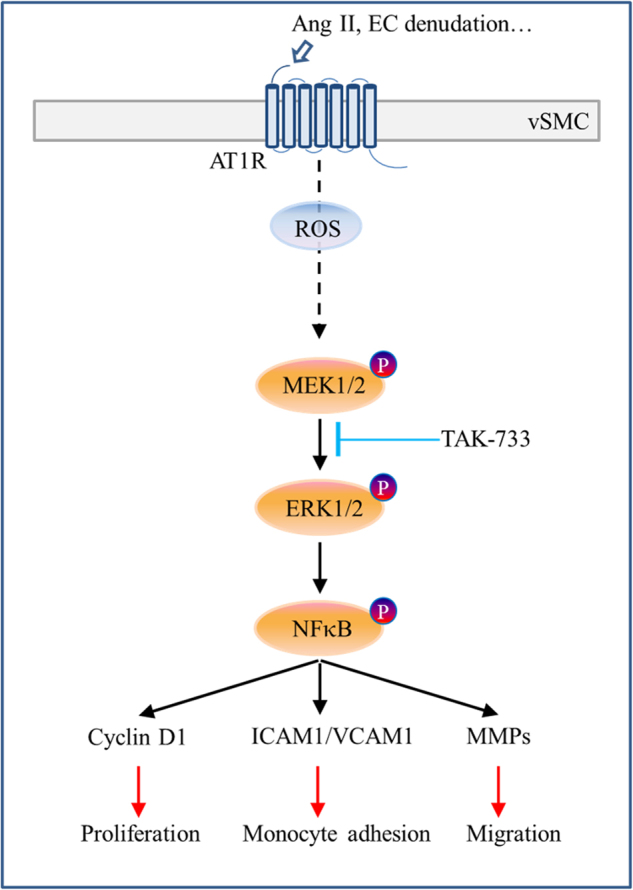
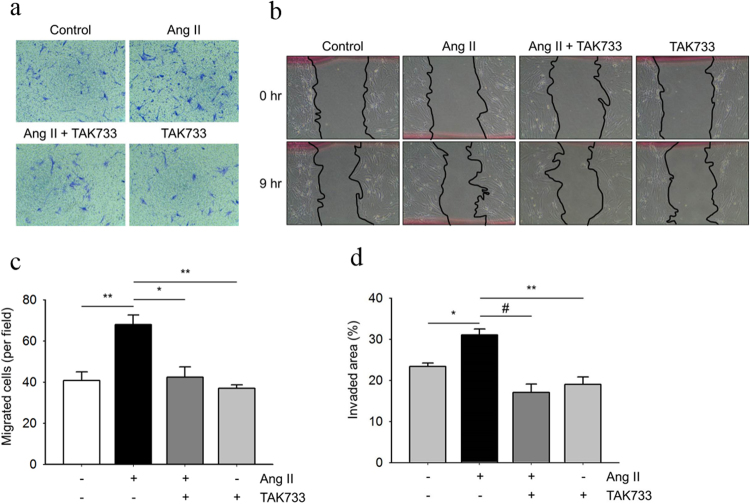
As a potent and selective allosteric inhibitor of MEK, TAK-733 has been shown to exert anti-cancer effects for a wide range of cancers both in vitro and in vivo. However, its effects on inhibiting growth have never been investigated in the cardiovascular system, where regulation of abnormal vascular smooth muscle cell growth in neointimal hyperplasia is an important area of focus. Angiotensin II was used to mimic inflammatory neointimal hyperplasia in an in vitro environment, and balloon catheter-induced injury with an infusion of angiotensin II was used to generate an in vivo rat restenosis model under inflammatory conditions. TAK-733 exerted anti-proliferative and anti-migratory effects on human vascular smooth muscle cells. These multiple effects of TAK-733 were evaluated using various assays, such as cell cycle analysis and wound healing. Interestingly, TAK-733 did not induce apoptosis in smooth muscle cells but only reduced the proliferation rate; additionally, it did not affect EC viability. TAK-733 also exhibited anti-inflammatory activity, as observed by attenuated monocyte adhesion to smooth muscle cells via inhibition of ICAM1 and VCAM1 overexpression. The in vivo study demonstrated that neointimal hyperplasia after balloon injury and angiotensin II stimulation was suppressed by TAK-733, and downregulation of the inflammatory signal and enhanced re-endothelialization were observed. TAK-733 may have therapeutic potential for treating neointimal hyperplasia by attenuating smooth muscle cell proliferation, migration, and inflammation. Thus, TAK-733 could be a promising drug candidate for treating patients with restenosis.
作为一种有效的、选择性的 MEK 别构抑制剂,TAK-733 已被证明在体外和体内对多种癌症具有抗癌作用。然而,它在心血管系统中抑制生长的作用从未被研究过,在心血管系统中,调节异常血管平滑肌细胞在新生内膜增生中的生长是一个重要的研究领域。血管紧张素 II 被用于模拟体外环境中的炎症性新生内膜增生,球囊导管损伤并输注血管紧张素 II 用于在炎症条件下生成体内大鼠再狭窄模型。TAK-733 对人血管平滑肌细胞表现出抗增殖和抗迁移作用。通过细胞周期分析和划痕愈合等多种实验来评估 TAK-733 的这些多种作用。有趣的是,TAK-733 不会诱导平滑肌细胞凋亡,而只会降低增殖率;此外,它不会影响 EC 的活力。TAK-733 还表现出抗炎活性,这可通过抑制 ICAM1 和 VCAM1 的过表达从而减少单核细胞黏附到平滑肌细胞来观察到。体内研究表明,TAK-733 抑制了球囊损伤和血管紧张素 II 刺激后的新生内膜增生,并观察到炎症信号下调和增强的再内皮化。TAK-733 通过抑制平滑肌细胞增殖、迁移和炎症可能具有治疗新生内膜增生的潜力。因此,TAK-733 可能成为治疗再狭窄患者的有前途的药物候选物。