
先天性角化不良患者中与肺纤维化相关的杂合性TINF2基因突变病例报告。
A case report of heterozygous TINF2 gene mutation associated with pulmonary fibrosis in a patient with dyskeratosis congenita.
作者信息
Du Hongchun, Guo Yubiao, Ma Di, Tang Kejing, Cai Decheng, Luo Yifeng, Xie Canmao
机构信息
Department of Respiratory Medicine, The First Affiliated Hospital, Sun Yat-sen University Department of Medical Genetics, School of Basic Medical Sciences, Southern Medical University, Guangzhou, Guangdong, China.
出版信息
Medicine (Baltimore). 2018 May;97(19):e0724. doi: 10.1097/MD.0000000000010724.
RATIONALE
Dyskeratosis congenita (DC) is a rare inherited disease characterized by the classical mucocutaneous triad. Pulmonary fibrosis, bone marrow failure, and solid tumors are the main causes of mortality in DC. Pathogenic variants in TERT, TERC, and DKC1 have been identified in individuals with familial pulmonary fibrosis. Mutations in TINF2 gene have been reported to be associated with bone marrow failure in most cases. However, the relationship between TINF2 mutation and pulmonary fibrosis is not yet clear.
PATIENT CONCERNS
Here, we report the case of a 32-year-old woman presented with irritating cough for 2 years and progressive breathlessness for 6 months.
DIAGNOSES
The patient was diagnosed with DC based on the following clinical evidences. Along with some family members, she had the typical mucocutaneous triad and pulmonary fibrosis. A heterozygous mutation (c.844C>T), located in exon 6 of TINF2 gene, that changed arginine to cysteine (Arg282Cys) was identified in this proband by whole exome sequencing.
INTERVENTIONS
The patient received corticosteroid therapy but refused to receive lung transplantation.
OUTCOMES
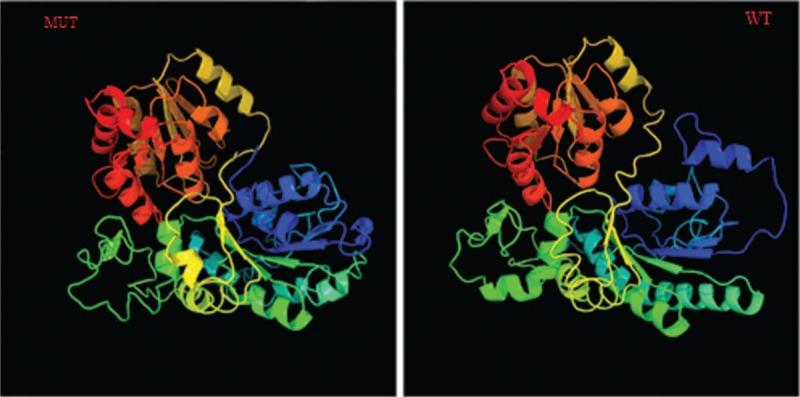
The proband died of respiratory failure 4 months after the diagnosis. The missense mutation was located in the conserved region of TINF2 gene and predicted to be deleterious by altering the protein structure.
LESSONS
Lung transplantation should be considered for improved survival of patients with DC, and pulmonary fibrosis. Whole exome and whole genome sequencing should be widely used in the identification of such rare genetic variants for clinical diagnosis. The study of DC with pulmonary fibrosis can provide a more appropriate means of clinical research and therapy to the unfortunate patients who suffer from this rare disorder.
原理
先天性角化不良(DC)是一种罕见的遗传性疾病,其特征为典型的黏膜皮肤三联征。肺纤维化、骨髓衰竭和实体瘤是DC患者死亡的主要原因。在家族性肺纤维化患者中已鉴定出TERT、TERC和DKC1的致病变异。据报道,大多数情况下TINF2基因突变与骨髓衰竭有关。然而,TINF2突变与肺纤维化之间的关系尚不清楚。
患者情况
在此,我们报告一例32岁女性患者,有2年刺激性咳嗽病史,6个月来进行性呼吸困难。
诊断
根据以下临床证据,该患者被诊断为DC。她与一些家庭成员一起具有典型的黏膜皮肤三联征和肺纤维化。通过全外显子组测序在该先证者中鉴定出位于TINF2基因外显子6的杂合突变(c.844C>T),该突变将精氨酸变为半胱氨酸(Arg282Cys)。
干预措施
患者接受了皮质类固醇治疗,但拒绝接受肺移植。
结果
先证者在诊断后4个月死于呼吸衰竭。错义突变位于TINF2基因的保守区域,预计会通过改变蛋白质结构而具有有害性。
经验教训
对于DC和肺纤维化患者,应考虑进行肺移植以提高生存率。全外显子组和全基因组测序应广泛用于鉴定此类罕见基因变异以进行临床诊断。对伴有肺纤维化的DC的研究可为患有这种罕见疾病的不幸患者提供更合适的临床研究和治疗手段。


 Zotero 插件