Institute for Diabetes and Obesity, Helmholtz Diabetes Center, Helmholtz Zentrum München, German Research Center for Environmental Health (GmbH), Neuherberg, Germany; Division of Metabolic Diseases, Department of Medicine, Technische Universität, Munich, Germany; Section for Molecular Physiology, Department of Nutrition, Exercise and Sports, Faculty of Science, University of Copenhagen, Copenhagen, Denmark.
Division of Endocrinology and Diabetology, Medical University of Graz, Graz, Austria.
Mol Metab. 2018 Jul;13:77-82. doi: 10.1016/j.molmet.2018.04.008. Epub 2018 Apr 27.
The inability of leptin to suppress food intake in diet-induced obesity, sometimes referred to as leptin resistance, is associated with several distinct pathological hallmarks. One prevailing theory is that impaired transport of leptin across the blood-brain barrier (BBB) represents a molecular mechanism that triggers this phenomenon. Recent evidence, however, has challenged this notion, suggesting that leptin BBB transport is acquired during leptin resistance.
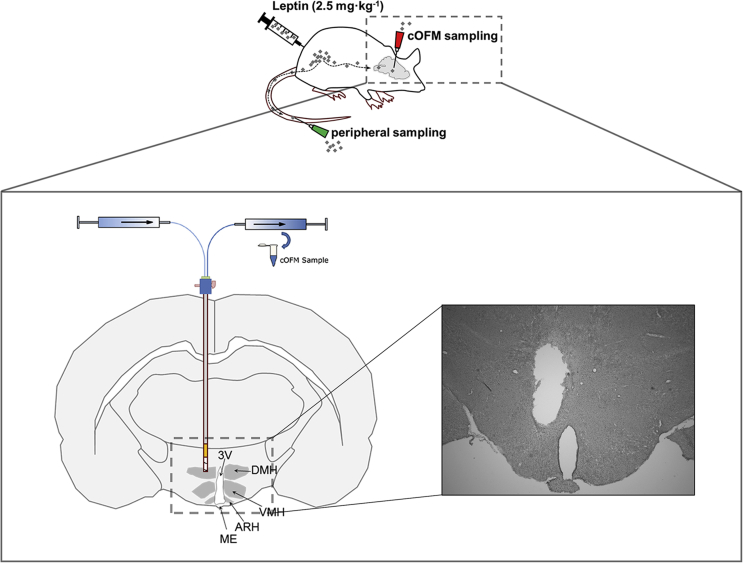
To resolve this debate, we utilized a novel cerebral Open Flow Microperfusion (cOFM) method to examine leptin BBB transport in male C57BL/6J mice, fed a chow diet or high fat diet (HFD) for 20 days.
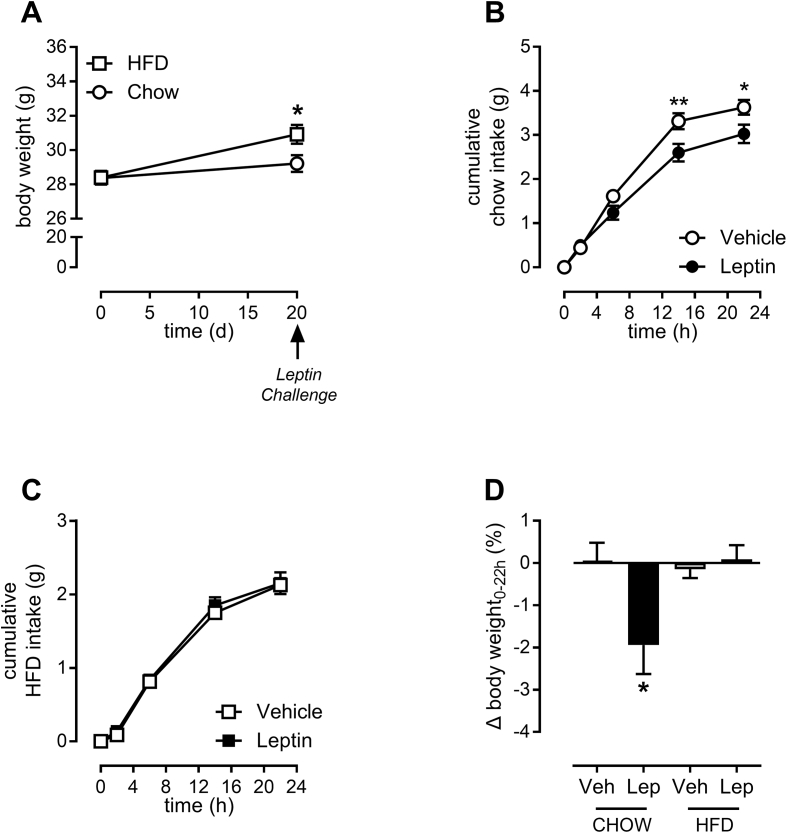
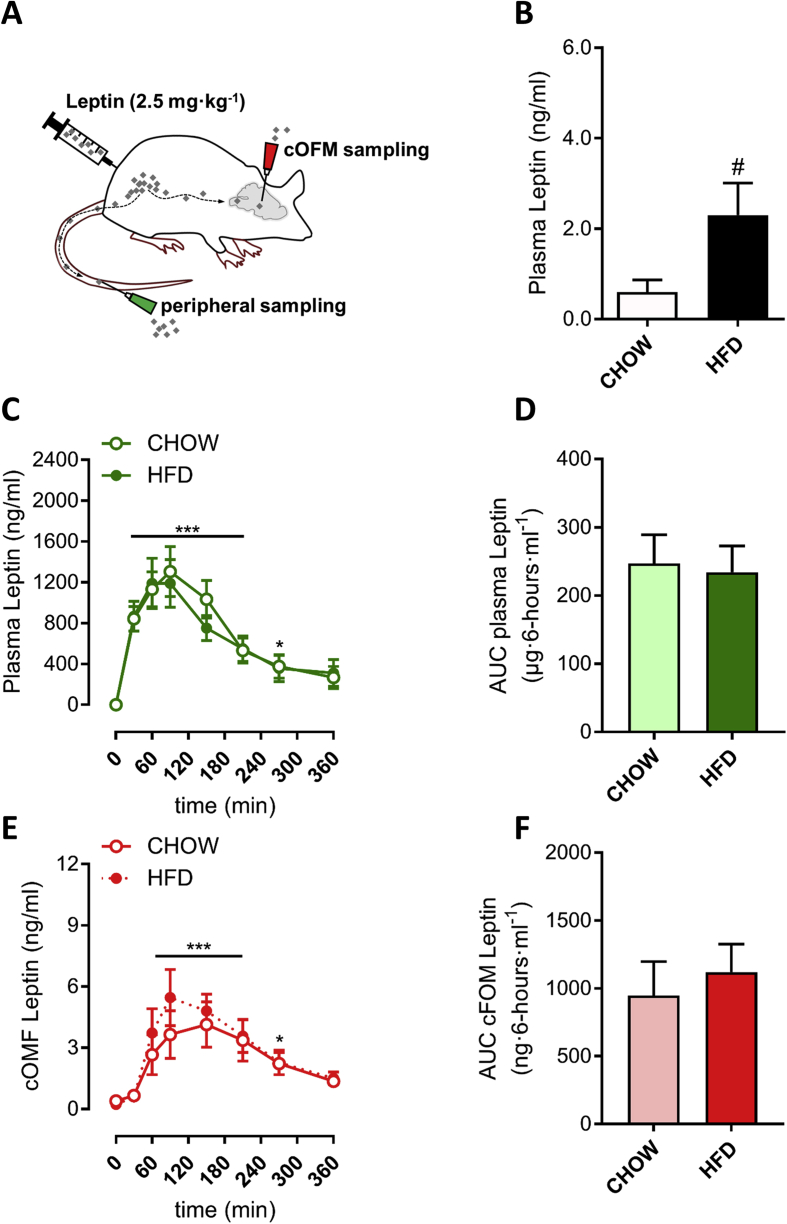
Basal plasma leptin levels were 3.8-fold higher in HFD-fed mice (p < 0.05). Leptin administration (2.5 mg/kg) elicited similar pharmacokinetic profiles of circulating leptin. However, while leptin reduced food intake by 20% over 22 h in chow-fed mice, it did not affect food intake in HFD-fed mice. In spite of this striking functional difference, hypothalamic leptin levels, as measured by cOFM, did not differ between chow-fed mice and HFD-fed mice following leptin administration.
These data suggest that leptin transport across the BBB is not impaired in non-obese leptin resistant mice and thus unlikely to play a direct role in the progression of pharmacological leptin resistance.
瘦素不能抑制饮食诱导肥胖症患者的食欲,这种现象有时被称为瘦素抵抗,与几种明显的病理特征有关。一种流行的理论认为,瘦素穿过血脑屏障(BBB)的转运受损代表了触发这种现象的分子机制。然而,最近的证据对这一观点提出了挑战,表明瘦素 BBB 转运是在瘦素抵抗期间获得的。
为了解决这一争议,我们利用一种新的脑开放式微灌注(cOFM)方法,检测了喂食标准饮食或高脂肪饮食(HFD)20 天的雄性 C57BL/6J 小鼠的瘦素 BBB 转运。
HFD 喂养的小鼠基础血浆瘦素水平高出 3.8 倍(p<0.05)。给予 2.5 mg/kg 的瘦素后,循环瘦素的药代动力学特征相似。然而,尽管瘦素在标准饮食喂养的小鼠中使食物摄入量减少了 20%,但在 HFD 喂养的小鼠中却没有影响。尽管存在这种明显的功能差异,但通过 cOFM 测量,给予瘦素后,下丘脑瘦素水平在标准饮食喂养的小鼠和 HFD 喂养的小鼠之间没有差异。
这些数据表明,非肥胖性瘦素抵抗小鼠的 BBB 内瘦素转运没有受损,因此不太可能在药理学瘦素抵抗的进展中发挥直接作用。