Oh Eun Hye, Lee Jae Hoon, Kim Hyo Jung, Choi Seo Young, Choi Kwang Dong, Choi Jae Hwan
Department of Neurology, Pusan National University School of Medicine, Research Institute for Convergence of Biomedical Science and Technology, Pusan National University Yangsan Hospital, Yangsan, Korea.
Research Administration Team, Seoul National University Bundang Hospital, Seongnam, Korea.
J Clin Neurol. 2019 Apr;15(2):143-148. doi: 10.3988/jcn.2019.15.2.143. Epub 2018 May 31.
The aim of this study was to determine the incidence and clinical significance of positional downbeat nystagmus (pDBN) after treatment of posterior canal (PC) benign paroxysmal positional vertigo (BPPV).
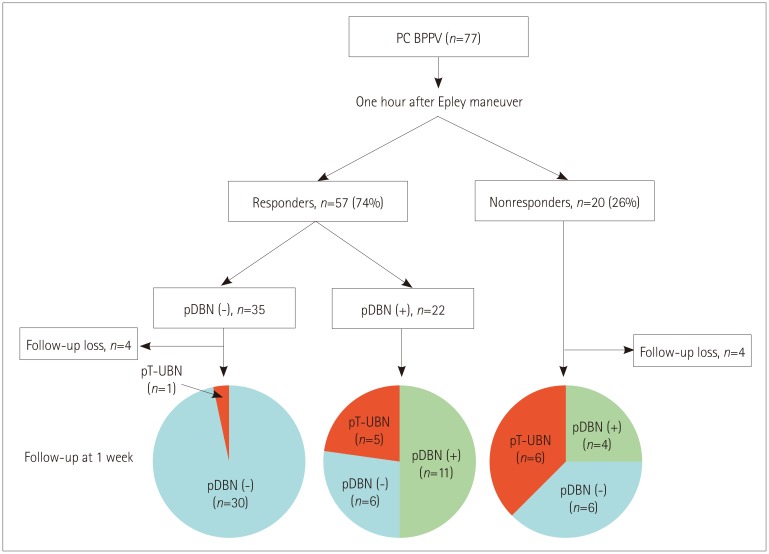
We recruited 77 patients with a diagnosis of PC BPPV, and assessed the presence of pDBN during follow-up positional tests after performing the Epley maneuver.
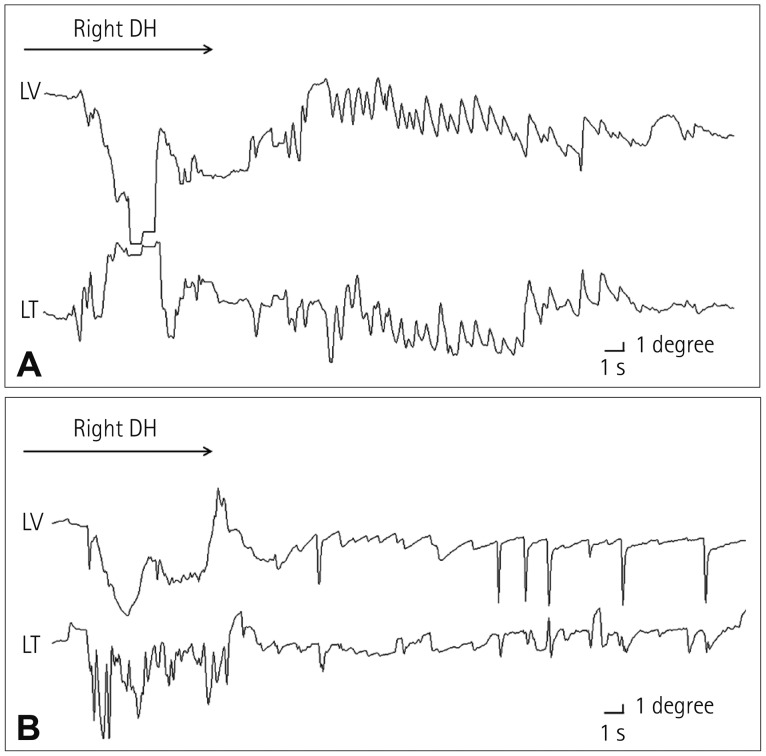
An immediate response to the Epley maneuver was exhibited by 57 of the 77 patients, with resolution of their positional torsional upbeat nystagmus (pT-UBN). Twenty-two (39%) of them exhibited pDBN during follow-up tests performed 1 hour later. The latency and duration of pDBN were 3.2±2.0 and 12.0±10.0 s (mean±SD), respectively. The maximum slowphase velocity of pDBN was 5.1±2.5 degrees, and ranged from 2.0 to 12.2 degrees. A torsional component was also observed in six patients. The patients with pDBN were much more likely to develop a typical form of PC BPPV again at a 1-week follow-up (5/22, 23%) compared to those without pDBN (1/31, 3%; =0.036). pDBN disappeared in all patients within 6 months.
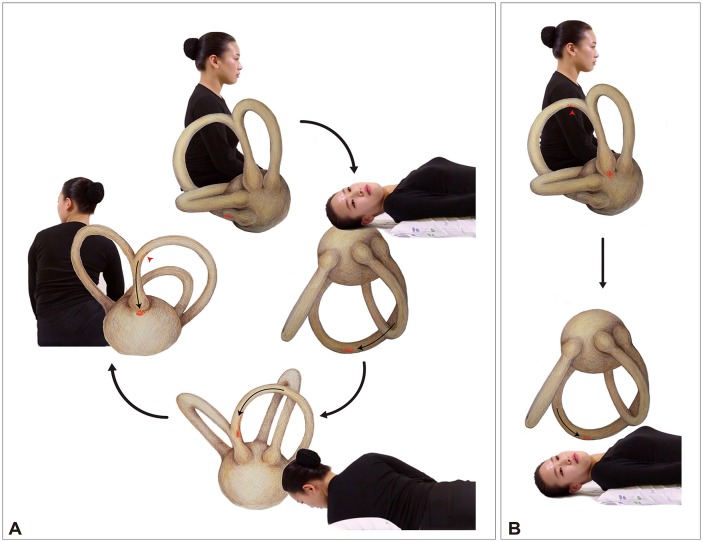
Our study found transient pDBN in 40% of patients with PC BPPV after the immediate resolution of positional vertigo and pT-UBN. pDBN may be attributed to residual debris in the distal portion of the PC, which can move toward the ampulla producing an ampullopetal flow of endolymph during positioning.
本研究旨在确定后半规管(PC)良性阵发性位置性眩晕(BPPV)治疗后位置性下跳性眼震(pDBN)的发生率及临床意义。
我们招募了77例诊断为PC BPPV的患者,并在进行Epley手法后,于随访位置试验中评估pDBN的存在情况。
77例患者中有57例对Epley手法立即产生反应,其位置性扭转上跳性眼震(pT-UBN)消失。其中22例(39%)在1小时后进行的随访试验中出现pDBN。pDBN的潜伏期和持续时间分别为3.2±2.0和12.0±10.0秒(均值±标准差)。pDBN的最大慢相速度为5.1±2.5度,范围为2.0至12.2度。6例患者还观察到扭转成分。与无pDBN的患者相比,有pDBN的患者在1周随访时再次发生典型PC BPPV的可能性更高(5/22,23% 对比1/31,3%;P = 0.036)。所有患者的pDBN在6个月内消失。
我们的研究发现,40%的PC BPPV患者在位置性眩晕和pT-UBN立即缓解后出现短暂性pDBN。pDBN可能归因于PC远端的残留碎片,其在定位过程中可向壶腹移动,产生内淋巴的向壶腹流动。