Kessler Foundation, East Hanover, and Rutgers, New Jersey Medical School, Newark, New Jersey (Drs Lequerica, Botticello, O'Neill, Lengenfelder, Krch, and Chiaravalloti); Department of Physical Medicine and Rehabilitation, Baylor College of Medicine and Harris Health System, and Brain Injury Research Center, TIRR Memorial Hermann, Houston, Texas (Dr Sander); Rusk Rehabilitation, NYU Langone Health, New York (Dr Bushnik); Craig Hospital Research Department, and Traumatic Brain Injury Model Systems National Data and Statistical Center, Englewood, Colorado (Dr Ketchum); Department of Physical Medicine and Rehabilitation, Indiana University School of Medicine, Rehabilitation Hospital of Indiana, Indianapolis (Dr Hammond); Departments of Rehabilitation Medicine and Neurology, Icahn School of Medicine at Mount Sinai, New York (Dr Dams-O'Connor); and Department of Physical Medicine and Rehabilitation, University of Miami Miller School of Medicine, Miami, Florida (Drs Felix and Johnson-Greene).
J Head Trauma Rehabil. 2019 Jan/Feb;34(1):E46-E54. doi: 10.1097/HTR.0000000000000398.
To examine the influence of nativity and residential characteristics on productive activity among Hispanics at 1 year after traumatic brain injury (TBI).
Acute rehabilitation facilities and community follow-up.
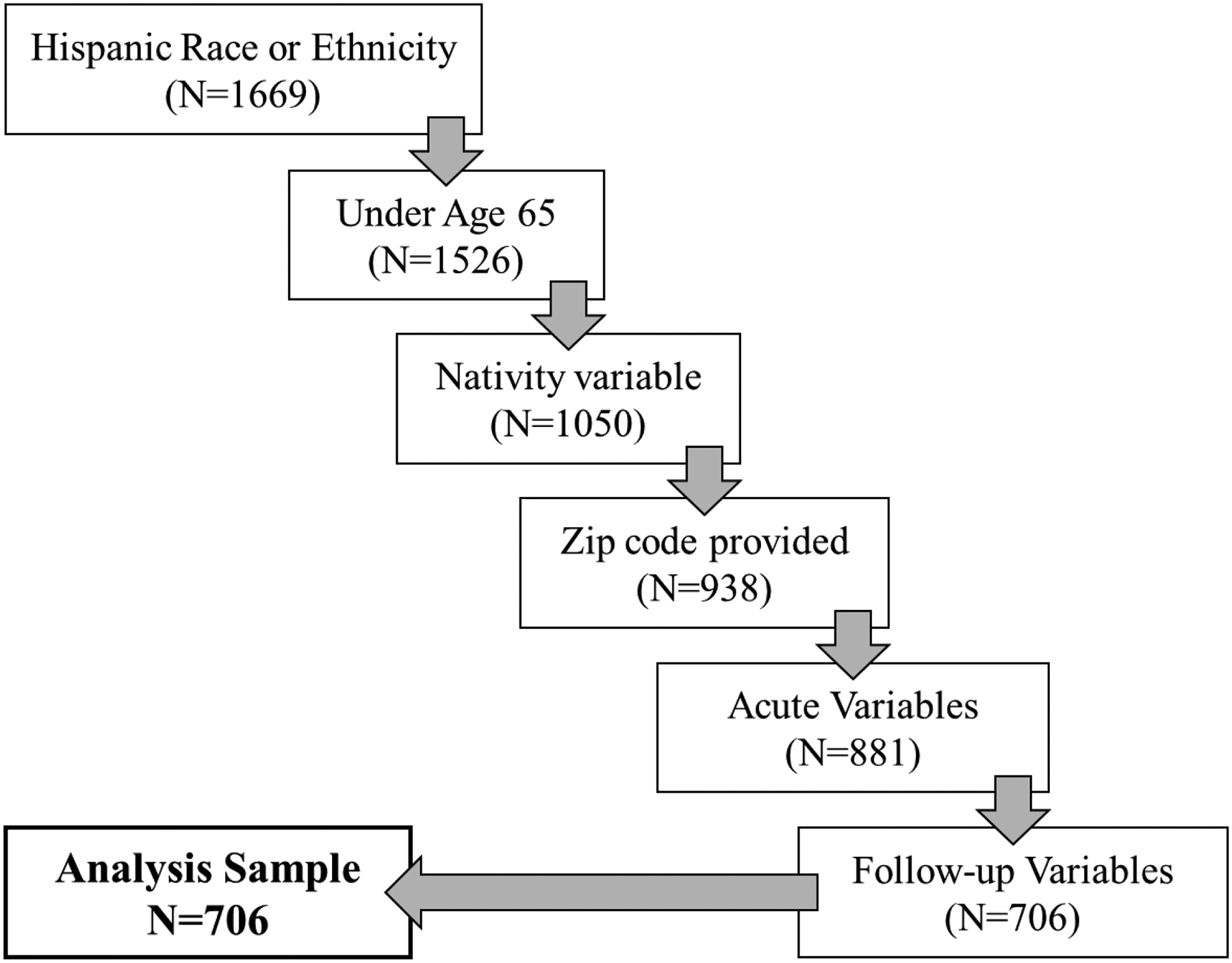
A total of 706 Hispanic individuals in the TBI Model Systems National Database.
Secondary data analysis from a multicenter longitudinal cohort study.
Nativity (foreign born or US native), productive activity derived from interview questions regarding employment status, and other demographic information. Census data were extracted by zip code to represent residential characteristics of aggregate household income and proportion of foreign language speakers (FLS).
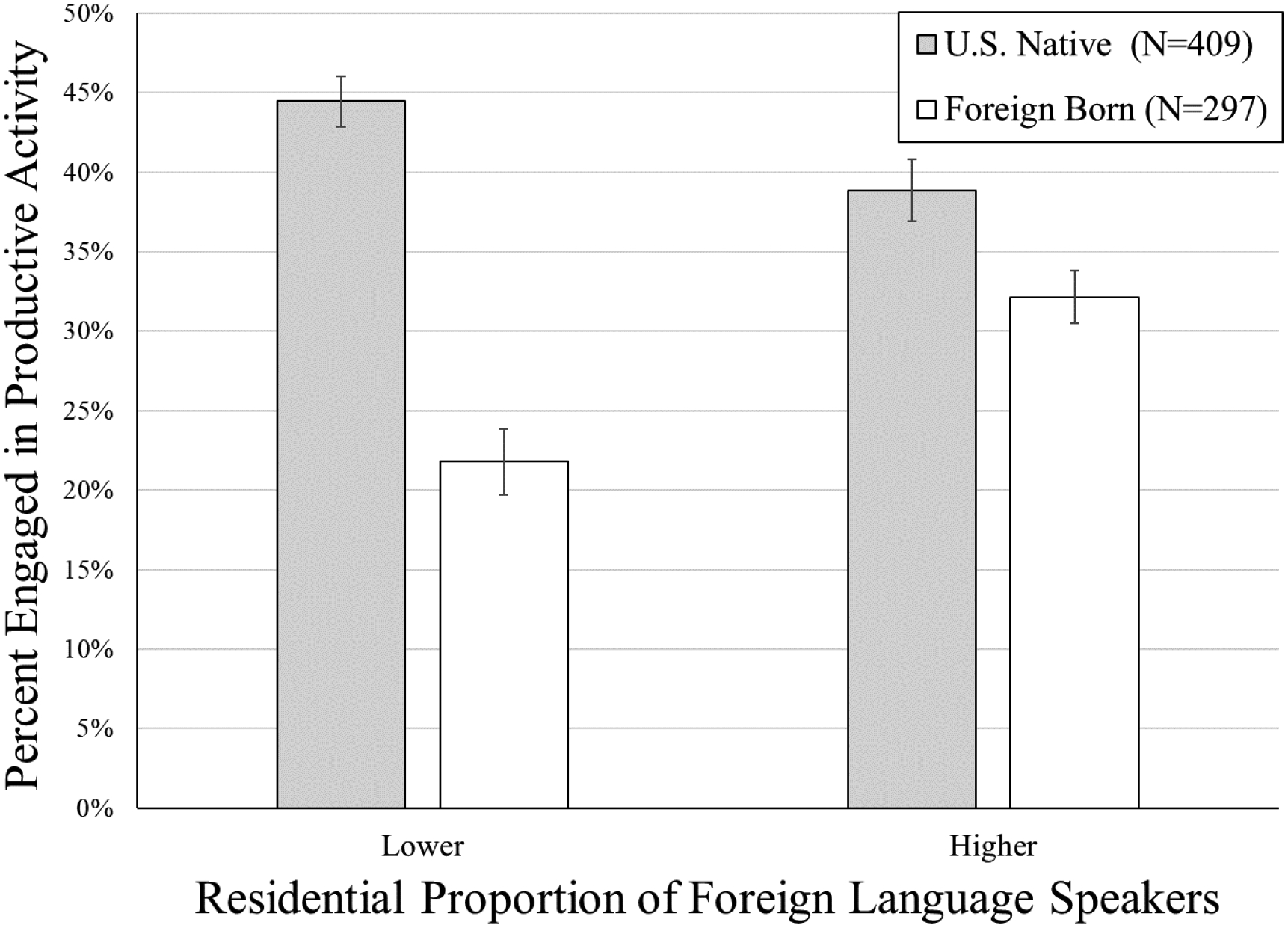
Among foreign-born individuals with TBI, those living in an area with a higher proportion of FLS were 2.8 times more likely to be productive than those living in areas with a lower proportion of FLS. Among individuals living in an area with a lower proportion of FLS, US-born Hispanics were 2.7 times more likely to be productive compared with Hispanic immigrants.
The relationship between nativity and productive activity at 1 year post-TBI was moderated by the residential proportion of FLS. Findings underscore the importance of considering environmental factors when designing vocational rehabilitation interventions for Hispanics after TBI.
研究出生国和居住特征对创伤性脑损伤(TBI)后 1 年西班牙裔人群生产性活动的影响。
急性康复设施和社区随访。
TBI 模型系统国家数据库中的 706 名西班牙裔个体。
多中心纵向队列研究的二次数据分析。
出生国(外国出生或美国本土出生)、通过询问就业状况得出的生产性活动,以及其他人口统计学信息。按邮政编码提取人口普查数据,以代表总体家庭收入和讲外语者比例(FLS)的居住特征。
在 TBI 外国出生的个体中,居住在 FLS 比例较高地区的个体比居住在 FLS 比例较低地区的个体从事生产性活动的可能性高 2.8 倍。居住在 FLS 比例较低地区的个体中,与西班牙裔移民相比,美国出生的西班牙裔从事生产性活动的可能性高 2.7 倍。
TBI 后 1 年出生国与生产性活动之间的关系受到居住 FLS 比例的调节。研究结果强调了在为 TBI 后的西班牙裔设计职业康复干预措施时,考虑环境因素的重要性。