School of Engineering and Technology, Southwest University, Chongqing 400715, China.
Australasian Joint Research Centre for Building Information Modelling, Curtin University, Perth 6102, Australia.
Int J Environ Res Public Health. 2018 Jun 8;15(6):1204. doi: 10.3390/ijerph15061204.
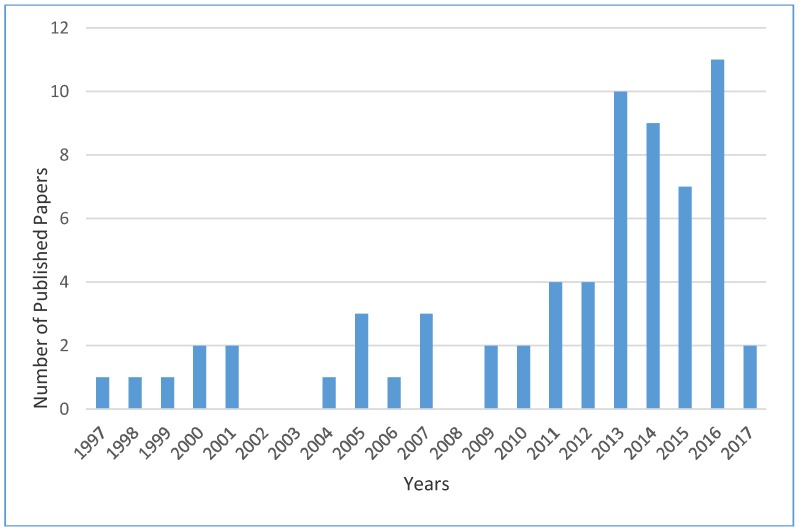
Virtual Reality (VR) has been rapidly recognized and implemented in construction engineering education and training (CEET) in recent years due to its benefits of providing an engaging and immersive environment. The objective of this review is to critically collect and analyze the VR applications in CEET, aiming at all VR-related journal papers published from 1997 to 2017. The review follows a three-stage analysis on VR technologies, applications and future directions through a systematic analysis. It is found that the VR technologies adopted for CEET evolve over time, from desktop-based VR, immersive VR, 3D game-based VR, to Building Information Modelling (BIM)-enabled VR. A sibling technology, Augmented Reality (AR), for CEET adoptions has also emerged in recent years. These technologies have been applied in architecture and design visualization, construction health and safety training, equipment and operational task training, as well as structural analysis. Future research directions, including the integration of VR with emerging education paradigms and visualization technologies, have also been provided. The findings are useful for both researchers and educators to usefully integrate VR in their education and training programs to improve the training performance.
近年来,虚拟现实(VR)由于其提供引人入胜和身临其境的环境的优势,在建筑工程教育和培训(CEET)中得到了迅速的认可和应用。本综述的目的是批判性地收集和分析 CEET 中的 VR 应用,目标是分析所有与 VR 相关的期刊论文,这些论文的发表时间为 1997 年至 2017 年。本综述通过系统分析,分三个阶段对 VR 技术、应用和未来方向进行了分析。研究发现,用于 CEET 的 VR 技术随着时间的推移而不断发展,从基于桌面的 VR、沉浸式 VR、基于 3D 游戏的 VR 到基于建筑信息模型(BIM)的 VR。近年来,CEET 应用中的一种姊妹技术——增强现实(AR)也开始出现。这些技术已经应用于建筑和设计可视化、施工健康和安全培训、设备和操作任务培训以及结构分析。还提供了未来的研究方向,包括将 VR 与新兴的教育范式和可视化技术集成。研究结果对研究人员和教育工作者都很有用,他们可以将 VR 有效地整合到他们的教育和培训计划中,以提高培训效果。