Department of Electrical and Information Engineering, Politecnico di Bari, 70125 Bari, Italy.
Sensors (Basel). 2018 Jul 2;18(7):2126. doi: 10.3390/s18072126.
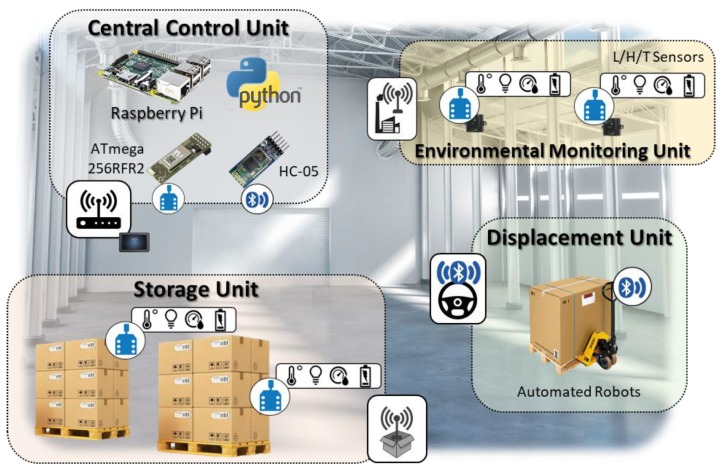
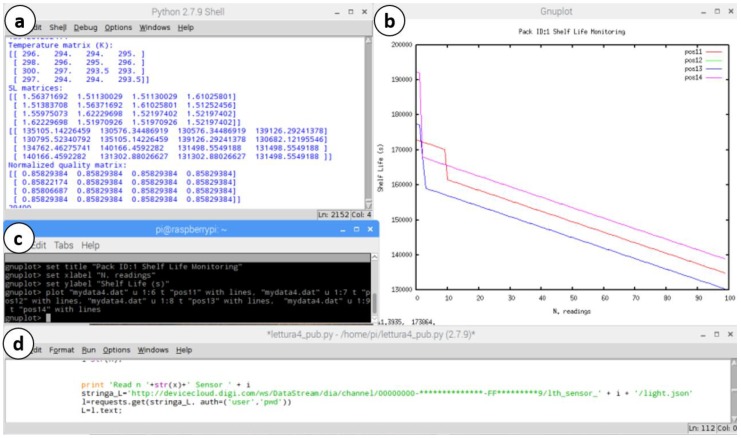
The waste in the perishable goods supply-chain has prompted many global organizations (e.g., FAO and WHO), to develop the Hazard Analysis and Critical Control Points (HACCP) protocol that ensures a high degree of food quality, minimizing the losses in all the stages of the farm-to-fork chain. It has been proven that good warehouse management practices improve the average life of perishable goods. The advances in wireless sensors network (WSN) technology offers the possibility of a "smart" storage organization. In this paper, a low cost reprogrammable WSN-based architecture for functional warehouse management is proposed. The management is based on the continuous monitoring of environmental parameters (i.e., temperature, light exposure and relative humidity), and on their combination to extract a spatial real-time prediction of the product shelf life. For each product, the quality decay is computed by using a 1st order kinetic Arrhenius model to the whole storage site area. It strives to identify, in a way compatible with the other products' shelf lives, the position within the warehouse that maximizes the food expiration date. The shelf life computing and the "first-expired first-out" logistic problem are entrusted to a Raspberry Pi-based central unit, which manages a set of automated pallet transporters for the displacement of products, according to the computed shelf lives. The management unit supports several commercial light/temperature/humidity sensor solutions, implementing ZigBee, Bluetooth and HTTP-request interfaces. A proof of concept of the presented pro-active WSN-based architecture is also shown. Comparing the proposed monitoring system for the storage of e.g., agricultural products, with a typical one, the experimental results show an improvement of the expected expiration date of about 1.2 ± 0.5 days, for each pallet, when placed in a non-refrigerated environment. In order to stress the versatility of the WSN solution, a section is dedicated to the implemented system user interfaces that highlight detecting critical situations and allow timely automatic or human interventions, minimizing the latter.
易腐货物供应链中的浪费促使许多全球性组织(如粮农组织和世界卫生组织)制定危害分析及关键控制点(HACCP)协议,以确保食品具有高度的质量,最大限度地减少从农场到餐桌链的所有阶段的损失。事实证明,良好的仓库管理实践可以提高易腐货物的平均寿命。无线传感器网络(WSN)技术的进步为“智能”存储组织提供了可能性。在本文中,提出了一种基于低成本可重编程 WSN 的仓库管理功能架构。该管理基于对环境参数(即温度、光照和相对湿度)的连续监测,并对其进行组合,以提取产品保质期的空间实时预测。对于每种产品,通过使用一阶动力学 Arrhenius 模型来计算整个存储区域的质量衰减。它旨在以与其他产品保质期兼容的方式,确定仓库内最大限度延长食品保质期的位置。保质期计算和“先进先出”物流问题委托给基于 Raspberry Pi 的中央单元,该单元根据计算出的保质期管理一组自动化托盘运输器来移动产品。管理单元支持几种商业的光/温度/湿度传感器解决方案,实现 ZigBee、蓝牙和 HTTP 请求接口。还展示了所提出的基于主动 WSN 的架构的概念验证。将所提出的用于存储农产品等的监测系统与典型系统进行比较,实验结果表明,当放置在非冷藏环境中时,每个托盘的预期保质期提高了约 1.2±0.5 天。为了强调 WSN 解决方案的多功能性,专门为实现的系统用户界面留出了一个部分,突出显示了检测关键情况并允许及时进行自动或人工干预,以最小化后者。