Scherer Ulrike, Schuett Wiebke
Institute of Zoology, Universität Hamburg, Hamburg, Germany.
School of Life Sciences, University of Sussex, Brighton, United Kingdom.
PeerJ. 2018 Aug 9;6:e5373. doi: 10.7717/peerj.5373. eCollection 2018.
In many species, males have a lower reproductive investment than females and are therefore assumed to increase their fitness with a high number of matings rather than by being choosy. However, in bi-parental species, also males heavily invest into reproduction. Here, reproductive success largely depends on costly parental care; with style and amount of parental effort in several cases being associated with personality differences (i.e., consistent between-individual differences in behaviour). Nonetheless, very little is known about the effect of personality differences on (male) mate choice in bi-parental species.
In the present study, we tested male mate choice for the level and consistency of female boldness in the rainbow krib, , a bi-parental and territorial West African cichlid. Individual boldness was assumed to indicate parental quality because it affects parental defence behaviour. For all males and females, boldness was assessed twice as the activity under simulated predation risk. Mate choice trials were conducted in two steps. First, we let a male observe two females expressing their boldness. Then, the male could choose between these two females in a standard mate choice test.
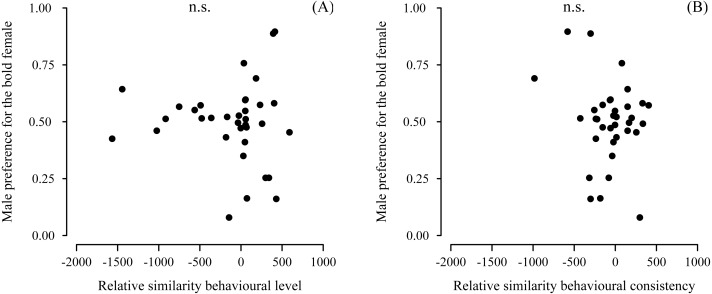
We tested for a male preference for behavioural (dis-)similarity vs. a directional preference for boldness but our data support the absence of effects of male and/or female boldness (level and consistency) on male mating preference.
Our results suggest female personality differences in boldness may not be selected for via male mate choice.
在许多物种中,雄性的生殖投入低于雌性,因此人们认为雄性通过大量交配来提高其适应性,而不是通过挑剔来实现。然而,在双亲共育的物种中,雄性在繁殖方面也投入巨大。在这里,繁殖成功很大程度上取决于代价高昂的亲代抚育;在某些情况下,亲代抚育的方式和程度与个性差异有关(即个体间行为的一致差异)。尽管如此,对于双亲共育物种中个性差异对(雄性)配偶选择的影响却知之甚少。
在本研究中,我们测试了彩虹短鲷(一种双亲共育且具领地意识的西非丽鱼科鱼类)中雄性对雌性大胆程度的水平和一致性的配偶选择。个体的大胆程度被认为可以表明亲代质量,因为它会影响亲代防御行为。对于所有雄性和雌性,大胆程度在模拟捕食风险下的活动中被评估了两次。配偶选择试验分两步进行。首先,我们让一只雄性观察两只表现出大胆程度的雌性。然后,在标准的配偶选择测试中,雄性可以在这两只雌性之间做出选择。
我们测试了雄性对行为(不)相似性的偏好与对大胆程度的定向偏好,但我们的数据支持雄性和/或雌性大胆程度(水平和一致性)对雄性交配偏好没有影响。
我们的结果表明,雌性在大胆程度上的个性差异可能不会通过雄性配偶选择而被筛选出来。