IoT Research Division, Electronics and Telecommunications Research Institute (ETRI), Daejeon 34129, Korea.
School of Convergence & Fusion System Engineering, Kyungpook National University, Sangju 37224, Korea.
Sensors (Basel). 2018 Aug 24;18(9):2792. doi: 10.3390/s18092792.
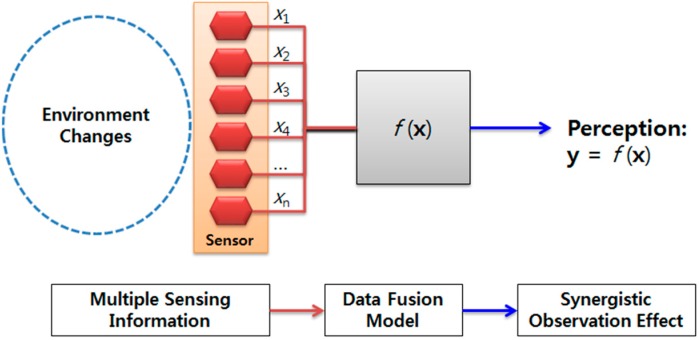
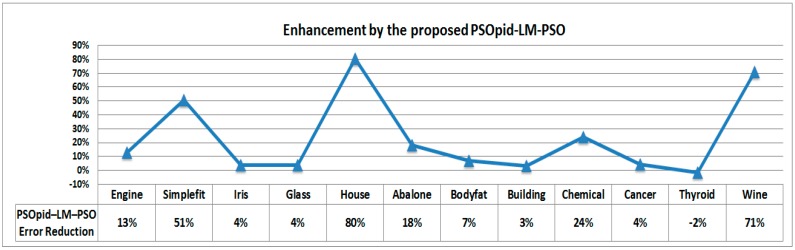
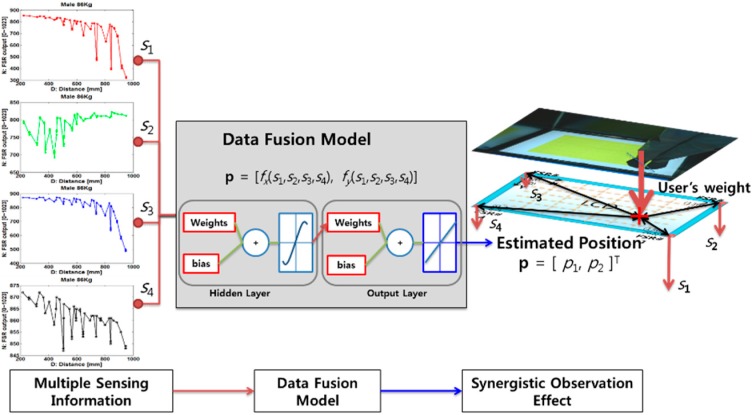
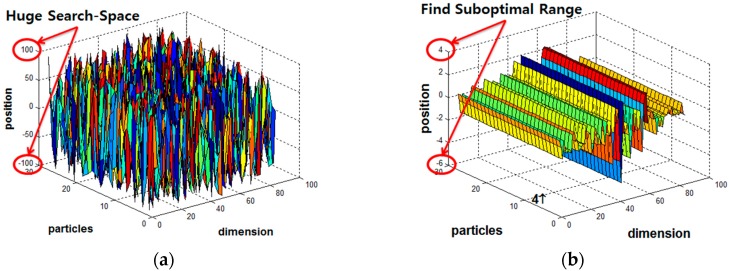
A hybrid particle swarm optimization (PSO), able to overcome the large-scale nonlinearity or heavily correlation in the data fusion model of multiple sensing information, is proposed in this paper. In recent smart convergence technology, multiple similar and/or dissimilar sensors are widely used to support precisely sensing information from different perspectives, and these are integrated with data fusion algorithms to get synergistic effects. However, the construction of the data fusion model is not trivial because of difficulties to meet under the restricted conditions of a multi-sensor system such as its limited options for deploying sensors and nonlinear characteristics, or correlation errors of multiple sensors. This paper presents a hybrid PSO to facilitate the construction of robust data fusion model based on neural network while ensuring the balance between exploration and exploitation. The performance of the proposed model was evaluated by benchmarks composed of representative datasets. The well-optimized data fusion model is expected to provide an enhancement in the synergistic accuracy.
本文提出了一种混合粒子群优化(PSO)算法,能够克服多传感信息数据融合模型中的大规模非线性或强相关性。在最近的智能融合技术中,多个相似和/或不同的传感器被广泛用于从不同角度支持精确的传感信息,并与数据融合算法集成以获得协同效应。然而,由于多传感器系统的限制条件(例如传感器的部署选项有限、非线性特征或多个传感器的相关误差),数据融合模型的构建并非易事。本文提出了一种混合 PSO 算法,以方便基于神经网络构建稳健的数据融合模型,同时确保探索和开发之间的平衡。通过由代表性数据集组成的基准评估了所提出模型的性能。优化后的数据融合模型有望提高协同精度。