Wang Qi, Zhao Tong, Zhang Wei, Yu Wenbin, Liu Bin, Wang Zhaoyang, Qiao Wen, Lu Qinghua, Wang Aihua, Zhang Mingxiang
The Key Laboratory of Cardiovascular Remodeling and Function Research, Chinese Ministry of Education and Chinese Ministry of Public Health, Qilu Hospital of Shandong University, Jinan, China.
Department of Cardiology, The Second Hospital of Shandong University, Jinan, China.
Front Pharmacol. 2018 Aug 15;9:882. doi: 10.3389/fphar.2018.00882. eCollection 2018.
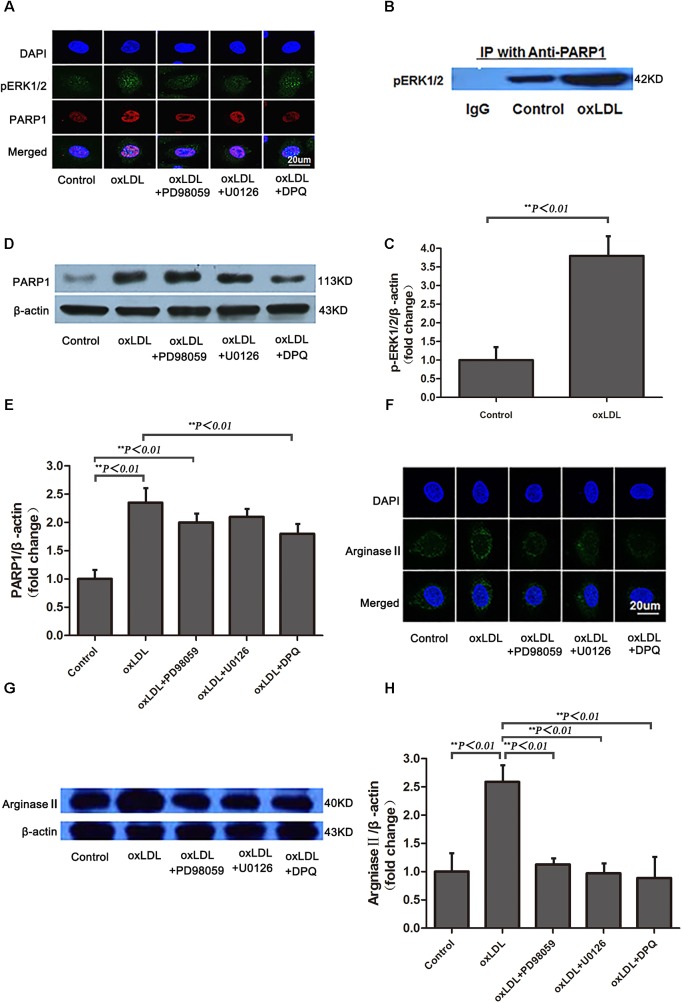
It is well known that arginase II leads to decreased synthesis of nitric oxide (NO) by competing with endothelial nitric oxide synthase (eNOS) for their same substrate L-arginine. However, the regulatory mechanisms of arginase II production remain unclear. In this study, we hypothesized that poly- (ADP-ribose) transferase/polymerase-1 (PARP-1) may be a critical factor responsible for ox-LDL (oxidized Low Density Lipoprotein)-enhanced arginase II activity. We used serial deletions within plasmid constructs and found that a core promoter region of arginase II was located at the element of -774 to -738 bp and PARP-1 was identified specifically binding to this region. Inhibition of PARP-1 markedly reduced the endogenous arginase II expression and enhanced eNOS and NO production. Similarly, ox-LDL-induced increase in arginase II production and eNOS and NO reduction was substantially abolished by PARP-1 inhibition both and . Significant decrease in arginase II expression and increase in eNOS expression and NO levels, as well as improved endothelial function were observed in PARP-1-/- mice. The underlying mechanisms of ox-LDL-induced changes of PARP-1 expression involved migration of phosphorylated ERK2 into nuclei and direct interaction with PARP-1 which dramatically enhanced PARP-1 production, followed by histone acetylation to activate arginase II transcription process. Our studies demonstrated for the first time that PARP-1 regulates basal transcription process and ox-LDL-induced up-regulation of arginase II. These results demonstrated that PARP-1 offers a promising therapeutic target for endothelial dysfunction and atherosclerosis.
众所周知,精氨酸酶II通过与内皮型一氧化氮合酶(eNOS)竞争相同底物L-精氨酸,导致一氧化氮(NO)合成减少。然而,精氨酸酶II产生的调节机制仍不清楚。在本研究中,我们假设聚(ADP-核糖)转移酶/聚合酶-1(PARP-1)可能是氧化型低密度脂蛋白(ox-LDL)增强精氨酸酶II活性的关键因素。我们使用质粒构建体中的系列缺失,发现精氨酸酶II的核心启动子区域位于-774至-738 bp元件处,并且PARP-1被鉴定为特异性结合该区域。抑制PARP-1可显著降低内源性精氨酸酶II的表达,并增强eNOS和NO的产生。同样,PARP-1抑制在体内和体外均基本消除了ox-LDL诱导的精氨酸酶II产生增加以及eNOS和NO减少。在PARP-1基因敲除小鼠中观察到精氨酸酶II表达显著降低,eNOS表达和NO水平增加,以及内皮功能改善。ox-LDL诱导的PARP-1表达变化的潜在机制涉及磷酸化的ERK2迁移到细胞核中并与PARP-1直接相互作用,这显著增强了PARP-1的产生,随后进行组蛋白乙酰化以激活精氨酸酶II转录过程。我们的研究首次证明PARP-1调节基础转录过程以及ox-LDL诱导的精氨酸酶II上调。这些结果表明PARP-1为内皮功能障碍和动脉粥样硬化提供了一个有前景的治疗靶点。