Peng Xingchen, Su Yonglin, Hu Zhonghua, Sun Xiye, Li Xiaoping, Dolansky Mary A, Qu Moying, Hu Xiaolin
Department of Medical Oncology, Cancer Center, State Key Laboratory of Biotherapy, West China Hospital Administration Center of Medicine, Sichuan University School of Nursing, Chengdu University of Traditional Chinese Medicine, Chengdu, Sichuan XiangYa School of Medicine, Central South University, Changsha, Hunan Department of Nursing, West China Hospital, Sichuan University, Chengdu, Sichuan Frances Payne Bolton School of Nursing, Case Western Reserve University, Cleveland, OH Department of Cardiology, West China Hospital, Sichuan University, Chengdu, Sichuan, People's Republic of China.
Medicine (Baltimore). 2018 Aug;97(35):e12069. doi: 10.1097/MD.0000000000012069.
Homed-based exercise training via telehealth is an effective method for cardiac rehabilitation in patients with heart failure (HF). However, little is known about the effects of telehealth exercise training among patients with HF in China.
A randomized controlled design with repeated measures was adopted in this study.
To examine the effect of our telehealth exercise training program on health outcomes in patients with HF in China.
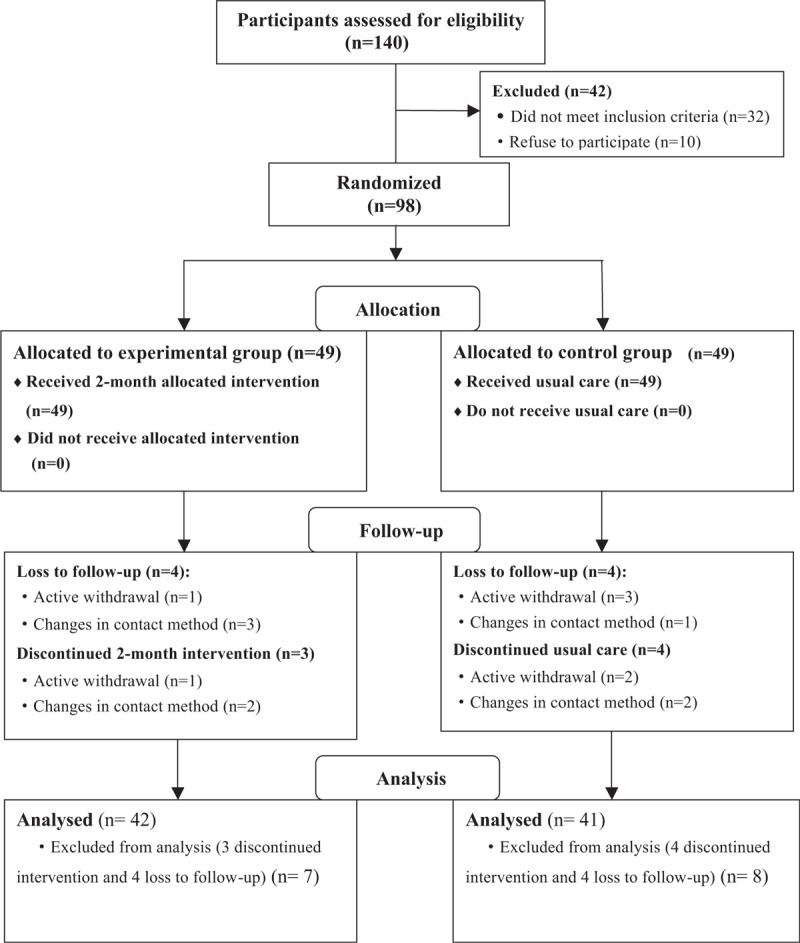
A total of 98 participants were randomly allocated to an experimental group (n = 49) and control group (n = 49) from January 2014 to February 2015 in a teaching hospital in Chengdu, People's Republic of China. Participants in the experimental group underwent an 8-week home-based telehealth exercise training program, including 32 exercise training sessions, with regular telephone or instant messaging follow-ups and consultations. Participants in the control group received usual care. The outcome variables used in this study were the Minnesota Living with Heart Failure Questionnaire, 6-minute walking distance (6MWD), resting heart rate (HR), Hospital Anxiety and Depression Scale, left ventricular ejection fraction (LVEF), and the New York Heart Association (NYHA) classification. Data were collected at baseline, post-test (2 months after discharge), and 4 months post-test (6 months after discharge). Repeated measures ANOVA was used to examine the effects of groups, changes over time, and interaction of time and group with the above variables.
Statistically significant improvements were observed in the experimental group regarding quality of life (QOL) and 6MWD compared to the control group post-test. Significant improvements in QOL, 6MWD, and resting HR were sustained for 4 months post-test. However, no significant improvements were observed regarding the NYHA classification, LVEF, anxiety, and depression at either the post-test or 4-month post-test follow-ups. No patients experienced any significant complications or adverse outcomes during the program.
The results reveal that telehealth exercise training is an effective alternative method for cardiac rehabilitation, especially under the conditions in China.
通过远程医疗进行的居家运动训练是心力衰竭(HF)患者心脏康复的有效方法。然而,在中国HF患者中,远程医疗运动训练的效果鲜为人知。
本研究采用重复测量的随机对照设计。
探讨我们的远程医疗运动训练方案对中国HF患者健康结局的影响。
2014年1月至2015年2月,在中国成都的一家教学医院,共有98名参与者被随机分配到实验组(n = 49)和对照组(n = 49)。实验组的参与者接受了为期8周的居家远程医疗运动训练方案,包括32次运动训练课程,并定期进行电话或即时通讯随访及咨询。对照组的参与者接受常规护理。本研究使用的结局变量包括明尼苏达心力衰竭生活问卷、6分钟步行距离(6MWD)、静息心率(HR)、医院焦虑抑郁量表、左心室射血分数(LVEF)以及纽约心脏协会(NYHA)分级。在基线、测试后(出院后2个月)和测试后4个月(出院后6个月)收集数据。采用重复测量方差分析来检验组间效应、随时间的变化以及时间与组间对上述变量的交互作用。
与对照组测试后相比,实验组在生活质量(QOL)和6MWD方面有统计学意义的改善。测试后4个月,QOL、6MWD和静息HR持续有显著改善。然而,在测试后或测试后4个月的随访中,NYHA分级、LVEF、焦虑和抑郁方面均未观察到显著改善。在该方案实施期间,没有患者出现任何严重并发症或不良结局。
结果表明,远程医疗运动训练是心脏康复的一种有效替代方法,尤其是在中国的条件下。