Department of Neuroscience, Thomas Jefferson University, Philadelphia, PA.
Department of Neurology, Thomas Jefferson University, Philadelphia, PA.
Ann Neurol. 2018 Oct;84(4):588-600. doi: 10.1002/ana.25325. Epub 2018 Oct 4.
Intracellular recordings from cells in entorhinal cortex tissue slices show that low-voltage fast (LVF) onset seizures are generated by inhibitory events. Here, we determined whether increased firing of interneurons occurs at the onset of spontaneous mesial-temporal LVF seizures recorded in patients.
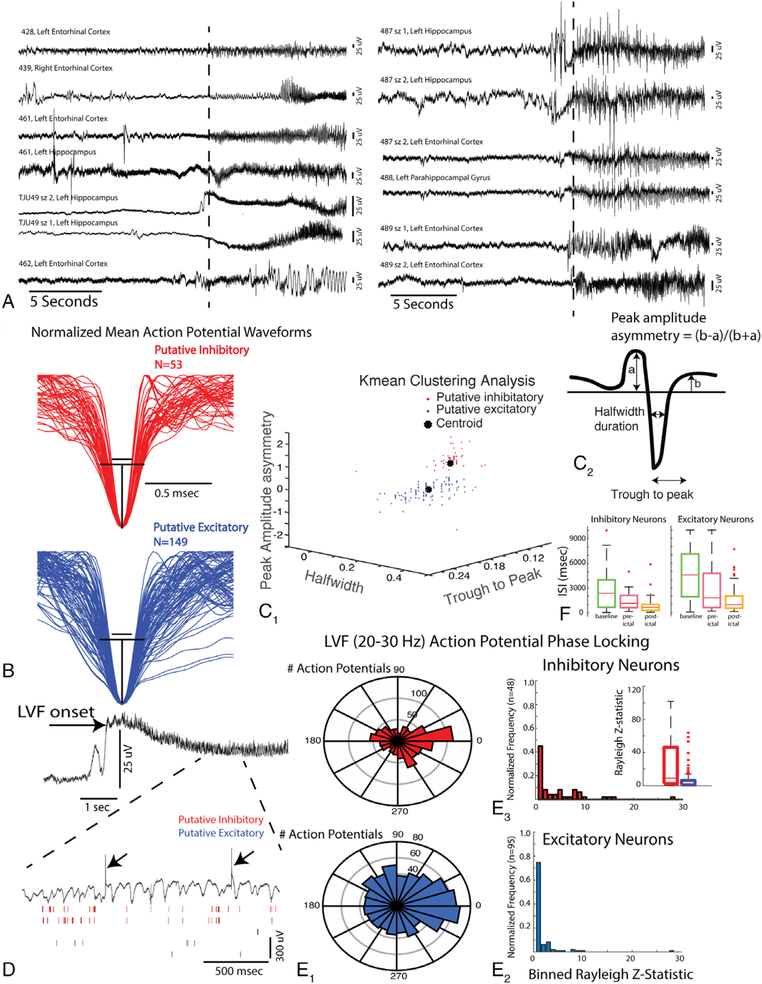
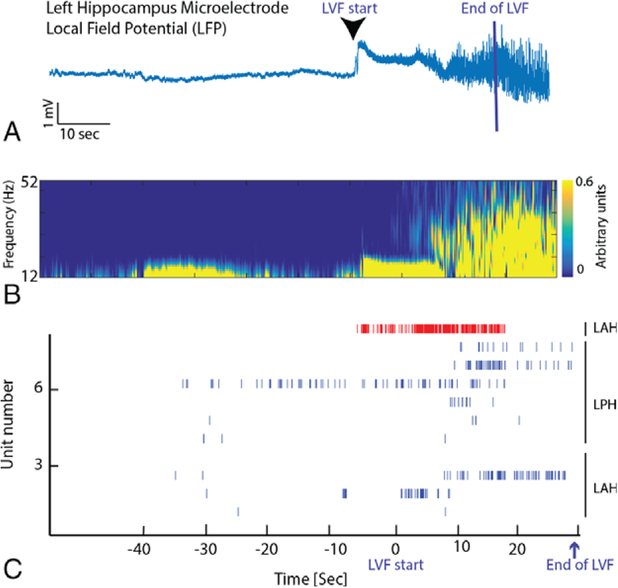
The seizure onset zone (SOZ) was identified using visual inspection of the intracranial electroencephalogram. We used wavelet clustering and temporal autocorrelations to characterize changes in single-unit activity during the onset of LVF seizures recorded from microelectrodes in mesial-temporal structures. Action potentials generated by principal neurons and interneurons (ie, putative excitatory and inhibitory neurons) were distinguished using waveform morphology and K-means clustering.
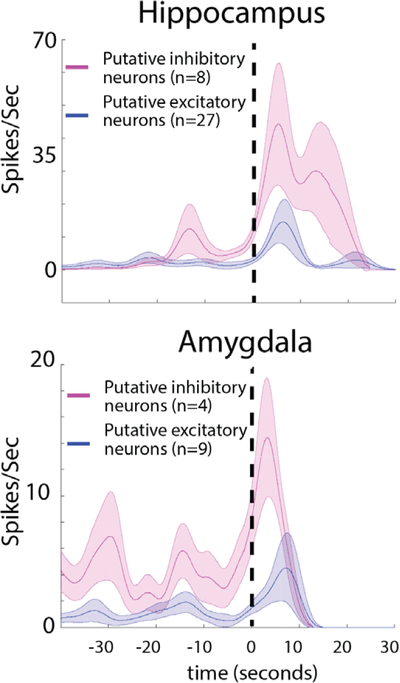
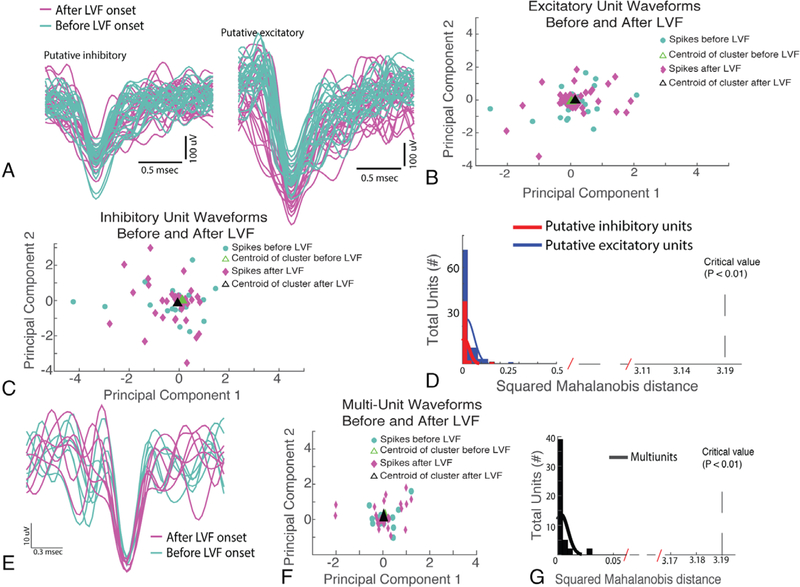
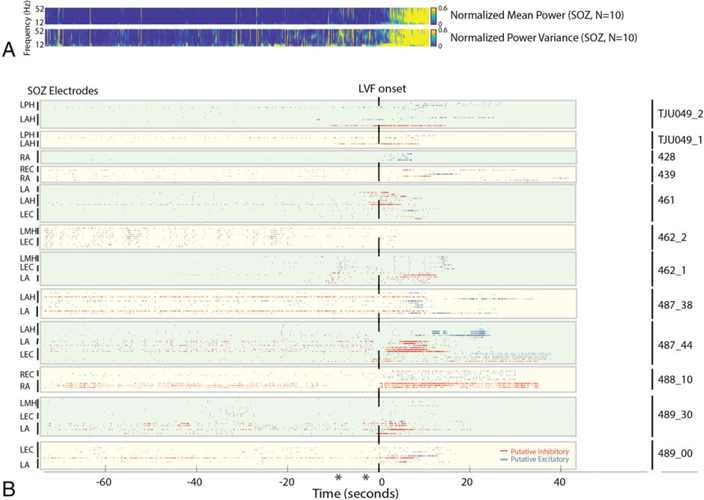
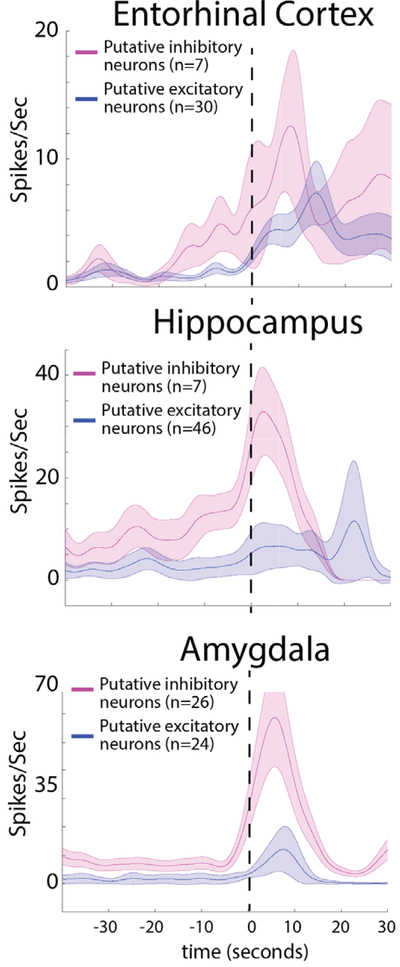
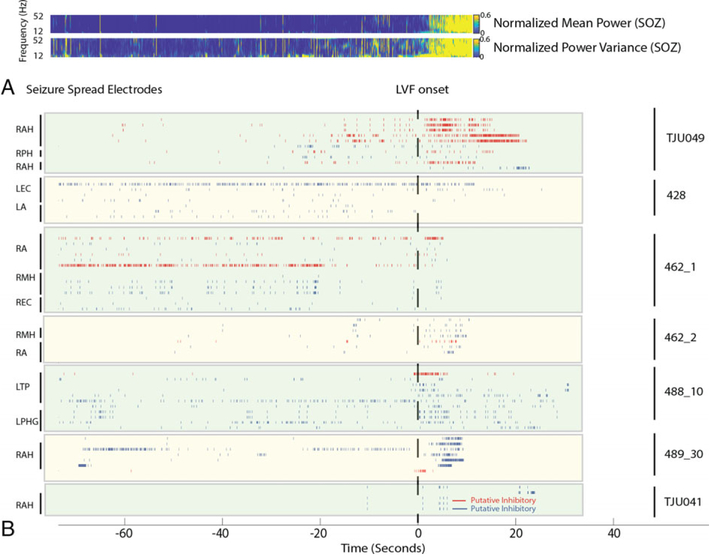
From a total of 200 implanted microelectrodes in 9 patients during 13 seizures, we isolated 202 single units; 140 (69.3%) of these units were located in the SOZ, and 40 (28.57%) of them were classified as inhibitory. The waveforms of both excitatory and inhibitory units remained stable during the LVF epoch (p > > 0.05). In the mesial-temporal SOZ, inhibitory interneurons increased their firing rate during LVF seizure onset (p < 0.01). Excitatory neuron firing rates peaked 10 seconds after the inhibitory neurons (p < 0.01). During LVF spread to the contralateral mesial temporal lobe, an increase in inhibitory neuron firing rate was also observed (p < 0.01).
Our results suggest that seizure generation and spread during spontaneous mesial-temporal LVF onset events in humans may result from increased inhibitory neuron firing that spawns a subsequent increase in excitatory neuron firing and seizure evolution. Ann Neurol 2018;84:588-600.
从内嗅皮层组织切片中的细胞进行的细胞内记录表明,低电压快速(LVF)发作性癫痫是由抑制性事件引起的。在这里,我们确定在患者记录的自发性内侧颞叶 LVF 发作的起始时,中间神经元的放电是否增加。
通过对颅内脑电图的视觉检查确定癫痫发作起始区(SOZ)。我们使用小波聚类和时间自相关来描述从中侧颞叶结构中的微电极记录的 LVF 发作起始时的单个单元活动的变化。使用波形形态和 K-均值聚类来区分主神经元和中间神经元(即,假定的兴奋性和抑制性神经元)产生的动作电位。
在 9 名患者的 13 次癫痫发作期间,总共在 200 个植入的微电极中,我们分离出 202 个单个单元;其中 140 个(69.3%)位于 SOZ 中,其中 40 个(28.57%)被分类为抑制性。在 LVF 期间,兴奋性和抑制性单元的波形均保持稳定(p>>0.05)。在中颞叶 SOZ 中,抑制性中间神经元在 LVF 发作起始时增加了其放电率(p<0.01)。兴奋性神经元的放电率在抑制性神经元后 10 秒达到峰值(p<0.01)。在 LVF 传播到对侧中颞叶时,也观察到抑制性神经元放电率的增加(p<0.01)。
我们的结果表明,在人类自发性中颞叶 LVF 起始事件中,癫痫发作的产生和传播可能是由于抑制性神经元放电增加,继而引起兴奋性神经元放电增加和癫痫发作的演变。Ann Neurol 2018;84:588-600。