
青少年大麻素暴露会引起易怒样行为和可卡因交叉敏感化,而不会影响成年后可卡因自我给药的升级。
Adolescent cannabinoid exposure induces irritability-like behavior and cocaine cross-sensitization without affecting the escalation of cocaine self-administration in adulthood.
机构信息
Department of Neuroscience, The Scripps Research Institute, La Jolla, CA, 92037, USA.
Department of Neuroscience, Columbia University, New York, NY, 10032, USA.
出版信息
Sci Rep. 2018 Sep 17;8(1):13893. doi: 10.1038/s41598-018-31921-5.
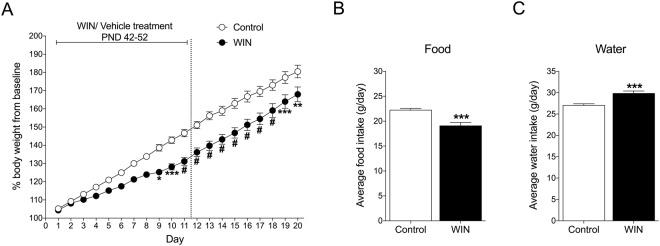
Cannabis use is typically initiated during adolescence and is a significant risk factor for the development of cocaine use in adulthood. However, no preclinical studies have examined the effects of adolescent cannabinoid exposure on cocaine dependence in adulthood using the escalation model of cocaine self-administration and the assessment of negative emotional states. In the present study, we found that exposure to the cannabinoid receptor agonist WIN55,212-2 (WIN) in adolescence produced irritability-like behavior and psychomotor cross-sensitization to cocaine in adolescence. In adulthood, rats were allowed to self-administer cocaine. The acquisition of cocaine self-administration was lower in rats with adolescent WIN exposure compared with controls. However, both WIN-exposed and control rats escalated their cocaine intake at the same rate, had similar responding under a progressive-ratio schedule of reinforcement, and had similar psychomotor responses to cocaine. Interestingly, the increase in irritability-like behavior that was previously observed in adolescence after WIN exposure persisted into adulthood. Whether the persisting increase in irritability-like behavior after WIN exposure has translational relevance remains to be studied. In summary, these results suggest that psychoactive cannabinoid exposure during adolescence is unlikely to have a major effect on the escalation of cocaine intake or the development of compulsive-like responding per se in adulthood in a rat model of cocaine self-administration. However, whether the persisting irritability-like behavior may predispose an individual to mood-related impairments in adulthood or predict such impairments warrants further investigation.
大麻的使用通常始于青少年时期,是成年后使用可卡因的一个重要风险因素。然而,目前还没有临床前研究使用可卡因自我给药的递增模型和对负性情绪状态的评估,来检测青少年期大麻素暴露对成年期可卡因依赖的影响。在本研究中,我们发现青春期暴露于大麻素受体激动剂 WIN55,212-2(WIN)可导致易怒样行为和对可卡因的精神运动交叉敏化。成年后,大鼠被允许自我给予可卡因。与对照组相比,青春期 WIN 暴露的大鼠可卡因自我给药的获得率较低。然而,WIN 暴露组和对照组大鼠以相同的速度增加可卡因摄入量,在递增比例强化程序下的反应相似,对可卡因的精神运动反应也相似。有趣的是,之前在青春期 WIN 暴露后观察到的易怒样行为增加在成年后持续存在。WIN 暴露后持续存在的易怒样行为是否具有转化相关性仍有待研究。总之,这些结果表明,在大鼠可卡因自我给药模型中,青春期的精神活性大麻素暴露不太可能对可卡因摄入量的增加或强迫样反应的发展产生重大影响。然而,持续存在的易怒样行为是否会使个体易患成年期与情绪相关的损伤,或者是否可以预测这种损伤,仍需要进一步研究。




 Zotero 插件