
免疫功能低下的低氧血症急性呼吸衰竭患者的氧合/无创通气策略及插管风险
Oxygenation/non-invasive ventilation strategy and risk for intubation in immunocompromised patients with hypoxemic acute respiratory failure.
作者信息
Dumas Guillaume, Chevret Sylvie, Lemiale Virginie, Pène Frédéric, Demoule Alexandre, Mayaux Julien, Kouatchet Achille, Nyunga Martine, Perez Pierre, Argaud Laurent, Barbier François, Vincent François, Bruneel Fabrice, Klouche Kada, Kontar Loay, Moreau Anne-Sophie, Reignier Jean, Papazian Laurent, Cohen Yves, Mokart Djamel, Azoulay Elie
机构信息
Medical Intensive Care Unit, Saint-Louis Teaching Hospital, Paris, France.
ECSTRA Team, Biostatistics and Clinical Epidemiology, UMR 1153 (Center of Epidemiology and Biostatistic Sorbonne Paris Cité, CRESS), INSERM, Paris Diderot University, Paris, France.
出版信息
Oncotarget. 2018 Sep 14;9(72):33682-33693. doi: 10.18632/oncotarget.26069.
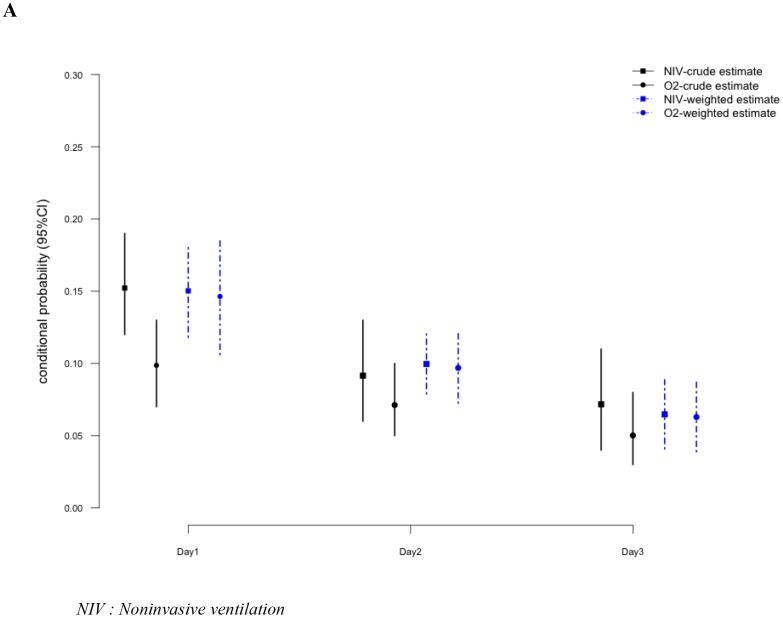
We investigated how the initial ventilation/oxygenation management may influence the need for intubation on the coming day in a cohort of immunocompromised patients with acute hypoxemic respiratory failure (ARF). Data from 847 immunocompromised patients with ARF were used to estimate the probability of intubation at day+1 within the first 3 days of ICU admission, according to oxygenation management. First, noninvasive ventilation (NIV) was compared to oxygen therapy whatever the administration device; then standard oxygen was compared to High Flow Nasal Cannula therapy alone (HFNC), NIV alone or NIV+HFNC. To take into account the oxygenation regimens over time and to handle confounders, propensity score weighting models were used. In the original sample, the probability of intubation at day+1 was higher in the NIV group vs oxygenation therapy (OR = 1.64, 95CI, 1.09-2.48) or vs the standard oxygen group (OR = 2.05, 95CI: 1.29-3.29); it was also increased in the HFNC group compared to standard oxygen (OR = 2.85, 95CI: 1.37-5.67). However, all these differences disappeared by handling confounding-by-indication in the weighted samples, as well as in the pooled model. Note that adjusted OR for day-28 mortality increased with the day of intubation. In this large cohort of immunocompromised patients, ventilation/oxygenation management had no impact on the probability of intubation on the coming day.
我们调查了在一组患有急性低氧性呼吸衰竭(ARF)的免疫功能低下患者中,初始通气/氧合管理如何影响次日的插管需求。根据氧合管理情况,使用来自847例患有ARF的免疫功能低下患者的数据来估计入住重症监护病房(ICU)前3天内第1天插管的概率。首先,将无创通气(NIV)与无论何种给药装置的氧疗进行比较;然后将标准氧疗分别与单独的高流量鼻导管治疗(HFNC)、单独的NIV或NIV+HFNC进行比较。为了考虑随时间变化的氧合方案并处理混杂因素,使用了倾向评分加权模型。在原始样本中,NIV组第1天插管的概率高于氧疗组(OR=1.64,95%CI:1.09-2.48)或高于标准氧疗组(OR=2.05,95%CI:1.29-3.29);与标准氧疗相比,HFNC组的概率也有所增加(OR=2.85,95%CI:1.37-5.67)。然而,在加权样本以及合并模型中,通过处理指示性混杂因素后,所有这些差异均消失。请注意,第28天死亡率的调整后OR随着插管日期的增加而升高。在这一大型免疫功能低下患者队列中,通气/氧合管理对次日插管的概率没有影响。

 Zotero 插件