
组蛋白赖氨酸甲基转移酶抑制剂通过改变双链断裂处的 H3K4 甲基化克服癌症中的放射抵抗性。
Jumonji Inhibitors Overcome Radioresistance in Cancer through Changes in H3K4 Methylation at Double-Strand Breaks.
机构信息
Department of Pharmacology, UT Southwestern Medical Center, Dallas, TX, USA; Instituto de Investigaciones en Medicina Traslacional, CONICET, Universidad Austral, Argentina.
Hamon Center for Therapeutic Oncology Research, UT Southwestern Medical Center, Dallas, TX, USA.
出版信息
Cell Rep. 2018 Oct 23;25(4):1040-1050.e5. doi: 10.1016/j.celrep.2018.09.081.
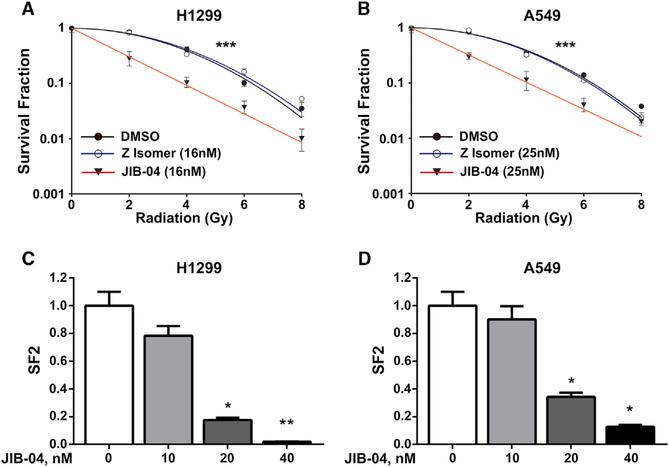
We have uncovered a role for Jumonji inhibitors in overcoming radioresistance through KDM5B inhibition. Pharmacological blockade of Jumonji demethylases with JIB-04 leads to specific accumulation of H3K4me3 at sites marked by γH2AX and impaired recruitment of DNA repair factors, preventing resolution of damage and resulting in robust sensitization to radiation therapy. In DNA-repair-proficient cancer cells, knockdown of the H3K4me3 demethylase KDM5B, but not other Jumonji enzymes, mimics pharmacological inhibition, and KDM5B overexpression rescues this phenotype and increases radioresistance. The H3K4me3 demethylase inhibitor PBIT also sensitizes cancer cells to radiation, while an H3K27me3 demethylase inhibitor does not. In vivo co-administration of radiation with JIB-04 significantly prolongs the survival of mice with tumors even long after cessation of treatment. In human patients, lung squamous cell carcinomas highly expressing KDM5B respond poorly to radiation. Thus, we propose the use of Jumonji KDM inhibitors as potent radiosensitizers.
我们发现 Jumonji 抑制剂在通过抑制 KDM5B 来克服放射抵抗方面发挥了作用。用 JIB-04 抑制 Jumonji 去甲基酶可导致 γH2AX 标记的位点特异性 H3K4me3 积累,并损害 DNA 修复因子的募集,从而阻止损伤的解决,导致对放射治疗的强烈增敏作用。在 DNA 修复功能正常的癌细胞中,H3K4me3 去甲基酶 KDM5B 的敲低,而不是其他 Jumonji 酶,模拟了药物抑制,而 KDM5B 的过表达挽救了这种表型并增加了放射抵抗性。H3K4me3 去甲基酶抑制剂 PBIT 也使癌细胞对辐射敏感,而 H3K27me3 去甲基酶抑制剂则没有。在体内,与 JIB-04 联合应用放射治疗可显著延长肿瘤小鼠的存活时间,甚至在治疗停止后很长时间。在人类患者中,高表达 KDM5B 的肺鳞状细胞癌对放射治疗反应不佳。因此,我们提出使用 Jumonji KDM 抑制剂作为有效的放射增敏剂。



 Zotero 插件