
血管内动脉瘤修复术后因感染产单核细胞李斯特菌而破裂的腹主动脉瘤的原位移植物置换术
In Situ Graft Replacement for a Ruptured Abdominal Aortic Aneurysm Infected with Listeria monocytogenes after Endovascular Aneurysm Repair.
作者信息
Yamamoto Tsunehisa, Oka Katsuhiko, Kanda Keiichi, Sakai Osamu, Watanabe Taiji, Yaku Hitoshi
机构信息
Department of Cardiovascular Surgery, Graduate School of Medical Science, Kyoto Prefectural University of Medicine, Kyoto, Japan.
出版信息
Ann Vasc Dis. 2018 Sep 25;11(3):346-349. doi: 10.3400/avd.cr.18-00040.
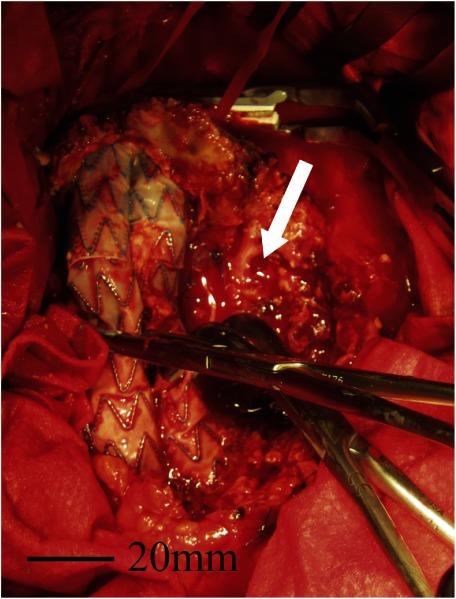
Listeria monocytogenes infection and rupture of the aneurysm sac, after endovascular aneurysm repair (EVAR), are both rare. We report the case of an 82-year-old man who presented with a ruptured aneurysm by infection with L. monocytogenes after EVAR. We successfully treated him by in situ reconstruction with a bifurcated expanded polytetrafluoroethylene (ePTFE) graft, with partial removal of the infected stent graft. At 30 months from the reoperation, the patient was in good health at home, with no symptoms of infection, and the gallium-67-citrate single-photon emission computed tomography/computed tomography (SPECT/CT) fusion images confirmed no fluid accumulation.
在血管内动脉瘤修复术(EVAR)后,单核细胞增生李斯特菌感染和动脉瘤囊破裂均较为罕见。我们报告一例82岁男性患者,其在EVAR术后因单核细胞增生李斯特菌感染出现动脉瘤破裂。我们通过使用分叉型膨体聚四氟乙烯(ePTFE)移植物进行原位重建,并部分移除感染的覆膜支架成功治疗了该患者。再次手术后30个月,患者在家中健康状况良好,无感染症状,枸橼酸镓-67单光子发射计算机断层扫描/计算机断层扫描(SPECT/CT)融合图像证实无积液。


 Zotero 插件