Iasevoli Felice, Avagliano Camilla, Altavilla Benedetta, Barone Annarita, D'Ambrosio Luigi, Matrone Marta, Notar Francesco Danilo, Razzino Eugenio, de Bartolomeis Andrea
Section of Psychiatry - Unit on Treatment Resistant Psychosis, Laboratory of Molecular and Translational Psychiatry, Department of Neuroscience, University School of Medicine Federico II, Naples, Italy.
Front Psychiatry. 2018 Oct 31;9:553. doi: 10.3389/fpsyt.2018.00553. eCollection 2018.
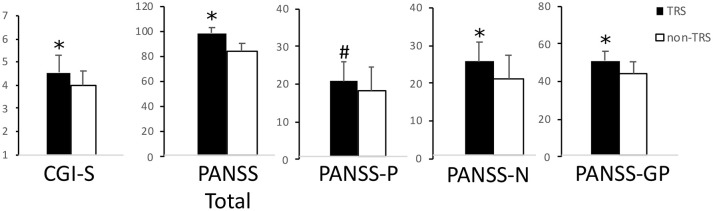
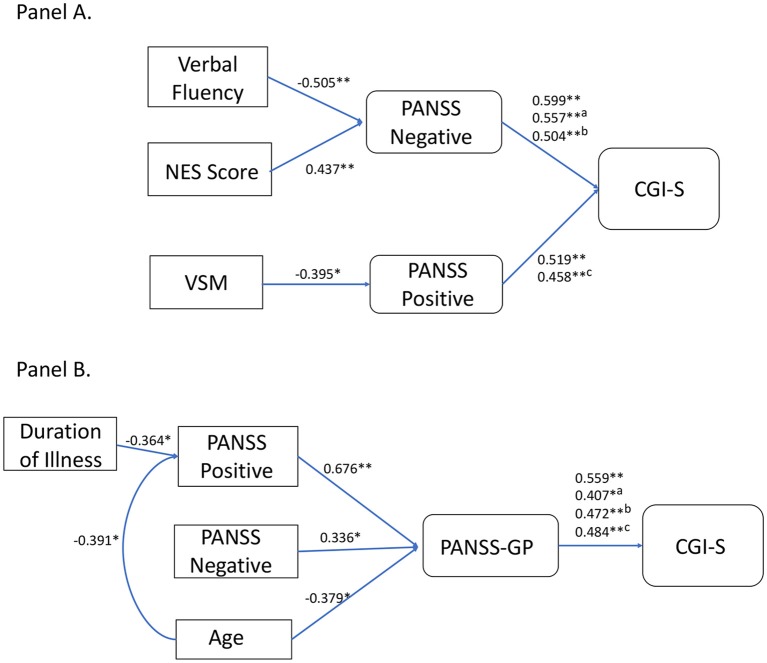
This study was aimed at assessing whether disease severity was higher in a sample of Treatment Resistant Schizophrenia patients (TRS) compared to schizophrenia patients responsive to antipsychotics (non-TRS). Determinants of disease severity were also investigated in these groups. Eligible patients were screened by standardized diagnostic algorithm to categorize them as TRS or non-TRS. All patients underwent the following assessments: CGI-S; PANSS; DAI; NES; a battery of cognitive tests. Socio-demographic and clinical variables were also recorded. TRS patients exhibited significantly higher disease severity and psychotic symptoms, either as PANSS total score or subscales' scores. A preliminary correlation analysis ruled out clinical and cognitive variables not associated with disease severity in the two groups. Hierarchical linear regression showed that negative symptoms were the clinical variable explaining the highest part of variation in disease severity in TRS, while in non-TRS patients PANSS-General Psychopathology was the variable explaining the highest variation. Mediation analysis showed that negative symptoms mediate the effects of verbal fluency dysfunctions and high-level neurological soft signs (NSS) on TRS' disease severity. These results show that determinants of disease severity sharply differ in TRS and non-TRS patients, and let hypothesize that TRS may stem from cognitive disfunctions and putatively neurodevelopmental aberrations.
本研究旨在评估与对抗精神病药物有反应的精神分裂症患者(非治疗抵抗性精神分裂症患者)相比,治疗抵抗性精神分裂症患者(TRS)样本中的疾病严重程度是否更高。还对这些组中疾病严重程度的决定因素进行了调查。通过标准化诊断算法对符合条件的患者进行筛查,以将他们分类为TRS或非TRS。所有患者均接受了以下评估:临床总体印象量表严重程度分量表(CGI-S);阳性和阴性症状量表(PANSS);功能大体评定量表(DAI);神经精神症状量表(NES);一系列认知测试。还记录了社会人口统计学和临床变量。TRS患者表现出明显更高的疾病严重程度和精神病症状,无论是PANSS总分还是各分量表得分。初步相关性分析排除了与两组疾病严重程度无关的临床和认知变量。分层线性回归表明,阴性症状是解释TRS疾病严重程度变化最大部分的临床变量,而在非TRS患者中,PANSS-一般精神病理学是解释变化最大的变量。中介分析表明,阴性症状介导了言语流畅性功能障碍和高级神经学软性体征(NSS)对TRS疾病严重程度的影响。这些结果表明,TRS和非TRS患者疾病严重程度的决定因素存在显著差异,并推测TRS可能源于认知功能障碍和假定的神经发育异常。