Kamiri Mourad, Stift Marc, Costantino Gilles, Dambier Dominique, Kabbage Tariq, Ollitrault Patrick, Froelicher Yann
UMR AGAP, CIRAD, San Giuliano, France.
Ecology, Department of Biology, University of Konstanz, Konstanz, Germany.
Front Plant Sci. 2018 Nov 2;9:1557. doi: 10.3389/fpls.2018.01557. eCollection 2018.
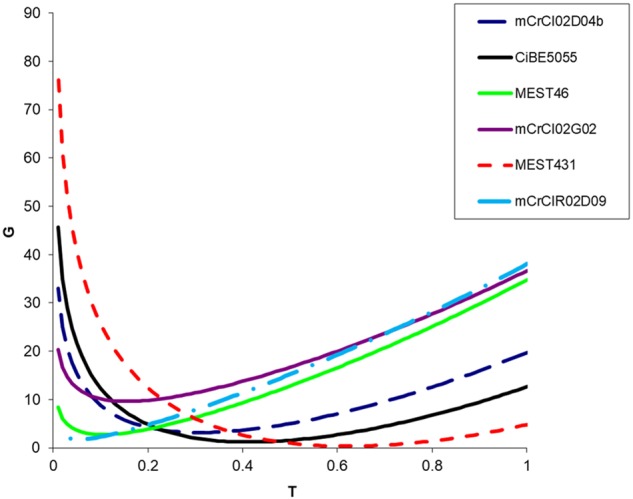
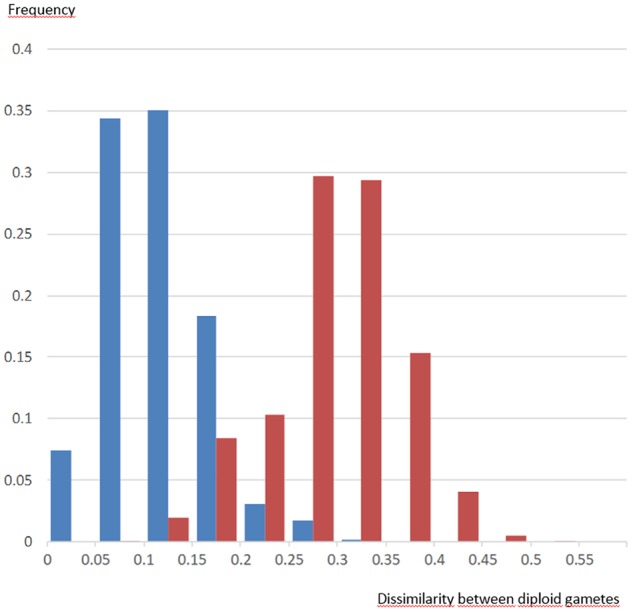
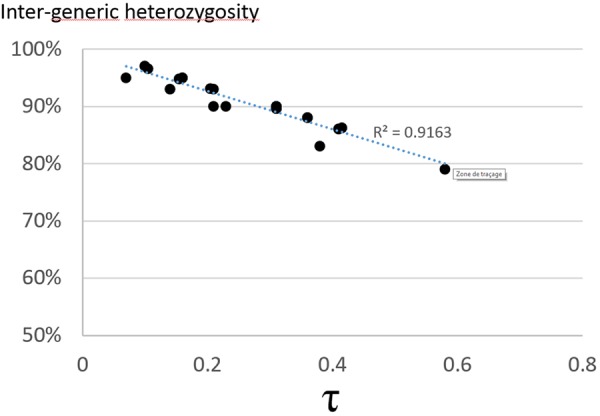
The creation of intergeneric somatic hybrids between and is an efficient approach for citrus rootstock breeding, offering the possibility of combining beneficial traits from both genera into novel rootstock lineages. These somatic hybrids are also used as parents for further tetraploid sexual breeding. In order to optimize these latter breeding schemes, it is essential to develop knowledge on the mode of inheritance in the intergeneric tetraploid hybrids. We assessed the meiotic behavior of an intergeneric tetraploid somatic hybrid resulting from symmetric protoplast fusion of diploid and diploid . The analysis was based on the segregation patterns of 16 SSR markers and 9 newly developed centromeric/pericentromeric SNP markers, representing all nine linkage groups of the genetic map. We found strong but incomplete preferential pairing between homologues of the same ancestral genome. The proportion of gametes that can be explained by random meiotic chromosome associations (τ) varied significantly between chromosomes, from 0.09 ± 0.02 to 0.47 ± 0.09, respectively, in chromosome 2 and 1. This intermediate inheritance between strict disomy and tetrasomy, with global preferential disomic tendency, resulted in a high level of intergeneric heterozygosity of the diploid gametes. Although limited, intergeneric recombinations occurred, whose observed rates, ranging from 0.09 to 0.29, respectively, in chromosome 2 and 1, were significantly correlated with τ. Such inheritance is of particular interest for rootstock breeding because a large part of the multi-trait value selected at the teraploid parent level is transmitted to the progeny, while the potential for some intergeneric recombination offers opportunities for generating plants with novel allelic combinations that can be targeted by selection.
创建 和 之间的属间体细胞杂种是柑橘砧木育种的一种有效方法,它为将两个属的有益性状组合到新的砧木谱系中提供了可能性。这些体细胞杂种也被用作进一步四倍体有性育种的亲本。为了优化这些后续的育种方案,了解属间四倍体杂种的遗传模式至关重要。我们评估了由二倍体 和二倍体 的对称原生质体融合产生的属间四倍体体细胞杂种的减数分裂行为。分析基于16个SSR标记和9个新开发的着丝粒/近着丝粒SNP标记的分离模式,这些标记代表了 遗传图谱的所有9个连锁群。我们发现同一祖先基因组的同源染色体之间存在强烈但不完全的优先配对。随机减数分裂染色体联会(τ)所能解释的配子比例在不同染色体之间差异显著,在第2号和第1号染色体上分别为0.09±0.02至0.47±0.09。这种介于严格二体性和四体性之间的中间遗传,具有整体优先二体性倾向,导致二倍体配子具有高水平的属间杂合性。虽然属间重组有限,但确实发生了,其在第2号和第1号染色体上的观察频率分别为0.09至0.29,与τ显著相关。这种遗传模式对砧木育种特别有意义,因为在四倍体亲本水平选择的大部分多性状价值会传递给后代,而一些属间重组的可能性为培育具有新等位基因组合的植物提供了机会,这些组合可以通过选择来定向培育。