
钠-葡萄糖共转运蛋白 2 抑制剂治疗 2 型糖尿病时与减少胰岛素剂量相关的持续空腹葡萄糖氧化和餐后脂质氧化:一项随机、开放标签、前瞻性研究。
Sustained fasting glucose oxidation and postprandial lipid oxidation associated with reduced insulin dose in type 2 diabetes with sodium-glucose cotransporter 2 inhibitor: A randomized, open-label, prospective study.
机构信息
Division of Diabetes, Metabolism and Endocrinology, Department of Internal Medicine, Toho University Graduate School of Medicine, Tokyo, Japan.
出版信息
J Diabetes Investig. 2019 Jul;10(4):1022-1031. doi: 10.1111/jdi.12994. Epub 2019 Feb 19.
AIMS/INTRODUCTION: Hyperglycemia impairs energy substrate oxidation as a result of glucotoxicity. We examined whether the reduction of plasma glucose using a sodium-glucose cotransporter 2 inhibitor, in inpatient diabetes management, has any effect on: (i) treatment period and basal-bolus dosage of insulin that achieve euglycemia; (ii) fasting/postprandial energy expenditure (EE); and (iii) energy substrate oxidation.
MATERIALS AND METHODS
This was a randomized, open-label, 7-day prospective study. Participants were type 2 diabetes patients with hyperglycemia, aged >20 years, with glycated hemoglobin >10%, daily mean preprandial blood glucose >11 mmol/L (200 mg/dL) and no previous antidiabetic medication. A total of 18 type 2 diabetes patients were randomized (1:1) to basal-bolus insulin titration algorithm (INS) alone or INS + dapagliflozin 5 mg/day (INS/DAPA). The main outcome measures were total daily insulin dose to achieve euglycemia, as well as EE and respiratory quotient during fasting and postprandial states, measured by indirect calorimetry.
RESULTS
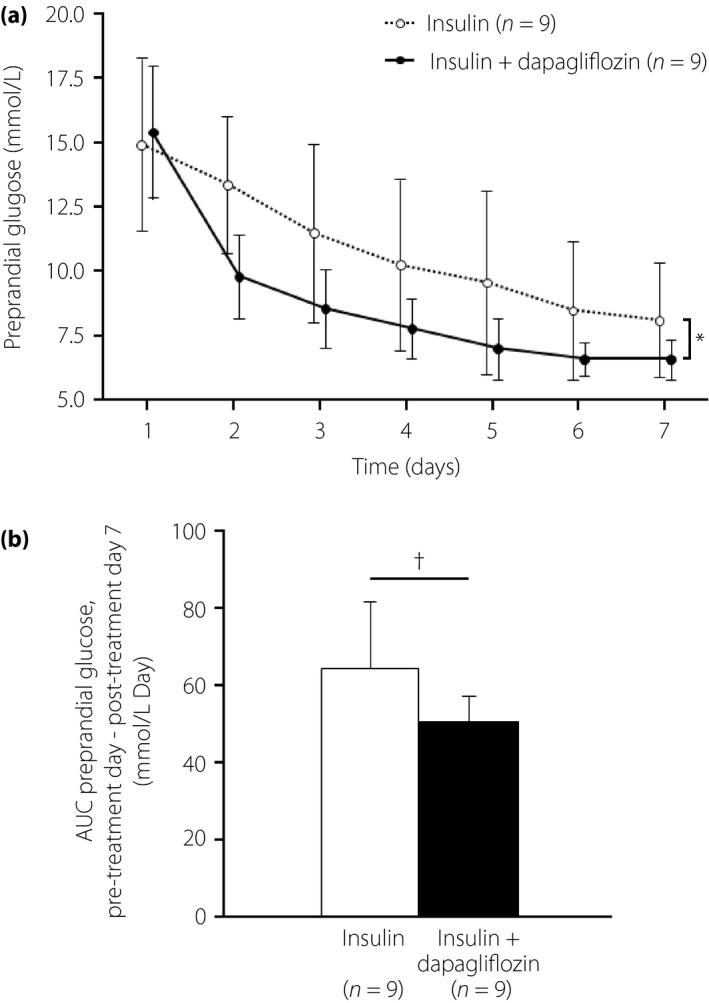
The rate of euglycemia was higher in the INS/DAPA compared with INS group (100 vs 55.6%, P = 0.04), whereas the total daily dose of insulin was 19% lower and was accompanied by a decreased basal-bolus ratio (P = 0.02). Fasting and postprandial EE elevation were similar in both groups. The post-treatment fasting respiratory quotient significantly increased in the INS/DAPA group (0.72 ± 0.05 vs 0.79 ± 0.08, P = 0.04), and the postprandial respiratory quotient elevation was abolished; the opposite trend was observed in the INS group (P < 0.02).
CONCLUSIONS
INS/DAPA sustained fasting carbohydrate oxidation, postprandial lipid-derived EE (failed to increase carbohydrate-derived EE) and reduced basal insulin requirement might be related to further bodyweight loss.
CLINICAL TRIAL REGISTRY
National University Hospital Medical Information Network UMIN000018997.
目的/引言:高血糖会导致糖毒性,从而损害能量底物的氧化。我们研究了在住院糖尿病管理中使用钠-葡萄糖共转运蛋白 2 抑制剂降低血糖是否会对以下方面产生任何影响:(i)实现血糖正常化的胰岛素基础-餐时剂量;(ii)空腹/餐后能量消耗(EE);以及(iii)能量底物氧化。
材料和方法
这是一项随机、开放标签、为期 7 天的前瞻性研究。参与者为患有高血糖的 2 型糖尿病患者,年龄>20 岁,糖化血红蛋白>10%,每日餐前平均血糖>11mmol/L(200mg/dL),且无既往降糖药物治疗。共有 18 名 2 型糖尿病患者被随机分为(1:1)胰岛素基础-餐时剂量滴定算法(INS)单独治疗组或 INS+达格列净 5mg/天(INS/DAPA)治疗组。主要观察指标为实现血糖正常化的总日胰岛素剂量,以及通过间接测热法测量的空腹和餐后状态下的 EE 和呼吸商。
结果
INS/DAPA 组的血糖正常化率明显高于 INS 组(100%比 55.6%,P=0.04),而胰岛素的总日剂量降低了 19%,且基础-餐时胰岛素比例降低(P=0.02)。两组的空腹和餐后 EE 升高相似。INS/DAPA 组治疗后空腹呼吸商显著升高(0.72±0.05 比 0.79±0.08,P=0.04),餐后呼吸商升高被抑制;INS 组则呈现相反的趋势(P<0.02)。
结论
INS/DAPA 持续促进空腹碳水化合物氧化,抑制餐后脂质衍生的 EE(未能增加碳水化合物衍生的 EE),并降低基础胰岛素需求,这可能与进一步的体重减轻有关。
临床试验注册号
国家大学医院医疗信息网 UMIN000018997。



 Zotero 插件