Kindt Nadège, Descamps Géraldine, Lechien Jérôme R, Remmelink Myriam, Colet Jean-Marie, Wattiez Ruddy, Berchem Guy, Journe Fabrice, Saussez Sven
Department of Human Anatomy and Experimental Oncology, Université de Mons (UMons), Research Institute for Health Sciences and Technology, 7000 Mons, Belgium.
Department of Oto-Rhino-Laryngology, Université Libre de Bruxelles (ULB), CHU Saint-Pierre, 1000 Brussels, Belgium.
J Clin Med. 2019 Jan 10;8(1):75. doi: 10.3390/jcm8010075.
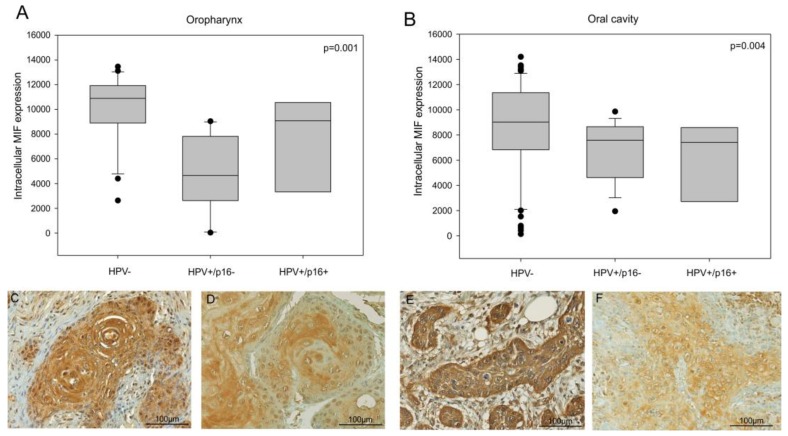
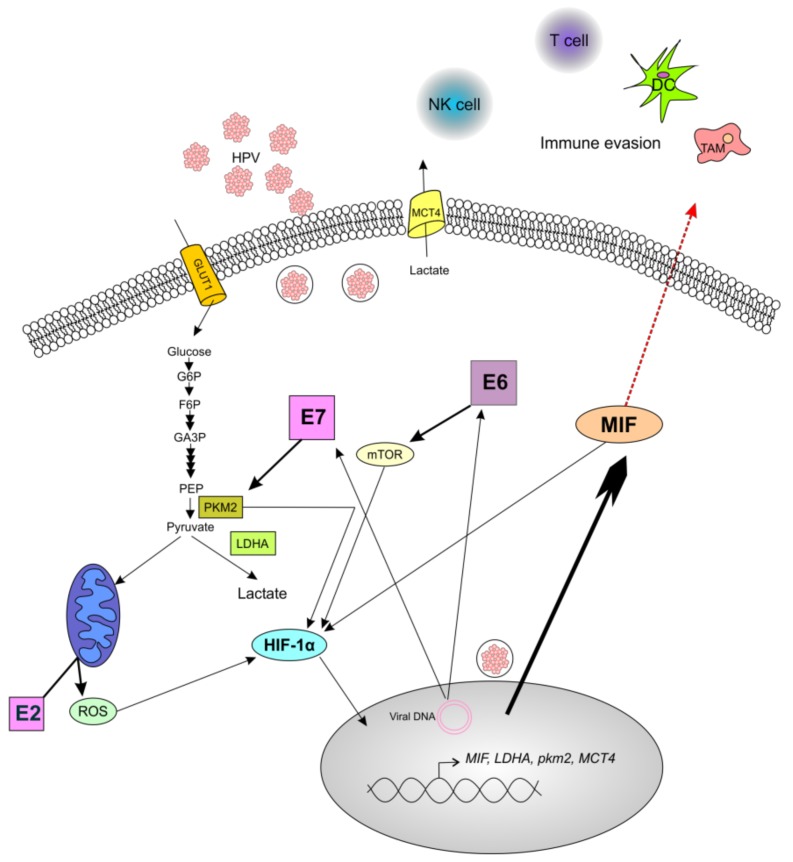
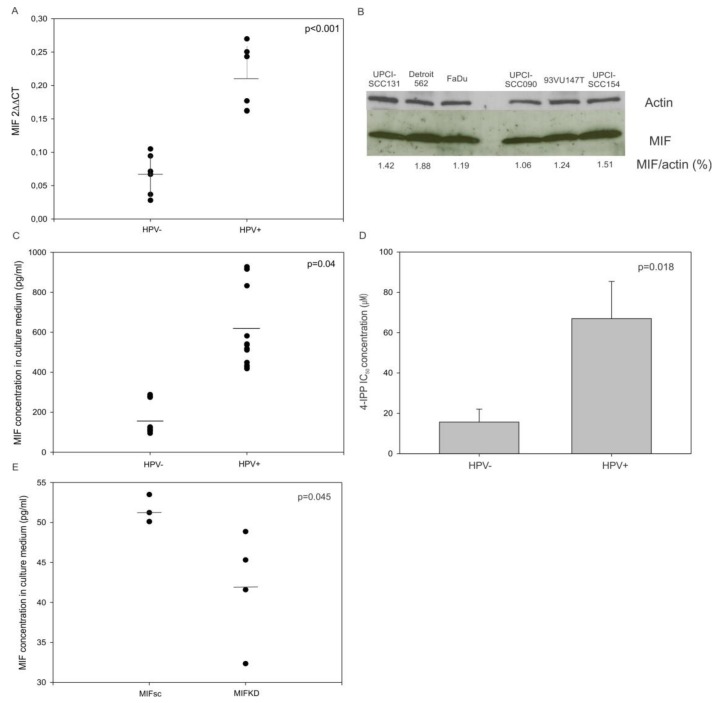
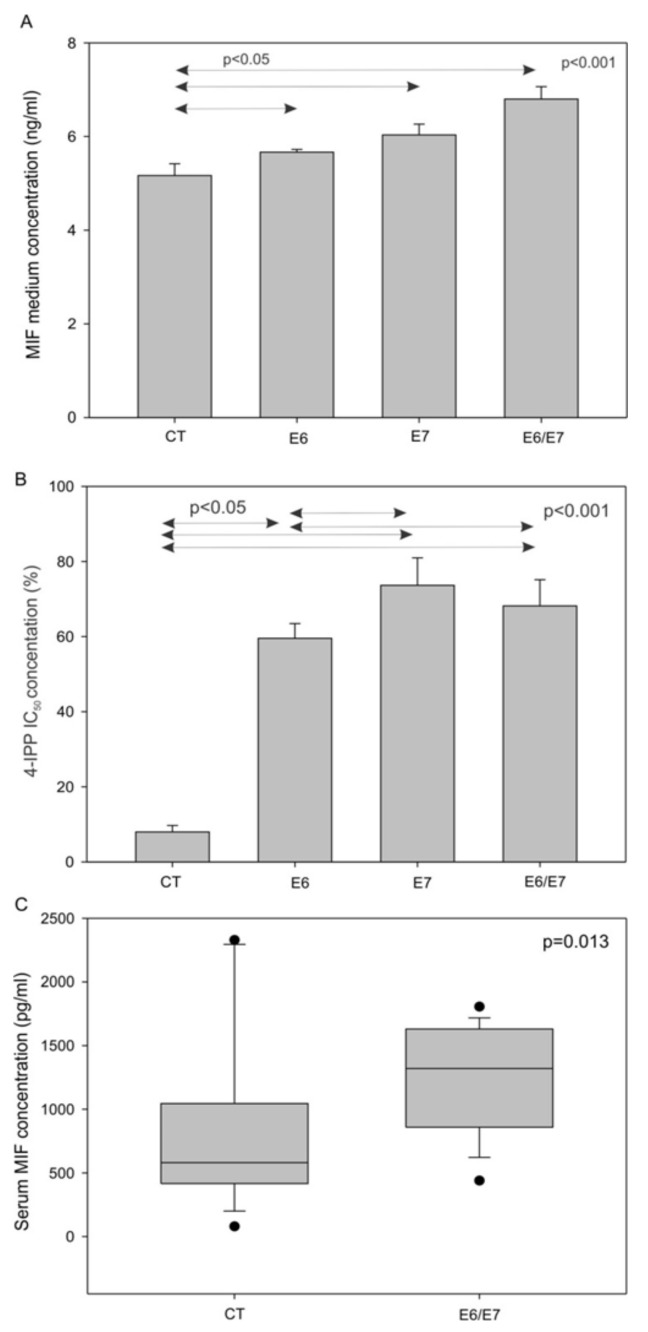
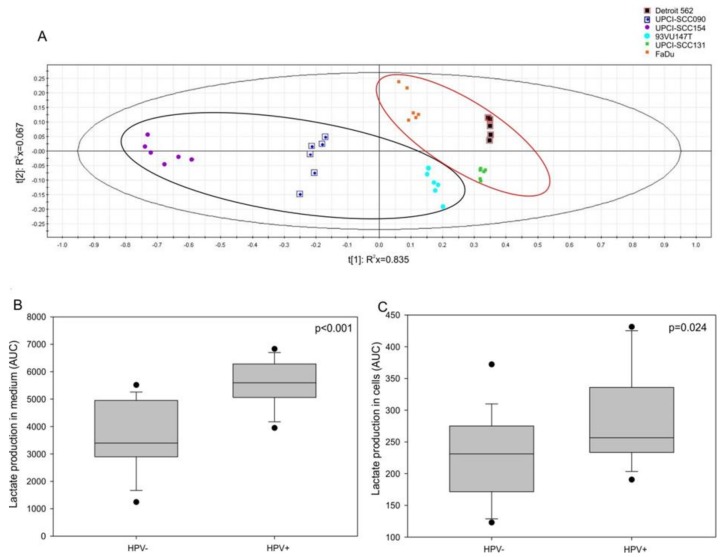
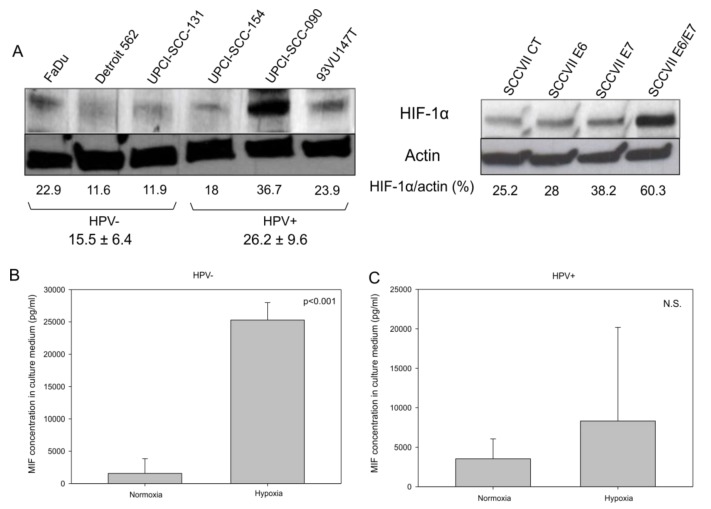
Human papilloma virus (HPV) infection has been well-established as a risk factor in head and neck squamous cell carcinoma (HNSCC). The carcinogenic effect of HPV is mainly due to the E6 and E7 oncoproteins, which inhibit the functions of p53 and pRB, respectively. These oncoproteins could also play a role in the Warburg effect, thus favoring tumor immune escape. Here, we demonstrated that the pro-inflammatory cytokine macrophage migration inhibitory factor (MIF) is expressed at higher levels in HPV-negative patients than in HPV-positive patients. However, the secretion of MIF is higher in HPV-positive human HNSCC cell lines, than in HPV-negative cell lines. In-HPV positive cells, the half inhibitory concentration (IC) of MIF inhibitor (4-iodo-6-phenylpyrimidine (4-IPP)) is higher than that in HPV-negative cells. This result was confirmed in vitro and in vivo by the use of murine SCCVII cell lines expressing either E6 or E7, or both E6 and E7. Finally, to examine the mechanism of MIF secretion, we conducted proton nuclear magnetic resonance (¹H-NMR) experiments, and observed that lactate production is increased in both the intracellular and conditioned media of HPV-positive cells. In conclusion, our data suggest that the stimulation of enzymes participating in the Warburg effect by E6 and E7 oncoproteins increases lactate production and hypoxia inducible factor 1α (HIF-1α) expression, and finally induces MIF secretion.
人乳头瘤病毒(HPV)感染已被确认为头颈部鳞状细胞癌(HNSCC)的一个风险因素。HPV的致癌作用主要归因于E6和E7癌蛋白,它们分别抑制p53和pRB的功能。这些癌蛋白也可能在瓦伯格效应中发挥作用,从而有利于肿瘤免疫逃逸。在此,我们证明促炎细胞因子巨噬细胞迁移抑制因子(MIF)在HPV阴性患者中的表达水平高于HPV阳性患者。然而,MIF在HPV阳性的人HNSCC细胞系中的分泌高于HPV阴性细胞系。在HPV阳性细胞中,MIF抑制剂(4-碘-6-苯基嘧啶(4-IPP))的半数抑制浓度(IC)高于HPV阴性细胞。通过使用表达E6或E7或同时表达E6和E7的小鼠SCCVII细胞系,在体外和体内证实了这一结果。最后,为了研究MIF分泌的机制,我们进行了质子核磁共振(¹H-NMR)实验,并观察到HPV阳性细胞的细胞内和条件培养基中的乳酸生成均增加。总之,我们的数据表明,E6和E7癌蛋白对参与瓦伯格效应的酶的刺激增加了乳酸生成和缺氧诱导因子1α(HIF-1α)的表达,最终诱导了MIF分泌。