Röthlisberger André, Häberli Sandra, Krogh Fabio, Galinski Henning, Dunand David C, Spolenak Ralph
Laboratory for Nanometallurgy, Department of Materials, ETH Zurich, Vladimir-Prelog-Weg 1-5/10, CH-8093, Zürich, Switzerland.
Mechanical Integrity of Energy Systems, Swiss Federal Laboratories for Materials Science and Technology, EMPA, CH-8600, Dübendorf, Switzerland.
Sci Rep. 2019 Jan 24;9(1):476. doi: 10.1038/s41598-018-36604-9.
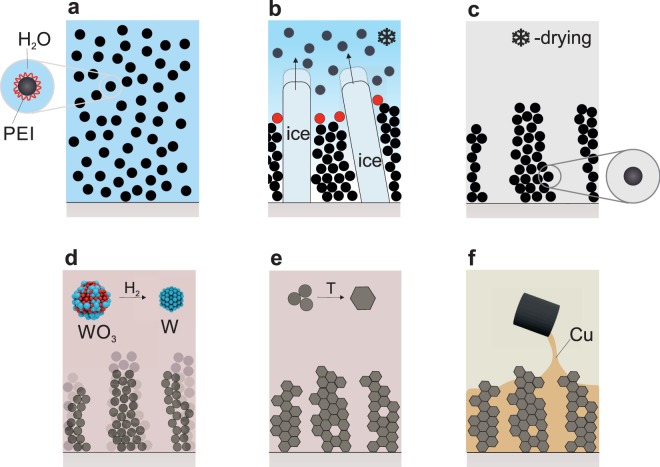
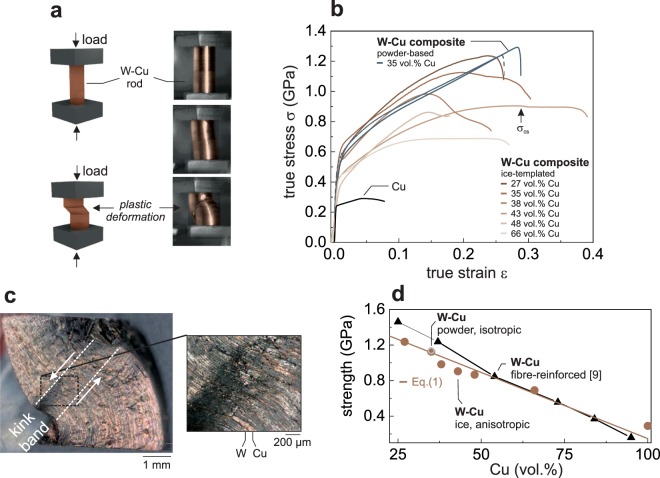
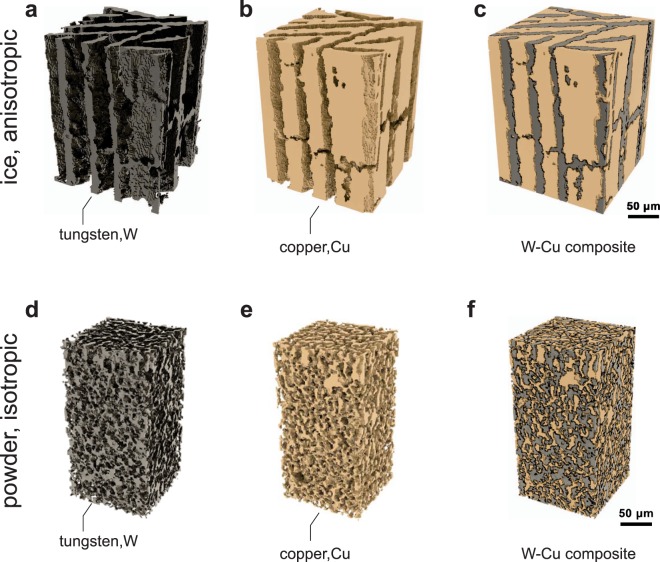
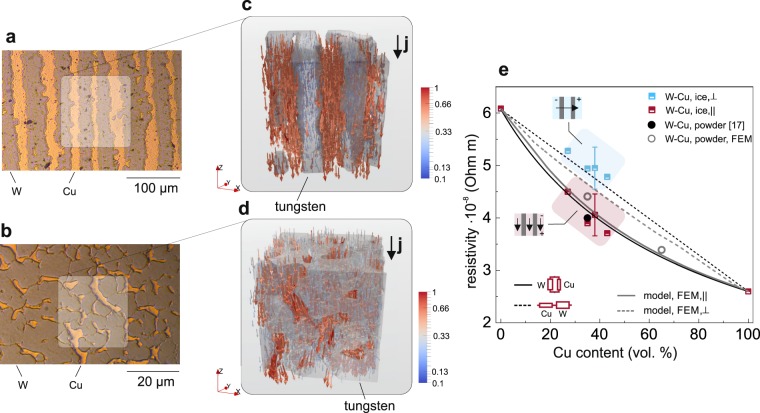
Controlling anisotropy in self-assembled structures enables engineering of materials with highly directional response. Here, we harness the anisotropic growth of ice walls in a thermal gradient to assemble an anisotropic refractory metal structure, which is then infiltrated with Cu to make a composite. Using experiments and simulations, we demonstrate on the specific example of tungsten-copper composites the effect of anisotropy on the electrical and mechanical properties. The measured strength and resistivity are compared to isotropic tungsten-copper composites fabricated by standard powder metallurgical methods. Our results have the potential to fuel the development of more efficient materials, used in electrical power grids and solar-thermal energy conversion systems. The method presented here can be used with a variety of refractory metals and ceramics, which fosters the opportunity to design and functionalize a vast class of new anisotropic load-bearing hybrid metal composites with highly directional properties.
控制自组装结构中的各向异性能够实现对具有高度定向响应的材料进行工程设计。在此,我们利用热梯度中冰壁的各向异性生长来组装一种各向异性难熔金属结构,随后用铜进行渗透以制成复合材料。通过实验和模拟,我们以钨铜复合材料这一具体实例展示了各向异性对电学和力学性能的影响。将所测得的强度和电阻率与通过标准粉末冶金方法制备的各向同性钨铜复合材料进行了比较。我们的研究结果有可能推动用于电网和太阳能-热能转换系统的更高效材料的开发。这里所提出的方法可用于多种难熔金属和陶瓷,这为设计和功能化一大批具有高度定向性能的新型各向异性承重混合金属复合材料创造了机会。